
The episode opens on a question Chuck could not answer for a tech vendor who asked him which industry events are worth attending, and the honest answer — nothing outside what he and Jenni are already running — sets up an hour about institutions that have stopped doing the work. Shel Holtz’s open letter argues PRSA’s own code of ethics does not merely permit it to speak on the Minneapolis ICE operations but demands it, and Chuck’s position is that neutrality and silence are both decisions, both privileges and, often, both cowardly. Harvard Business Review makes the case for getting off the transformation treadmill by fixing the system rather than the symptom. Edelman’s 26th Trust Barometer reports 70% hesitant or unwilling to trust someone different from them, and gets a rougher reception than any story this year. And Gartner’s nine predictions for 2026 give Chuck the chance to start what he calls trend shaming.
Chuck’s cold open is a question he could not answer. A tech vendor new to the comms world asked which industry events were worth investing in, and beyond what he and Jenni run themselves, he had no recommendations — his test for IABC World Conference was whether the vendor had missed not being there, and the answer was no. Jenni’s UK equivalents are the Gallagher summits in June and November and the Institute of Internal Communication, with the caveat that the senior practitioners who want the deepest conversations have already stopped attending large events, which is why she runs roundtables instead. Her counter to Chuck’s test is the fairest point in the exchange: you do not know what you do not know, and an audience that never showed up cannot tell you what it missed. Chuck’s diagnosis is structural, that vendors now run their own events and will not attend each other’s, and his own response is Transform, an HR event turned employee experience event that he is trying to open to communicators in both directions. The second kickoff item is Resist and Unsubscribe, a US campaign built on the premise that the administration does not listen to people but does listen to business and tech leaders, so the pressure that works is economic: not a one-day boycott but actually cancelling subscriptions — three LLM subscriptions become one, eight streaming services become two — and the site names which companies sit in the blast zone. Chuck is doing it at home and is unreserved about it. His aside is the sharpest bit of consumer psychology in the episode: most people discover they have been paying for things they forgot about years ago, which is exactly what a subscription business is designed to produce.
Following the previous week’s conversation about CEOs signing a joint statement on ICE, Jenni brings something closer to the profession: Shel Holtz’s open letter to the Public Relations Society of America on the ethical imperative to speak out on the Minneapolis ICE operations. Holtz’s argument is built inside PRSA’s own rules rather than outside them: the code of ethics does not merely permit organizational advocacy, it demands it, because PRSA’s authority to set standards depends on modeling the commitments it asks communicators to uphold, particularly when the integrity of public information is materially compromised. Against PRSA’s stated concern about maintaining member trust across a diverse profession, his response is that silence also makes a statement, and that a diverse membership can disagree about immigration policy while still agreeing that government communication should be truthful and due process respected. Jenni notes the letter had drawn nearly 200 reactions and more than 60 comments at the time of recording, and picks up Holtz’s answer to the people asking why he had not written to other bodies too — PRSA is the one that wrote to him. Chuck applauds him and immediately widens the frame past PRSA to IABC, SHRM and every large governing body: neutrality is a decision, silence is a decision, both are privileges, and either can be cowardly. What frustrates him is how low the bar actually sits — saying the US has a genuine immigration challenge and this approach to it is wrong damns nobody — and his verdict is that PRSA said something that was actually nothing, which tells you more about its leadership than a position would have. His closing observation cuts both ways: if PRSA reverses now, the reversal proves they knew what they should have said the first time.
Jenni’s first Harvard Business Review article, Get Off the Transformation Treadmill, argues that the best way to manage transformations is to minimize the need for them. A healthy organizational ecosystem — one that constantly senses shifts, prunes unproductive activity and nurtures new growth avenues — rarely needs transforming, and when it does, the transformation works. The failure mode is the opposite: a small, temporary change in demand prompts wild swings, each well-intentioned isolated fix magnifies the imbalance rather than solving it, and leaders who misread systemic problems and treat individual symptoms plunge the organization into chronic transformation. Jenni is openly preaching to the converted, connecting it to her Field Model’s understand-diagnose-fix sequence and to The Friction Project, which she is reading, and highlighting the Boston Scientific example where the CEO started with the comprehensive business system redesign leaders usually postpone. Chuck’s reaction is two notes: words, words, words, and then, obviously. He credits the article for opening on the Onion headline “CEO unveils bold new plan to undo damage from last year’s bold new plan”, and for the treadmill image itself, which he thinks describes how employees actually feel — walking hard, going nowhere. Everything else he treats as a Boston Scientific puff piece, and he takes apart the purpose rewrite it celebrates: replacing “improve the quality of patient care through less invasive medical devices” with “advancing science for life” strips an employee of a focus rather than giving them one. His real question is whether companies need to slow down to speed up, and whether most of what gets called transformation is simply evolution with a label he has never liked. Jenni’s take-away is the ecosystem framing and the root-cause discipline, plus a suspicion that last year’s change fatigue is what a treadmill feels like when leaders keep optimizing individual functions for cost instead of looking at the whole system. Chuck’s word of the day supplies the running joke: transmogrify, and Jenni’s own coinage, transmogrific.
The 2026 Edelman Trust Barometer is in its 26th year, covering 28 countries and nearly 34,000 respondents — around 1,200 per country, a base Jenni quietly notes felt smaller than she expected. Its theme is trust and the crisis of grievance, layered as polarization, then grievance, then insularity, and its headline finding is that 70% are hesitant or unwilling to trust someone different from them, with 42% preferring to switch departments rather than report to a manager with different values and 34% saying they would put less effort into helping a project leader with different political beliefs succeed. Edelman’s answer is trust brokering, a set of practices that facilitate trust across difference by surfacing the common interests of insulated parties rather than trying to change them, and its workplace strategies are to promote a shared identity, build teams that force people with different values to work together, and provide mandatory training in constructive dialogue. Jenni’s verdict is that none of this is new — she points to Patrick Lencioni’s Five Dysfunctions of a Team and Charles Duhigg’s Supercommunicators — and reads the recommendations in a voice Chuck immediately identifies as the corporate values video voice. He used to stop everything to tear the Barometer apart and has not read it in years. His substantive objection is the contradiction: the same institutions telling organizations to emphasize what unites rather than divides have spent two years dismantling diversity, inclusion and belonging programs, and forcing people who have already said they will not work with people unlike them into teams together is not a plan. He wants Edelman to define “different” in that 70% — where someone is from, the color of their skin, their values, their beliefs — and he rejects the celebration of business being the most trusted institution: it is not that companies are trusted more, it is that nothing is trusted, and trust is ultimately a choice. His alternative is the most actionable idea in the episode, one he has been carrying for a decade or more: replace the engagement survey with a trust survey, and find out which individuals — not layers, not titles — employees actually trust. Jenni closes the loop from her credibility work and its eight practices: disengagement is distrust, an engagement problem is a trust problem, a trust problem is an integrity problem, and Chuck’s pin is that trust and integrity are personal, which makes the conversations harsh but the improvement possible.
The closing story is 9 Trends Shaping Work in 2026 and Beyond, Gartner’s list as written up by Harvard Business Review: AI layoffs outpacing AI productivity gains, culture dissonance blocking performance goals, AI taking a toll on mental fitness, AI work slop as a top productivity drain, employers restoring humanity to hiring, rising insider corporate espionage risk, tech-to-trades career paths, process pros rather than tech prodigies unlocking AI value, and employees demanding compensation for training their digital doppelgangers. Chuck’s first objection is definitional and he intends to keep making it: these are predictions, not trends, and he is starting a policy of trend shaming, with real trends promised for the following week. His second is that blaming AI for work slop pretends everything humans produced beforehand was immaculate — the call, as he puts it, is coming from inside the house. His third is that the AI-layoffs-outpace-gains prediction is fear mongering that newer data contradicts. On Gartner’s information security point, his question is whether CHROs thinking about insider threat translates into anyone doing anything about it, and on number nine he simply enjoys the improbability: employees who are struggling to keep their jobs and taking 1% or 2% raises are not about to win compensation for training their own digital replacements. Jenni takes number eight seriously, because systems thinking came up at her virtual internal comms roundtable the same week and it is the one piece of advice in the list that survives the pace of the tools — the quote she reads argues the most successful organizations in 2026 will prioritize work process experts whose creativity and systems thinking let them redesign entire processes rather than optimize individual tasks. Her plan is to hold the whole list to account at the end of the year.
What is Shel Holtz’s open letter to PRSA about? It argues that PRSA’s own Code of Ethics does not merely permit the organization to speak out on the Minneapolis ICE operations but demands it, because PRSA’s authority to set standards depends on modeling the ethical commitments it asks communicators to uphold. Against PRSA’s concern about member trust across a diverse profession, Holtz’s answer is that silence also makes a statement.
Is staying neutral a legitimate position for a professional body? Chuck’s argument is that it is not a non-position at all. Neutrality is a decision, silence is a decision, both are privileges, and either can be cowardly. He points out how low the bar actually is — saying there is a genuine immigration challenge and this approach to it is wrong condemns nobody — and reads PRSA’s statement as saying something that was actually nothing.
What is the transformation treadmill? The Harvard Business Review argument that the best way to manage transformations is to minimize the need for them. A healthy organizational ecosystem senses shifts, prunes unproductive activity and grows new avenues; transformation becomes chronic when leaders misread systemic problems and launch fixes aimed at individual symptoms, each of which magnifies the imbalance rather than solving it.
What did the 2026 Edelman Trust Barometer find? In its 26th year, across 28 countries and nearly 34,000 respondents, it found 70% hesitant or unwilling to trust someone different from them, 42% who would rather switch departments than report to a manager with different values, and 34% who would put less effort into helping a project leader with different political beliefs succeed. Its theme is trust and the crisis of grievance, layered as polarization, grievance and insularity.
What is trust brokering? Edelman’s proposed counter to insularity: a set of practices that facilitate trust across difference by surfacing the common interests of insulated parties and translating their needs and realities for one another, rather than trying to change anyone. A trust broker can be a person, organization or institution trusted by each stakeholder group facing a shared problem. Jenni’s point is that the idea is not new — Lencioni’s Five Dysfunctions of a Team and Duhigg’s Supercommunicators cover the same ground.
Should companies run trust surveys instead of engagement surveys? It is Chuck’s most concrete recommendation of the episode. Engagement is a broad, vague measure, while trust is about a relationship you can name: do employees trust this leader, this manager, this individual. Finding out that only 30% of employees trust their leaders tells a board something an engagement score never will. Jenni’s framing from her credibility work is that an engagement problem is a trust problem and a trust problem is an integrity problem.
What are Gartner’s 2026 workplace predictions, and are they trends? Nine of them: AI layoffs outpacing AI productivity gains, culture dissonance holding back performance, AI’s toll on mental fitness, AI work slop as a productivity drain, restoring humanity to hiring, rising insider espionage risk, tech-to-trades career paths, process pros rather than tech prodigies unlocking AI value, and employees demanding compensation for training their digital doppelgangers. Chuck’s position is that they are predictions rather than trends, and should be held to account as such.
Why does systems thinking matter more than AI tool skills? Because the tools move too fast to be worth specializing in. The Gartner point Jenni singles out is that the most successful organizations in 2026 will prioritize work process experts whose creativity and systems thinking let them redesign entire processes rather than optimize individual tasks — a capability that outlasts whichever platform is current.
Jenni: Welcome to Frequency, I’m Jenni Field.
Chuck: And I’m Chuck Gose. Frequency is your go-to for real talk about comms, culture and employee experience, beyond the buzzwords and straight to what matters. Jenni, great to be recording with you again. Earlier this week I was posed a question from one of the tech vendors in our space. This person was relatively new to the comms world, and they said, hey, what are the events that we should be looking at? What are the events that we should be investing in? And I had to say, outside of the stuff that I’m doing and the stuff that you’re doing, I didn’t really have any recommendations. And part of that was — I’m just going to call it all out here — I was like, were you at World Conference last year, IABC World Conference? They were like, no. And I was like, did you miss it? And they were like, no. And I said, okay, so then that’s probably not worth you going to. And then PRCA Connect — I haven’t heard a peep about anything with PRCA Connect this year. Maybe there is one, maybe there isn’t. I haven’t heard. I also haven’t looked. Everybody knows where I stand on Ragan and ALI stuff out there, so I don’t, of course, recommend those. So it just got me thinking: what are they? Where are they? I don’t know.
Jenni: I mean, I’m with you. In the UK we talk about Gallagher events. So Gallagher do a summit in June and November, and that’s kind of the place where you’re going to catch up with people. So I tend to go to those to just kind of network with people. I don’t know how the tech vendors feel that sponsor it, but there’s always tech vendors there. And then there’s kind of the bodies over here, like the Institute of Internal Communication. I’ve not been to their conference for a long time. But a bit like you, I think your point about did you miss it — no, but then you don’t know what you don’t know. They could have been a massive audience for them there, but they don’t know that. I think it’s a really hard question, because also the conversation we had last year about senior internal comms people not wanting to go to the big events because they want to have the really deep conversations, which is why I do the roundtables now — you’re not going to get lots of those folks there. So yeah, it’s tricky. Maybe we should start a new event series.
Chuck: Well, it got me thinking about that. I think it goes to the fact that so many of these vendors are creating their own events out there. They’re not going to likely participate in each other’s, even as much as we believe in community over competition. I don’t see them necessarily attending each other’s events or allowing that to happen. So I do think there’s an opportunity here, but again, we are two people.
Jenni: Well, maybe there’s something about Frequency and all the themes and stuff that we talk about here, and bringing all of that knowledge into an event for people to come to. Well, if you’re listening and that sounds good, let us know.
Chuck: Yeah. It just got me thinking about — have we stalled a bit? Have we hit a stagnation? Which is part of why I’ve been investing in Transform, which was historically an HR event that became an employee experience event. And I’m trying to bring the comms angle to that event as a refreshed experience, mostly so that those audiences hear from communicators, but also that communicators then hear from those HR and EX audiences.
Jenni: Yeah, I think that’s the sweet spot. It’s bringing everyone together that needs to come together to make the difference.
Chuck: Yeah. And then the other thing that’s got me wound up this week — I don’t know if you have seen any of the stuff around the Resist and Unsubscribe efforts that are going on here in the US. So it’s basically acknowledging that the current administration is not listening to people, but who does the administration listen to? Business and tech leaders. And so if enough people start unsubscribing — not like for a day, like actually unsubscribe from these platforms — then you’ll finally get their attention. So we in our house are going through the effort of unsubscribing from things. Not everything, that’s unreasonable to say. But do you need three AI or LLM subscriptions? No, probably just one. Do you need eight streaming platforms to watch content on? No, maybe one or two. It doesn’t have to be forever, but part of this economic protest of saying, you have the ear, you are not coming out and saying anything, so we’re going to say something by unsubscribing. I’m 100% here for it.
Jenni: Nice. I know it hasn’t come here, not to my knowledge, but I like it. I shall have a think.
Chuck: Yeah, I’ll put in the show notes a link to the website around this, where they’ve identified who are the key companies, who’s in the blast zone, who’s kind of a little bit outside, and how to go through and actually cancel all these things. And what’s interesting is I’ve seen that people are not realizing they’ve been subscribed to things for years and kind of forgot about it, which is kind of the — that’s what they want from subscriptions. They want you to just keep renewing without even thinking about it. All right, let’s go into the content for today, Jenni.
Jenni: Okay, so we could have just talked about that the whole time. So I’ve got four articles for us today, but they are on some meaty topics. So I want to dive into the Edelman Trust Barometer, as that was published a few weeks ago. And I also want to have a look at some insights from Gartner around the future trends of the workplace and what leaders need to be considering. It’s linked to AI and how we need to think about that in line with the broader shifts that are going on. I also wanted to have a good conversation about change and whether or not all the transformations going on need to happen.
Jenni: But first, following on from our conversation last week about CEOs issuing a joint statement about ICE in the US, we have something that’s a little closer to home, and that’s an open letter to the Public Relations Society of America, PRSA, from Shel Holtz on LinkedIn. Now, the subject of the letter is the ethical imperative for PRSA to speak out on Minneapolis ICE operations. Shel says, I’m writing in response to your recent message clarifying PRSA’s advocacy approach. While I appreciate the stated commitment to maintaining professional standards, the ongoing ICE operations in Minneapolis clearly demonstrate that PRSA’s Code of Ethics not only permits, but also demands, organizational advocacy. While the Code formally governs member conduct, PRSA’s authority to set standards depends on modeling the ethical commitments it asks communicators to uphold, especially when the integrity of public information is materially compromised. Silence on this issue threatens to erode the very credibility and ethical standing you seek to preserve.
Jenni: Now, Shel’s articulation of the PRSA concerns and his counter to each of them shows a really clear request for a change from PRSA. He documents all of these in his letter, but one of them is the concern from PRSA, which is that we want to maintain member trust across a diverse profession. His response is that silence also makes a statement, one that may erode trust among members who expect PRSA to uphold its stated values. Our diverse membership can disagree about immigration policy while still agreeing that government communications should be truthful and that due process should be respected. Now, at the time of recording this, he’s had nearly 200 reactions, six reposts and over 60 comments. So it’s a very big topic. You can’t ignore this. And I love the fact that some people had commented and said, why aren’t you calling out other bodies? And he’d said, because none of them had written to me, whereas PRSA wrote to me to explain it, and that’s what triggered it. I know this is close to your heart. We talked about it last week, so I’m just going to throw this to you for your thoughts.
Chuck: Yeah. To me, one, I applaud Shel for calling this out and surfacing the conversation and continuing on. I don’t think anybody’s going to be shocked by my stance on this. And this goes outside of PRSA. This could be IABC. This could be SHRM. It could be any of these big association governing bodies out there. Neutrality is a decision. Silence is a decision. Also, both of those are privileges as well. And in my opinion, either one of those can also be quite cowardly. So it’s obviously easiest to say nothing, which is essentially kind of what they’ve done. But what does that say when you’re always taking the easiest route to things? There are people who have pretty well articulated, hey, we don’t believe in illegal immigration, or we believe things have gone too far, blah blah blah. Not this de-escalation softening type language, but actually coming out and saying, yes, we have an immigration challenge in the US, but this approach is wrong. That’s a pretty easy thing to say without damning anyone in the process. And I think the fact that PRSA said something, which was actually nothing, actually says a lot about them from a leadership standpoint. Or I would say lack thereof.
Jenni: I just think the point about the importance of government communication being truthful and that due process should be respected — I think there is a duty of professional bodies to address that, and I think that is important. So it’s a strange move to come out and say, we’re not going to say anything, because you’re opening up the conversation for exactly what’s happening now. So I’d be very interested to see whether they change tack or what they do. But with you, I think Shel’s open letter is exceptional, and I think it’s great that he’s calling it.
Chuck: And also, if they changed — obviously people can change their mind and we shouldn’t condemn them for that — but also, if they changed their mind, that also says something about the initial communication, that they probably know they should have said something, but that they chose not to say something. And so, yeah, I haven’t looked to actually see from the HR side of things if SHRM has said anything. But also, no, SHRM is not exactly high up on the list for a lot of HR pros, with some of the lawsuits that are out there. So I’m sure SHRM is fighting its own battles, let alone doing anything else. But I am going to look into whether other groups have even said anything at all. Whereas PRSA did say something, which was actually truly nothing.
Jenni: Yeah, exactly. Right, we’re going to kick off with the first of my Harvard Business Review articles. This one was called Get Off the Transformation Treadmill, which I loved, because I’m a real advocate of leaders not making changes at all. So I’ve written for a long time about leaders don’t need to be transformers and stuff like that. And I’m also reading at the moment The Friction Project, and that’s all about what organisations are doing to make things better. It’s not always about change. It’s a topic quite close to my heart. But in this article, they’re talking about the fact that the best way to manage transformations is to minimise the need for them. The purpose of the article is to help executives whose companies are addicted to transformations break the cycle, and to assist others in avoiding them in the first place.
Jenni: It talks about things like the organisational ecosystem, and when that system is healthy — which is evidenced by the organisation’s ability to constantly sense shifts, prune unproductive activities and nurture new growth avenues — transformations are rarely needed, and when they do occur, they’re more productive. So that’s an important point there about the whole ecosystem of the organisation. The article then goes on to explain how things can go wrong, and this made me think about some of the feedback that comms teams can get and how it can lead to some big swings. So they say a small, temporary change in customer demand often prompts players to take wild swings that make the problems worse. Each well-intentioned but isolated fix magnifies the imbalance rather than solving it. Similarly, if leaders neglect or misread underlying systemic problems and launch misguided transformations that treat individual symptoms rather than the overall system, or if they overreact to a single element and make changes that throw the system further out of alignment, all these problems multiply and plunge the organisation into a cycle of chronic transformations.
Jenni: Now, this is preaching to the converted for me. My Field Model that I developed a few years ago is all about helping teams understand, diagnose and fix what’s going on in communications and in the organisation as a whole. I just want to bring us to an example in the article, which is from the company Boston Scientific, where it says the CEO broke the chronic transformation cycle by starting with the hard work that leaders often postpone: a comprehensive redesign of the whole business system, followed by continual adaptation to maintain the strategic fit among its elements. So combining empirical evidence with human judgment drives better decision making, and during strategizing sessions effective leaders are asking questions that encourage people to leverage both data and intuition. There’s some big stuff in here, but there’s so much change going on that I didn’t want to not talk about it. And I think, when it comes to comms and HR teams, what can they do to help advise leaders? How can anyone listening to this help leaders reconsider the transformation treadmill?
Chuck: As you were reading through that, two thoughts came to mind. One was just, words, words, words, words, words. And the other one was like, duh. Like, obviously. So it was funny — when you sent this over, I get an email that’s like the word of the day, every day, that’s supposed to teach you a new word. And today’s word — I’m going to read this, get this right — transmogrify, which is transforming in a surprising or magical manner. I’m not sure that there are a lot of comms teams, or any teams inside companies, that would feel like these transformations are transmogrifying. But what I liked about this article is it began with talking about the Onion, where it uses this subject line: CEO unveils bold new plan to undo damage from last year’s bold new plan.
Chuck: And that is where the Onion just speaks truth to life so often, every single day. But reading through it, I will say this felt like a bit of a puff piece about Boston Scientific. Part of the argument here talked about this CEO — and I’m quoting here — bolstered the organization’s intertwined purpose and ambitions. He updated the product-centric pledge to improve the quality of patient care through less invasive medical devices, to a future-oriented statement: advancing science for life. I’m like, advancing science for life is somehow better than improving the quality of patient care through less invasive medical devices? I feel like if I’m an employee, I understand, okay, we’re here to improve the quality of patient care through less invasive medical devices. Okay, that’s my focus. Advancing science for life? Like, this is it? So I don’t know. Leaders are going to be leaders. They’re going to have to put their fingerprints on it, and some are going to sit back and let it happen. Others are, nope, I’m going to introduce a bold new plan to undo damage from last year’s bold new plan. And so often of this, I feel like — do companies truly need to slow down in order to speed up? Do we need to actually pause a bit in order to build some acceleration? And often, so many of these things — when it talked in the article about transformation, I wondered, is that really just evolution? Is this just companies evolving over time, instead of having this weird transformation label? Which I will say, I’ve never liked that.
Jenni: No, I’m with you, and I know some companies have got rid of using transformation. I want to come back to transmogrify, because I want to know if we could be transmogrific. Transmogrific? Okay, okay, I liked it. I was like, I feel like I could use this in a sentence.
Chuck: You know what, you should use that at some point and see if anybody asks you what that even means.
Jenni: It’s really transmogrific today. What I liked about the article was, think about your organisation from an ecosystem perspective and how you’re measuring the success of that, because that plays into my — what are we really trying to measure when it comes to engagement? So that’s kind of seeded something for me. Addressing the root cause, not the symptoms. But the piece I also liked was — and it was a bit of a Boston Scientific puff piece, I will give you that — but it’s doing the hard work from the leadership team to look at the whole business system, rather than looking at each individual function and how you can save some costs, right? That’s what sometimes leads to the transformation, and I’m not sure that’s the right way to do it. And I think that’s what got me: actually, how many people are looking at the whole thing and really considering that? And maybe that change fatigue that we talked about last year is because people are just on this constant treadmill of doing stuff, because you’re not looking at the whole thing. You’re just looking at all the different bits.
Chuck: I agree that there are a lot of employees who probably feel like they’re on this treadmill. You just keep working and not going anywhere. I think that analogy works well. I think that’s the only part of the article that I liked.
Jenni: Yeah, fair. I can’t wait for this next one. So this is Edelman’s Trust Barometer, and the title of this video was The Danger of Insular Trust Mindset. Now, the Edelman Trust Report came out a few weeks ago. I caught up on my reading on the plane at the weekend, so I had a bit of time to read through the report. I saw a lot of articles on LinkedIn flying around about it all, but I wanted to read the report before getting into other people’s opinions. So it’s the Trust Report, or Barometer, however you want to call it — they call it a barometer. It’s in its 26th year. It’s an annual survey, and this year it’s included 28 countries, nearly 34,000 respondents, and that’s around 1,200 respondents per country. I’m not going to lie, that felt quite small to me in consideration to what I thought it was in terms of representation of the world, but I’ll park that.
Jenni: So the theme of the report this year is trust and the crisis of grievance. The report shows three layers at the beginning. It talks about polarisation, the belief that our country is divided and those divisions are entrenched; then grievance, resentment toward a system that’s rigged against you; and then insularity, this reluctance to trust anyone who’s different from you. I should say at this point that the trust report is looking at trust as a whole. It’s not just looking at it in organisations. This is the world, essentially. But they talk about having an insular trust mindset, and the stats in the report include that 70% are hesitant or unwilling to trust someone who is different from me; 42% would rather switch departments than report to a manager with different values than me, so that’s workplace conflict; 34% said they would put less effort into helping their project leader succeed if they have different political beliefs than me. And those with an insular trust mindset trust their CEO and their neighbours, but do not trust CEOs generally, journalists or government leaders. The insular mindset means a sense of grievance is moderate or higher.
Jenni: The report goes on to talk about trust brokering. It explains that trust brokering is a set of practices and behaviours that counter insularity by facilitating trust across difference. Rather than trying to change people, it surfaces the common interests of insulated parties and translates their needs, goals and realities for one another. A trust broker can be a person, organisation or institution trusted by each stakeholder group facing a common problem. Now, when I read this, my first take was, this is not new. I’ve just been re-listening to Patrick Lencioni’s Five Dysfunctions of a Team. A lot of this trust brokering is talked about in there. It’s also talked about in the book Supercommunicators by Charles Duhigg. If you haven’t read that, there’s an excellent case study in there about bringing together two different sides of the gun control argument and how you can navigate that. Anyway, Edelman go on to offer some effective strategies for the workplace — those are their words. Their effective strategies are: promote a shared identity and culture so that employees are reminded of what unites rather than divides them. I feel like I’ve put on a voice now. Build teams that will require people with different values to work together to succeed. Provide mandatory employee training for engaging in constructive dialogue and conflict. Well, none of that feels new. It feels like something HR and comms have been grappling with for years. What are your thoughts?
Chuck: Well, one, I think that voice you just described is like that generic voice you hear in corporate mission values videos. That’s what it felt like. Anyway. I used to — maybe for right reasons or wrong reasons, I don’t know — when the Edelman Trust Barometer would come out, I would, truly not exaggerating, stop what I was doing, look at it, dig it apart, tear it apart, find nuggets in there. That stopped years ago. I haven’t even read it. I didn’t even look at it, because, kind of to your point, there is nothing new. This is what we are all living every single day. If anything, this shows, one, we are all in our own bubbles out there. We need to acknowledge that. And some people don’t want to get out of their bubble. Some people want to stay in that bubble, and I guess that’s their choice.
Chuck: But I think the most haunting stat of all of them you shared was the very first one. 70% are hesitant or unwilling to trust someone who is different from me. Different can mean a lot of different things here, which I felt like they played a little too safe with. I want to know what different means to someone who answered, I’m hesitant. Is that based on where they’re from, the color of their skin, their values, their beliefs? Different. Who is actually like you? Who do you say is like you? That is such a dangerous statistic to me.
Chuck: I also saw myself on the opposite side of how some of these people voted, where we said 42% would rather switch departments. Different values — yeah, I would like to switch departments if their values don’t align with mine. And 34% say they would put less effort into helping their project leader succeed. Yeah, if they have different political beliefs, yeah, I’m putting less effort, because they’re actually working against me. Not at work — in this greater good of society, I actually feel like they are working against me. And the brokering trust — I’m trying to find the notes here. Oh, their effective strategies. That’s what I want to get to.
Chuck: I really wish we could swear in this podcast, because, no kidding. Come on, Edelman. Promote a shared identity and culture, reminded what unites us rather than divides us. Literally, these organizations are supporting an administration that is focused on showing what makes everyone different. And then companies are echoing that. You got rid of diversity, inclusion and belonging efforts that are out there. Like, now you’re saying, no, we need to unite instead of divide. No. We’ve been dividing each other now for the last couple of years. So yeah, no kidding that would make things better, but nobody’s doing that. So what are the other recommendations that companies are actually going to follow? Build teams that require people with different values. They already said people aren’t going to work with people that aren’t like them. So you’re going to now force people who don’t want to work with each other into each other, and that’s going to somehow make a better product. I don’t know. It just adds to my lack of interest and enthusiasm about the Trust Barometer.
Chuck: The other part that I want to call out here, and I’ll shut up eventually: everybody likes to point to this thing that companies are the most trusted source, and journalists aren’t, scientists aren’t, leaders aren’t. And people are propping that up as a good thing. That’s a horrible thing. That’s a horrible thing. And it’s not that companies are trusted more, but they’re not trusted. This just shows nobody trusts anything. And ultimately trust is a choice. We are making that choice to trust or not.
Jenni: Yeah, I’m with you on the wishing I could swear on that. We’ll just go with no kidding, because that’s easier. But it just smacks of, here’s some simple, effective way — doing the voice again — to improve your workplace. But no one’s going to give you the budget to do that. No one’s going to give you the time to do that. And actually, no one’s going to really do the work to do that, because, to your point, you’ve taken half of that away.
Chuck: Or invest a budget in that.
Jenni: Yeah, exactly. So the trust building piece inside organisations is not new. It’s been a topic inside organisations from the HR and comms world for over a decade. And all that’s happened outside of organisations is things that will erode that, that have leaked into the organisation. And that is why we’re now in this insular mindset. And a bit like you, I was disappointed in reading it this year. I don’t know that I read it last year. I keep an eye on it. But I remember the days where we would be poring over it and it’d be like, oh my god, it’s come out, quick, I need to read it and talk about it. And I just — yeah.
Chuck: I think the trust here — as you were talking, I remember, probably about, if it was 10 years ago, it might have been 15 years ago, reading this and thinking, man, instead of engagement surveys, companies should be doing trust surveys, and actually finding out who do your employees trust and not trust. That’s actually something to focus on. Engagement is this big ball out there, but trust speaks very much to the relationship. Do you trust your leaders? Yes or no? All of a sudden, if a company finds out only 30% of our employees trust our leaders, man, what does that say to the leadership, and what does that say to the board out there, or managers? Or what if they find out, hey, people actually do trust the manager? Okay, that’s amazing. I haven’t seen a company really dig into the trust to figure out where are the gaps and who is actually trusted inside organizations — not layers or titles, but actually individual people.
Jenni: Yeah, because it’s very uncomfortable. And I think it’s interesting that you bring that together, because I’ve written before, and I think you’ve written before, about the fact that disengagement is distrust. And when I was doing my credibility work, I’ve got the eight practices that make you a credible leader. One is trustworthy and another one is integrity. If you don’t have integrity, you get distrust. If you are not trustworthy, you get disengagement. So they’re all intertwined, and integrity and trust go hand in hand. But these are the things you’ve got to address. If you’ve got an engagement problem, you’ve got a trust problem. If you’ve got a trust problem, you’ve got an integrity problem. It’s all linked to behaviour and communication. And we probably need to have a bigger conversation about engagement and what that is, because I’ll go down a rabbit hole again.
Chuck: Well, and just to put a pin in this: trust and integrity are personal. If someone doesn’t seem to have integrity, or they don’t have trust in people, that is a very personal thing. It could be very harsh conversations to have, but also those things can be improved. Those can be improved.
Jenni: Yeah, 100%, 100%. Right, my final article this week is Nine Trends — your favourite topic — Shaping Work in 2026 and Beyond. It’s another Harvard Business Review article, and it caught my eye because it said trends in the title, but it was also in the AI section. So I wanted to read a bit more in terms of the broader insights into this than just the comms space, but also it was bringing in a lot of layers of organisational trends that are linked to AI, but not just AI focused. So it covers the nine predictions from Gartner, and they’re designed to help leaders prepare for the unexpected or underappreciated risks that organisations may encounter in 2026. So the nine are: number one is AI layoffs outpace AI productivity gains. Culture dissonance holds organisations back from performance goals. AI takes a toll on employees’ mental fitness. Number four is AI work slop becomes a top productivity drain. Forward-thinking employers restore humanity to the hiring process. Insider corporate espionage — that’s number six — risks increase. Tech-to-trades career paths blossom. Number eight is process pros, not tech prodigies, unlock AI value. And number nine is employees demand compensation for training their digital doppelgangers.
Jenni: Now, there was lots in this article, but there were two quotes that I wanted to bring here for us to discuss. So linked to number eight, which is process pros, not tech prodigies, unlock AI value, the quote in the article says, instead of seeking out employees with skill in particular platforms or tools, the most successful organisations in 2026 will prioritise finding work process experts, employees whose creativity and systems thinking allow them to redesign entire processes, not just optimise individual tasks. And then the second quote is linked to point six, which is the insider corporate espionage risks increase. It says, HR is not traditionally considered to be at the front lines of information security, but they must be in 2026. While CIOs will focus efforts on threat detection and increased cybersecurity measures, CHROs will need to invest in deterring insider threats by building employee readiness for identifying and reporting malicious behaviour. Now, thinking about these two quotes from the nine, how do people get better at systems thinking, and are CHROs, people directors, thinking about any of this stuff? What do you reckon?
Chuck: Let’s make this podcast more efficient, Jenni, and rather than put out questions, just say, what are you going to say? What do you think? Because, one, my first note here when you put this article was, yay, trends. Yay, we get to talk about trends that actually aren’t trends. They’re in fact predictions. So I think I’m going to start trend shaming out there of things that actually aren’t, because next week’s episode I’m putting something in about trends that are actually trends. They’re not predictions, they’re not wishes out there. So there. That being said, are CHROs thinking about this stuff? Probably. But I guess my wonder is, are they doing anything about it? Is it just thoughts in the head, or are they doing something? I don’t know that they are.
Chuck: The ones that stood out to me. One, I love that we’re now blaming AI for work slop. Somehow that didn’t exist before AI. Are you kidding me? All this stuff people were producing before was this amazingly perfect stuff. Right. But now AI — it’s like, narrator, it’s been there the whole time. The call is coming from inside the house. We’re now just blaming AI for this. The other prediction, which I think is interesting that Gartner put on it, which is number one, AI layoffs outpace AI productivity gains — that’s the fear mongering that’s out there, because new data is showing the opposite. That the layoffs actually are right in line with any productivity gains, and the companies are going to realize, wait a minute, we’re kind of doing this wrong. So again, I love a good prediction. So let’s hold them as accountable, instead of labeling it a trend.
Jenni: Okay, I can’t wait till we get to the end of this year and we go back to all of these conversations we’ve had and test whether or not anything’s come true. But I thought that the systems thinking is something that came up on my virtual internal comms roundtable, which was earlier this week. And this systems thinking piece, I think, is really something for anyone listening to take hold of in terms of an AI perspective. It’s not about learning the tools, because they’ll move too quickly. It’s about learning systems thinking. And I think that is something that we can all take away, learn, build on, all those things, to help with this shift that’s coming around technology. And it’s definitely something I’m going to be leaning into more and reading more about, because I’m a bit of a systems thinker, so it’s natural in my brain, but I want to dig into that a little bit more. Right, that’s the end. Yes, go on, keep going.
Chuck: Can I go back to number nine? I want to go back to number nine here. Employees demand compensation for training their digital doppelgangers. People are, one, having trouble hanging on to their jobs; two, probably are getting their one or 2% raises; and now they predict that employees are going to demand compensation. I want to see how CHROs respond to that.
Jenni: Yeah, okay. And we’re going to have to capture all of these in our notes to make sure that we can come back to it at the end of the year. Now, what are you freq-ing out about this week?
Chuck: So this is on a personal side. One thing everyone should do is obviously have a will. So my wife Kristen and I are going through this process of a will. Well, you’ve got to have a system — you said systems thinking, right? You’ve got to have a system in place here of, something happens to one, what goes to the other, what happens to the other, what happens if it happens to both of us. You’ve got the system in place. Very important, responsible thing to do. But part of what the attorney talked to us about is like, well, what do you want to have happen when you die? What are your wishes? And this actually speaks to both my wife and I being very humorous, but in very different ways of viewing this, where she labeled hers My Funerals — like putting the fun in funeral — with all series of wishes and stuff going on. There’s glitter, there’s hot dogs, there’s all these things happening.
Chuck: Mine I called My Death Wish, which is basically I want my ashes — because that’s part of it, like what happens to you. I want to be purely cremated. I don’t want to be buried anywhere. My ashes taken on a tour of some of my favorite spots around the world, with just little sprinkles in all these spots so that I can be. It’s some pretty cool places, but it’s also some very obscure places, like my favorite donut shop in the town that I grew up in, my favorite ice cream shop that I grew up with. This kind of stuff. But just a message: make sure you have a will out there. It’s a little somber to think about when you go through it, but also we decided to have a little fun with both our death wish and our funeral.
Jenni: Okay, you’ve been smart. I mean, to be fair, I do need to document some things, so thank you for pointing that out. Yeah, well, I want to be out to sea on a raft, and then people fire arrows with fire and set me — a bit like a Viking funeral. My friends are like, we’re going to be like 80 and trying to draw a bow and arrow on a beach. I was like, I’m here for it. I think it’d be great.
Chuck: Amazing. Yeah, have some fun with it
Jenni: So my freq-out this week is really just reflecting on my weekend away. So I said earlier I was on a plane, so I caught up with some reading, and I was at a wellness retreat in Spain for the weekend, which I’ve been to before — and actually went to nine years ago, where I was very stuck and didn’t know what to do with work, and that’s where I decided to set up my business and go out on my own. So it’s a really important place for me to go back to. It’s my sixth trip back. So I just had a lovely restorative — I had a bit of Reiki, did some walks, did a workshop on how to find your inspired path. And it was lovely. I feel a bit nourished in the soul, which I think is a nice way to start the year. It certainly is for me. So yeah, that was mine.
Chuck: I just realized something. I need to start referring to my annual Vegas man camp thing as a wellness retreat. I’ve been mislabeling it this whole time.
Jenni: I mean, I’m not sure that counts as wellness, but…
Chuck: I think it does. I actually think it does. It’s now a wellness retreat. Thank you for that. Help me label that, Jenni.
Jenni: I’m very happy to help you rebrand. Thank you for joining us this week. All of the articles that have inspired this conversation are in the show notes, and don’t forget to rate and review after you’ve listened. Subscribe so that you don’t miss another episode, and pass this along to someone that you think would enjoy listening or watching, because don’t forget, you can find us on YouTube. Thank you to Poet Ali for contributing the music to the show. We’re back every Monday with more news, insights and opinions about everything comms and leadership in workplaces today. Keep tuning in and turning up.
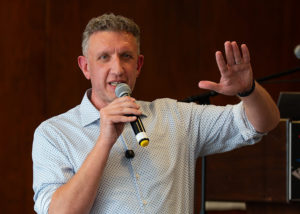
Chuck is a US-based internal communications strategist and the founder of ICology – a community and resource hub for IC professionals. He brings a practitioner lens to every conversation. Chuck is a recognised voice in the industry, a regular speaker and event host, and one of the most connected people in the North American IC world.

Jenni is a UK-based leadership and internal communications consultant, author of two best-selling books, and international speaker. She runs Redefining Communications, a consultancy working with organisations around the world to help them communicate better and close the gap between what leaders say and what employees experience.