
Jenni brings a genuinely meaty stack this week: a UK report on the state of the internal comms profession, Jamie Dimon’s blunt advice to fire toxic people to protect culture, a Forbes piece arguing employee advocacy is a culture problem before it’s a content problem, and a preview of a new paper linking cultural intelligence to AI adoption. Chuck reframes “shadow comms” as possibly a good thing in disguise, and delivers a rant on what “employee advocacy” gets wrong as a term in the first place.
Jenni brings new research from the Institute of Internal Communication (IOIC) on the future of the profession: IC is taking on more strategic work (56% more on change comms, 51% on digital transformation, 34% advising senior leaders), but only 30% feel fully equipped for their role, citing gaps in AI, data, and digital fluency, and 80% report negative feelings about their job, with just 43% happy and 31% feeling appreciated. The report also flags “shadow comms” — 63% saying non-IC teams are now producing their own communications, driving inconsistency and channel overload. Chuck pushes back on reading that number as purely negative — it could reflect overburdened IC teams, or it could reflect genuine democratization, where more people are empowered to communicate without everything bottlenecking through one team. Jenni agrees there’s nuance worth digging into, drawing on her own experience decentralizing content on an early intranet project — not shadow comms, just distributed ownership — and argues the real diagnostic question for any organization seeing this is why it’s happening: are people going around IC because it’s a blocker, because they don’t know it exists, or because IC is simply too stretched to help.
Jenni raises Jamie Dimon’s advice at the Databricks Data & AI Summit to fire toxic people — his term is blunter — before they poison meetings or demoralize teams, even if those people are customers rather than employees, alongside his continued skepticism of remote work. Chuck complicates the framing by pointing to a recent podcast appearance of his own exploring why it can feel “wrong” to be difficult at work — noting that motivation matters more than the label: someone pushing colleagues toward a harder, better outcome through friction is a different problem than someone quietly undermining people or violating trust behind their back, even though both get called the same name. Jenni’s practical takeaway is that leaders need a much sharper definition before acting — protect people whose challenge comes from genuine positive intent, but call out anyone whose behavior makes colleagues shrink or disengage, regardless of intent.
Jenni brings a Forbes Communications Council piece arguing advocacy only happens organically once employees genuinely believe in an organization’s values and feel psychologically safe — tokenistic campaigns and slick content can’t manufacture it without that foundation. Chuck goes further, arguing the term “employee advocacy” itself misplaces the burden — patient advocacy means people advocating for patients, child advocacy means people advocating for children, but somehow employee advocacy has come to mean employees advocating for the company. His favorite example is his father, a lifelong General Motors employee who’d strike up conversations with strangers at gas stations and hand out dealership discount cards — genuine advocacy with zero tracking or gamification, driven purely by pride and ownership of the story. His conclusion: advocacy is a byproduct of doing right by employees, never a goal you can engineer directly through content alone.
Jenni previews a new paper from cultural-intelligence expert Sarah Black, applying the CQ (cultural intelligence) framework — drive, knowledge, strategy, and action — to AI adoption, arguing AI functions like a different culture that teams need to navigate the same way they’d navigate any cross-cultural difference. Among its points: organizations need a shared definition of what “AI” actually means before adopting it, since most people default to thinking only of ChatGPT or Copilot; low personal drive to adopt AI isn’t automatically a bad sign, since it can reflect valuable risk-awareness; and a memorable line from consultant Tom Wilson — “you can’t lay AI on top of a business with broken or inconsistent processes and expect it to work, you’ll only create more problems” — which both hosts single out as the single clearest piece of advice in the whole segment. Jenni also cites new Gallup data showing frequent AI use nearly doubling in two years, though Chuck notes the underlying numbers (40% using AI a few times a year, 19% a few times a week) are far more modest than the “AI is everywhere” narrative implies.
Is it bad if other departments start doing their own internal communications? Not necessarily, argues Chuck — it can reflect genuine empowerment and democratized communication rather than pure dysfunction, though inconsistency and channel overload are real risks worth investigating.
Should leaders fire “toxic” employees to protect culture, as Jamie Dimon advised? Only once “toxic” is properly defined — the hosts distinguish between people creating productive friction with good intent and people genuinely undermining colleagues or violating trust.
Why doesn’t the term “employee advocacy” quite make sense? Chuck argues every other form of advocacy (patient, child) means people advocating for a group — employee advocacy has flipped that, putting the burden of advocating for the company onto employees themselves.
What’s the one thing organizations should know before adopting AI? Per cultural-intelligence consultant Tom Wilson, quoted in Sarah Black’s paper: you can’t layer AI onto broken or inconsistent processes and expect it to work — it will only create more problems.
Chuck: Welcome to Frequency, I’m Chuck Gose.
Jenni: And I’m Jenni Field.
Chuck: Frequency is your go-to for real talk about comms, culture, and employee experience — beyond the buzzwords and straight to what matters. Jenni, I’m excited because by the time this episode is out, I’ll actually be seeing you in person in Toronto at Comms Reboot. But first — I saw something on Instagram that troubled me slightly. You celebrated your dad’s 75th birthday, but also referenced his 70th. I’m assuming this is pandemic-related — go ahead and defend yourself.
Jenni: So my dad turned 70 on March 8th — which happens to be International Women’s Day — right before the pandemic really took hold in the UK. We had a big family lunch for his 70th, but my sister and I had also planned a special Japanese lunch just the two of us with him, since that’s one of his favorite things. That kept slipping for five years — I’m well aware of that — between everything going on in the family and scheduling. This year, turning 75, I told my sister we genuinely had to make it happen before more time slipped by. We finally got to a fantastic Japanese restaurant in London with our husbands — so it ended up covering both the 70th and the 75th at once. Go ahead, come at me now.
Chuck: No real complaint — just noting that dads sometimes get the short end of the stick in these situations.
Jenni: He really doesn’t, I promise — we talk every day, and he’s actually part of the reason I wrote Nobody Believes You, since he challenges and pushes me constantly. Definitely not shortchanged.
Chuck: Maybe someday I’ll get to meet him and hear the real Jenni stories.
Jenni: That thought slightly terrifies me, but we’ll have him on as a guest sometime — he’d be great.
Chuck: That would be something — maybe we get both our parents on eventually. Marilyn would love you, by the way. Also, for listeners and YouTube watchers — after Toronto you’re headed to Niagara Falls, is that still the plan?
Jenni: Yes — it’s actually my ten-year wedding anniversary the day after Comms Reboot, so my husband’s flying out and we’re doing some wine tasting, seeing the falls, taking the boat tour, the whole thing.
Chuck: Worth noting publicly that I invited you to celebrate a real anniversary with us in Vegas, and you still chose Niagara Falls over Las Vegas.
Jenni: I did — but that’s a rain check, not a no. We already had plans, but Vegas is still happening eventually.
Chuck: FAir enough. What have you got for us this week?
Jenni: A lot today — some meaty reports I want to dig into. We’re covering the link between AI and cultural intelligence, protecting culture by removing what I’ll politely call horrible people, since I can’t use the actual phrase from the article, and the role of content in employee advocacy. Starting with the latest from the Institute of Internal Communication — the IOIC, based in the UK — and their report on the future of the profession. It finds that while more professionals are taking on change, digital transformation, and advising leadership, they often feel under-equipped, overwhelmed, and undervalued. IC is now expected to humanize organizations, build trust, and navigate complex change, but that’s come with real burnout, blurred responsibilities, and unclear career paths — familiar territory, but there are some stats worth sharing. On becoming more strategic: 56% report more work on change comms, 51% on digital transformation, 34% advising senior leaders. Core skills — audience understanding, influencing, strategic thinking — are well recognized. But the skills gap is real: only 30% feel fully equipped for their current role, citing AI, data, and digital fluency as the gaps. Morale is a real issue too — 80% report negative feelings about their role, only 43% feel happy, and just 31% feel appreciated. On the positive side, a third of IC professionals are being asked to advise more, not just relay messages. And “shadow comms” is causing genuine chaos — 63% report non-IC teams taking on communications themselves, driving inconsistency and channel overload. The report itself doesn’t say much new — fix shadow comms, invest in upskilling, clarify career pathways, advocate for strategic IC — a list we’ve heard for a decade, though shadow comms specifically feels like a newer focus. Anything jump out at you, or same story, different day?
Chuck: Feels a bit like “second verse, same as the first” overall, though the 63% non-IC-teams-doing-comms stat is genuinely interesting to me — it could read as bad news, or it could be democratization in disguise. Are internal communicators so overburdened that other teams have to step in, or are those teams simply more empowered now, so comms isn’t a single bottleneck everything has to flow through? Depending on your view, that number could be very negative or genuinely positive. The inconsistency and channel overload part is clearly bad, though I’d argue organizations always have some inconsistency somewhere — you’re never fully defeating that. Where I see potential is internal communicators shifting into more of an advisory role — not necessarily “trusted advisor to the C-suite,” but peer-to-peer, advising other team managers, giving them the how-tos, structure, and light oversight to do their own comms well. So yes, inconsistency and overload are bad, but other teams doing their own comms isn’t inherently “shadow” anything to me.
Jenni: I think you’re right that there’s more nuance here worth digging into — how is this actually showing up? Some of my clients are genuinely concerned about other departments going directly to frontline audiences without IC’s oversight, which seems to be the real sticking point. But when I introduced an early intranet at a previous organization and decentralized content so people could upload and tag their own updates, that wasn’t shadow comms — that was distributed ownership, deliberately designed. So I think it depends heavily on root cause: is it because IC is seen as a blocker, because people don’t know IC exists to help, or because IC is simply too overloaded? Worth actually investigating rather than assuming the worst.
Chuck: One more data point before we move on — only 30% feel fully equipped for their role, citing AI, data, digital fluency gaps. If your company isn’t going to equip you, I think this is an opportunity to equip yourself — invest in your own development if the organization won’t.
Jenni: Fair, though sometimes it’s genuinely hard to know where to even look. I got a LinkedIn DM this week from someone at an organization with almost no training budget, asking where to find free masterclasses — I pointed them toward a series I did with the Workvivo team, six sessions, all free. But you’d only know that exists if you’re plugged into the right networks. So my advice to anyone listening who feels in that 30% and doesn’t know where to start — message either of us, we’ll point you somewhere useful.
Chuck: And places like ICology too — joinicology.com is exactly built for that kind of support. Next — a Business Insider piece on Jamie Dimon’s advice to fire what he bluntly called “assholes” to protect culture, even if those people are customers rather than employees. He argued removing toxic individuals fosters mutual respect and lets employees fully contribute, alongside reiterating his skepticism of remote work, arguing in-person interaction enables more honest, focused conversation — which I actually agree with. What stood out most to me was the idea of protecting your people from disruptive culture, since I know plenty of workplaces with people who fit that description. Given how common this is, what can leaders actually do to get it right, since it’s easy to say at a summit but harder to actually act on?
Chuck: I was recently a guest on a podcast episode themed around why it can feel so wrong to be difficult at work, and what came out of that conversation is that it’s entirely a matter of perspective. We’ve joked before — I was first called “the Taylor Swift of internal comms,” then someone mistakenly applied that label to you too — and Taylor Swift herself has been called difficult by plenty of people, while millions of others love exactly how she operates. It’s about motivation. If the person you’re thinking of is genuinely pushing others to be better, having hard conversations because they want good outcomes, that’s different friction than someone violating trust, talking badly about colleagues behind their back, or tearing down projects. You have to look at motivation — sometimes you need someone willing to push a conversation further than others have the courage to, versus someone actively undermining people. I hope that’s the distinction Dimon actually means, though the term gets used pretty loosely — I’m sure I’ve been called difficult for entirely valid reasons myself, but my motivation has always been pushing toward something better, not tearing anything down.
Jenni: So the takeaway is really to define clearly what you mean by “difficult” before acting, and make sure you’re not removing people who challenge with genuinely positive intent. But when you see behavior that doesn’t align with stated values, it has to be called out regardless of intent — if someone’s actions are making colleagues shrink or disengage, that deserves a direct conversation, even if it doesn’t ultimately mean removing them.
Chuck: I think people pushing with good intent often don’t even realize they might be coming across as difficult — reflecting on my own behavior here too.
Jenni: Same — I absolutely fit into that bucket as well. Bit of a mini therapy session today.
Chuck: There’s a quote attributed to Guy Kawasaki — in my own rough paraphrase — that if you’re not upsetting someone, you’re probably not pushing hard enough; pure status quo doesn’t help anyone.
Jenni: Depending entirely on your goals, sure. Next — employee advocacy, something we’ve discussed for years without much progress, from a Forbes Council piece on why advocacy starts with culture, not content. Successful advocacy programs depend on an authentic culture — employees share stories when they genuinely believe in organizational values and feel safe doing so; tokenistic campaigns or slick content don’t stick without that underlying trust, inclusion, and engagement. Building that culture takes ongoing internal comms work, transparent leadership, and real channels for genuine voices — because once employees feel empowered and valued, advocacy becomes organic, amplifying brand and recruitment naturally. It made me think about the broader challenge of comms professionals overreaching beyond their actual influence — if advocacy is fundamentally about culture, what’s the actual role of content, and how tokenistic is a lot of what currently passes for advocacy content?
Chuck: I love this topic for two reasons — one being that, much like employee engagement, we’ve collapsed advocacy into one narrow definition, and anything outside that definition somehow doesn’t count. My favorite advocacy story is my father, a lifelong, deeply proud General Motors employee — if you cut him, he’d probably bleed GM blue. If we pulled into a gas station in our GM car and someone in a non-GM car parked nearby, he’d start a conversation and often hand them a dealership discount card. That’s advocacy driving actual business. Compare that to Amazon’s stated advocacy goal — winning the dinner-table conversation, being the person who actually knows the real story when someone repeats a rumor they heard. Which brings me to my actual rant: we’ve misnamed this entirely. Patient advocacy isn’t patients advocating for themselves, it’s people advocating for patients. Child advocacy is people advocating for children. Somehow “employee advocacy” flipped that, putting the burden on employees to advocate for the company, which breaks the pattern of every other use of the word. Advocacy, to me, is a byproduct — if you do everything else right, advocates emerge naturally. Treating advocacy itself as the goal, hoping it retroactively fixes everything else, is backwards. Are people talking about where they work unprompted at a gas station? Are they correcting a neighbor’s misinformation about their employer? That’s advocacy — not LinkedIn shares or comments, which is where we’ve lost the plot. It’s employees feeling like they genuinely co-own the company’s story.
Jenni: I love that rant — genuinely nothing to add, which is unusual for me. The “how did this become the employee’s burden” point is completely fair given every other use of the term. Your dad’s story also had something tangible behind it — a real link to a campaign or mechanism, similar to how Pret used to empower store staff to hand out free coffees to whoever they chose. There’s something there about a real, felt connection to organizational impact that’s missing from a lot of today’s advocacy conversations, which just becomes LinkedIn shares. Really good call-out.
Chuck: This was the 80s and 90s too — no QR codes, no tracking websites, no gamified leaderboard of who referred the most vehicle sales. People who wanted to be part of it simply opted in because they felt genuine ownership over the story — it wasn’t handed to them, they internalized it and made it their own.
Jenni: And there was no measurement pressure either — I wonder if our obsession with measuring everything today, every purchase followed by five feedback emails, is actually part of what’s suppressing genuine advocacy. People don’t want to feel tracked; they want to want to do it, because they believe in it. That’s harder, deeper organizational work than most are willing to do — probably a whole separate episode on its own.
Chuck: Because organizations have to do all the right things first for an employee to want to advocate at all.
Jenni: Completely. Moving to cultural intelligence as a compass for AI — we’ll keep returning to AI throughout this podcast, clearly. Gallup recently reported that the percentage of US employees using AI in their role a few times a year or more has nearly doubled in two years, from 21% to 40%; frequent use, a few times a week or more, has also nearly doubled, from 11% to 19% since 2023; and daily use has doubled in the past year, from 4% to 8%. Sarah Black, who I’ve mentioned before, is a cultural intelligence expert working on a paper connecting CQ — cultural intelligence — to AI, and she gave me an early read for the show. It applies the CQ framework — drive, knowledge, strategy, action — to a world blending human and AI interaction, treating AI adoption like navigating a genuinely different culture. A few takeaways: people respond to AI very differently across teams — enthusiasts, resisters, everyone in between — and that gap itself causes friction and a sense of unfairness. Low personal drive to adopt AI isn’t inherently negative — some risk-awareness is valuable and necessary for balance — while high drive without strategy or action is equally ineffective. She also stresses getting a shared definition of “AI” across an organization, since most people default to thinking only of ChatGPT or Claude, when AI is embedded far more broadly than that. There’s a great quote from Tom Wilson in the paper: “you can’t lay AI on top of a business with broken or inconsistent processes and expect it to work — you’ll only create more problems,” which feels true of so many places right now. She also touches on declining trust in AI companies since 2019, tied to unease about ethical use, the importance of culturally and legally aware prompting across different countries, and the value of staying reflective about your own biases — since AI removes the natural self-awareness check we’d normally apply to our own thinking. She closes with: “flexible, don’t bend and don’t break — culturally intelligent action should not force you to become someone you’re not, or to compromise your values, personally or as an organization.” What’s your take on this CQ-and-AI overlay, and does Tom Wilson’s quote hold up as the real starting point before adopting AI?
Chuck: Another “Q” acronym to add to our growing collection — IQ, EQ, whatever AQ was, and now CQ. I want to genuinely internalize that Tom Wilson quote, because as obvious as it sounds, I don’t think most companies — myself included — have actually thought about it that plainly: you can’t layer AI on top of broken, inconsistent processes and expect it to work, you’ll just create more problems. I think that’s exactly what we’re starting to see — leaders assuming AI will fix underlying dysfunction rather than expose or worsen it. I also like the point about needing an internal shared definition of what AI even means before you have that conversation — it’s not just ChatGPT, Copilot, or Claude, it’s embedded everywhere already. I’m also struck by how modest the actual usage numbers are compared to how AI gets talked about — only 40% using it a few times a year, “frequent” defined as just a few times a week. I’m using it multiple times a day — am I some kind of AI addict at that point?
Jenni: We may need an AI Anonymous meeting at this rate.
Chuck: Something like that. But I think the real point stands — you’ve got people like me pushing hard for AI adoption, and others being more cautious, sometimes for the wrong reasons, sometimes for genuinely good ones — neither side is automatically right or wrong. The more organizations can have open conversations, set expectations, and encourage exploration rather than defaulting to restriction — while still having sensible guidelines — the better. We could do a whole episode just on this report, honestly, but I want to repeat Tom Wilson’s line one more time because I want it printed on a T-shirt: you can’t layer AI on top of a business with broken or inconsistent processes and expect it to work, you’ll only create more problems. That’s really all people need to know.
Jenni: Completely agree. That wraps our articles for the week.
Chuck: Great list this week, Jenni — well done.
Jenni: I’ll share too — I used AI myself to help surface articles outside my usual feed, since I was conscious that algorithmic feeds can narrow what we naturally see. Using it to deliberately widen that net felt like a genuinely good use of the tool.
Chuck: And to listeners — if you’re reading things you think we should cover, or want our take on, send them our way. We only see what shows up in our own feeds, so let us know what you’re seeing that we might be missing.
Jenni: Completely. What’s freq-ing you out this week?
Chuck: Mine’s a positive one this week — if you’re not celebrating your friends, what are you even doing? A friend of mine, Jason Etter, quietly launched a genuinely thoughtful YouTube channel called The Family Vibes — we’ll link it in the show notes. It’s a series of short, high-EQ meditations and videos, five or ten minutes long, specifically designed for families, kids, moms, dads. If you just need five minutes to dial things back, it’s a real resource, and he’s clearly not doing it for money — just something he genuinely cares about. Thank you, Jason, for building that, especially with everything going on right now — it’s a simple place people can go to take a breather.
Jenni: Lovely — I’ll check it out. Mine is less positive, though not exactly negative either — I’ve got a mini freak-out about the interchangeable use of “consultant,” “freelancer,” and “contractor.” I’ve been sitting with this for about six months, asking people with networks in these spaces to define the difference, and getting no clear answers. I feel strongly they’re distinct things — I’m a consultant, not a freelancer, and I think they carry different roles, different pay structures, different kinds of support offered. Equally, is someone doing three-to-five-day-a-week interim work still a “consultant,” or is that a contractor? It feels genuinely messy for the industry, and unhelpful for people trying to find the right kind of support and understand what they’re actually getting.
Chuck: Honestly, I’ve never really thought about it — and I noticed you stress a different syllable on one of those words than I do.
Jenni: Which one?
Chuck: I realized I’m not even consistent myself — I say “consultant” one way but “contractor” differently. I think I know the distinction intuitively, but I couldn’t cleanly put it into words. Genuinely tricky.
Jenni: Same. Do you think it actually matters, or am I just overthinking something for the sake of it? I can be that person, I know.
Chuck: If it Matters to you, then it matters — I’d be curious what other people think, or whether they care at all.
Jenni: Let us know if you have thoughts. Genuinely feels better having said it out loud. Thank you for that, and thank you all for joining us this week — all the articles that inspired this conversation are in the show notes, so don’t forget to rate and review after listening, and subscribe and follow so you don’t miss an episode. Pass this along to anyone you think would enjoy listening or watching — you can also find Frequency on YouTube. Thank you to Poet Ali for contributing the music to the show. We’ll be back next week with more news, insights, and opinions about comms and leadership in the workplace today. Keep tuning in and turning up.
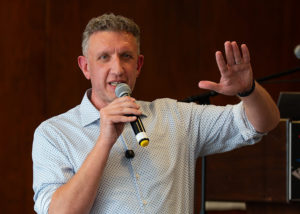
Chuck is a US-based internal communications strategist and the founder of ICology – a community and resource hub for IC professionals. He brings a practitioner lens to every conversation. Chuck is a recognised voice in the industry, a regular speaker and event host, and one of the most connected people in the North American IC world.

Jenni is a UK-based leadership and internal communications consultant, author of two best-selling books, and international speaker. She runs Redefining Communications, a consultancy working with organisations around the world to help them communicate better and close the gap between what leaders say and what employees experience.