
Nearly six in ten millennial workers say they would rather be laid off than quit, and the CEO who commissioned the survey has a name for it: career dysmorphia. Jenni, back from two weeks in Japan, refuses to read that as a workplace story — she calls it a story about personal agency, and about people waiting to be told to go instead of investing in themselves. Chuck, recording at 7 a.m. from Las Vegas during Transform, lines up four stories on the same fault line: the collapsing career ladder, women in their 40s and 50s leaving corporate roles over what McKinsey’s Lareina Yee calls the absence of reciprocity, Anthropic’s 81,000-person study of what people actually want from AI, and AI brain fry, the cognitive overload that comes from supervising machine output all day.
Chuck opens with the finding that millennials don’t want to quit, they want to get laid off — a survey of 2,000 Gen Z and millennial workers by the education platform ELVTR showing 37% dissatisfied with their roles, 55% unsettled in their careers, and a cohort too financially trapped to resign, which ELVTR’s CEO labels career dysmorphia. Jenni, who mildly identifies as a millennial, declines the framing: what made her smile is the image of someone sitting there hating the job and hoping to be made redundant rather than asking what a mentor, a coach or a single two-hour session might unlock, and she calls that a story about agency, not about the state of work. She has skin in it — nine years ago, unsure whether to take another in-house comms director role, she spent two hours on her values and options and came out of it having decided to start Redefining Communications, and without that she reckons she would have been swimming in her own head for ages. Chuck’s version of the same advice comes via Heather Wagner: if you are not investing in yourself, who is? The structural half is bleaker. AI is removing the entry-level roles that fed the pipeline, 76% of HR professionals surveyed expect it to significantly reduce hiring, and Avature’s CEO says the pyramid structure simply will not exist — so millennials are clinging to a crumbling ladder and Gen Z may arrive to find no ladder at all. Chuck wonders whether the phrase itself disappears; Jenni points out her own ladder was always wonky, moving sideways from comms assistant to media relations to internal comms, and suggests the honest name might be a corporate trampoline. Chuck’s Transform takeaway lands in the same place: the smarter organizations do not want anyone in one role for more than two years.
The second story argues that women in their 40s and 50s are leaving corporate jobs because they are not burnt out, they are done — 63% of C-suite leaders in a 2024 Upwork and Workplace Intelligence survey said RTO mandates drove a disproportionate number of women out, most of them reporting productivity losses as a result. The supporting numbers are the argument: only 60% of women say they get useful feedback from a manager and only 40% feel their manager actually cares about their career, which is why McKinsey’s Lareina Yee calls this the absence of reciprocity rather than burnout. Jenni starts with the juggle — the women she knows with school-age children find the childcare-and-work arithmetic close to impossible — and reaches for a book she read a few years ago, Can’t Even, on a generation sold the idea it could have it all and exhausted by trying. But she does not let RTO carry the blame: the feedback and the caring are the real story, and the return-to-office mandate is only the straw that breaks the camel’s back after five years of small, consistently poor management behaviors stacking up, which is the part leaders can actually act on. Chuck’s contribution is skepticism about the price tag: replacing a C-suite leader may cost up to 213% of salary, women CEOs leave at four times the rate of male counterparts in their first year, and corporate commitment to gender diversity has slid from 87% in 2019 to 78% in 2024 — but no percentage captures what a strong leader’s exit does to the team left behind. He reaches for corporate Jenga: pull enough blocks and the tower does not fall immediately, it just weakens until it drops.
Anthropic’s study of nearly 81,000 Claude users across 159 countries and 70 languages — billed as the largest and most multilingual qualitative study of its kind — finds that people’s hopes are not really about productivity. Professional excellence tops the stated visions at 19%, but pressed further, most respondents describe productivity as the vehicle and time as the destination: time with family, time to think, time to be human. Jenni recognizes the pattern from her own work, where AI genuinely saves her hours on analysis and interview data but also hands her ten blog drafts in under ten minutes that all still need reviewing, and she notes that most people inside organizations are limited to Copilot, which she abandoned after five minutes stuck in a permissions loop. The study’s light and shade pattern is the finding both hosts sit with: half of respondents cite time saved as the top benefit while 18% flag the treadmill, where AI has not freed time so much as raised expectations, with freelancers reporting both the highest economic benefit and the highest precarity. Chuck’s read is that there is something close to a paradox in turning to a deeply inhuman technology to buy back time to be human, and he brings a data point from Transform: an HR director who has stopped using AI altogether because Copilot is the only sanctioned tool and it did not help. The geographic split is where the conversation gets sharpest. Workers in lower- and middle-income countries are significantly more optimistic, framing AI as economic opportunity and access to learning, and Chuck wonders whether they see a chance to skip several steps at once. Jenni names the mindset difference and then names the word she is not sure is fair — greed — for a Western framing that asks how to get more out of the tool rather than what it could teach. Across every region, the concern driving negative sentiment is jobs and the economy, not hallucinations, privacy or existential risk.
The closing story gives the fatigue a name: AI brain fry, from a Harvard Business Review study led by BCG researcher Gabriella Rosen Kellerman, describing the cognitive overload of maintaining constant oversight of AI output. It is distinct from burnout, already affects 14% of US workers, and tracks with a 39% increase in major, outcome-altering errors and a 39% rise in intent to quit — and the people most at risk are the best AI users, who are 40% more likely to be rated critical to retain. The mechanism is uncomfortable: productivity drops once three or more AI tools are in play at once, and the more polished the output looks the less it gets scrutinized, with reasoning evaluation falling three percentage points and identification of missing context falling over five. ActivTrak data shows time on email and admin more than doubled for AI users while focused strategic work fell 9%. Jenni’s response is to add the phrase to the Frequency buzzword list and then question whether anything here is new: nobody can multitask, it takes 40% longer to finish a task when you try, and this looks like the same cognitive ceiling meeting a tool of unprecedented scale. What she wants on a billboard is the arithmetic from SaaStr CEO Jason Lemkin, who has moved 60% of his sales function to AI agents: managing an agent takes three to four hours a week, about the same as a human direct report, except those four hours yield 168 hours of output instead of 40. Chuck’s frying-pan analogy writes itself, and his sharper point is that the thing companies are actively encouraging is degrading the work — people are told to run four tools at once and are doing exactly as instructed. His advice to comms teams is the structural fix in the research: engaged managers who answer AI questions cut fatigue by 15%, and teams that share workflows beat individuals racing to prove personal fluency, so be open, compare tools, and talk to your manager. Jenni adds the manager’s half of the deal — someone has to decide what all that extra volume is actually for, and how many hours it is reasonable to spend reviewing it.
What is career dysmorphia? It is ELVTR CEO’s term for the gap between how workers feel about their careers and where they actually are. In their survey of 2,000 Gen Z and millennial workers, 37% were dissatisfied with their roles and 55% unsettled in their careers, with nearly six in ten hoping for an external excuse to leave — a layoff — rather than resigning. Jenni’s view is that this is a problem of agency more than a verdict on workplaces.
Why do 60% of millennials want to be laid off instead of quitting? Money and permission. A layoff comes with severance and no guilt, while quitting means walking away from income many people feel they cannot afford to lose. Chuck also wonders whether people have looked around and concluded nowhere else is better. Jenni’s answer is that a single coaching conversation, which need not cost thousands, usually beats waiting to be told to go.
Is the career ladder actually disappearing? The article’s claim is that AI is removing the entry-level roles that fed the pipeline, with 76% of HR professionals surveyed expecting AI to significantly reduce hiring and Avature’s CEO saying the pyramid structure will not exist. Both hosts note their own careers moved sideways as much as up — squiggly, as one BBC team described it, or as Jenni puts it, a corporate trampoline.
Why are women in their 40s and 50s leaving corporate jobs? Not burnout, according to the research — reciprocity. Only 60% of women say they get useful feedback from their manager and only 40% think their manager cares about their career, which is what McKinsey’s Lareina Yee means by the absence of reciprocity. RTO mandates are the trigger rather than the cause: 63% of C-suite leaders in a 2024 Upwork and Workplace Intelligence survey said RTO drove a disproportionate number of women out.
What did Anthropic’s study of 81,000 people find about AI? That the stated goal and the real goal differ. Professional excellence topped the visions at 19%, but most respondents described productivity as a vehicle for time — with family, to think, to be human. Half cited time saved as the top benefit while 18% flagged the treadmill problem, where the time saved is reinvested in higher workloads. Across every region, jobs and the economy drove negative sentiment more than hallucinations, privacy or existential risk.
What is AI brain fry and who gets it? It is a term from a Harvard Business Review study led by BCG researcher Gabriella Rosen Kellerman for the cognitive overload of constantly supervising AI output. It is distinct from burnout, affects 14% of US workers, and comes with a 39% rise in major errors and a 39% rise in intent to quit. The heaviest, most valued AI users are most at risk, and marketing has nearly double the rate of sales because quality is subjective and nothing is ever clearly done.
How can teams reduce AI fatigue? By treating it as a workflow design problem rather than an individual one. The research found engaged managers who actively answer AI questions reduce fatigue by 15%, teams with shared AI workflows outperform individuals racing to demonstrate personal fluency, and building in physical breaks measurably preserves cognitive performance. Productivity also drops once three or more AI tools are running simultaneously.
Jenni: Welcome to Frequency, I’m Jenni Field.
Chuck: And I’m Chuck Gose. Frequency is your go-to for real talk about comms, culture, and employee experience, beyond the buzzwords and straight to what matters. Jenni, this week we’re going to be talking about millennials, because they frankly love being talked about. We’re going to answer a question: is it burnout, or is it just being done? In addition to the largest AI study ever conducted, and the question, are we frying our brains because of AI? But before we get to the stories, Jenni, I want to hear about what you’ve been up to the last couple of weeks.
Jenni: I know, I’m sorry I missed everything last week, but I’ve had a brilliant time exploring Japan with my husband and with some friends who live out there. So we were in Tokyo for about a week, then we went off to Kyoto for about five days, then we had a few days back in Tokyo. So it’s been brilliant. I went to Japan 20 years ago with my mum and my sister, so I managed to find — I uploaded one of the pictures from that trip, which was before iPhones, before any of that stuff. My mum sent me some photos, so I uploaded it to AI and I was like, where is this? So I managed to find where that statue was that was me and my sister, and went and had another photo next to it, sort of 20 years on, which was cool. But we saw some sumo, we went to the grand tournament in Osaka and did the bullet train and saw some cherry blossom and ate lots of gyozas, and it’s just been brilliant. The trip of a lifetime, 100%.
Chuck: That’s amazing. Yeah, I haven’t been fortunate enough to go to Japan.
Jenni: It’s definitely somewhere I think everybody should go to, just because I feel like I’ve just immersed myself in a different place for an absolutely solid two weeks. I just caught up with Alia, my assistant, today to go through everything, and she was like, did you manage to switch off? And I was like, yeah, I shouldn’t really think about it. I was too busy in Google Maps trying to navigate which temple we were going to, or which restaurant we were going to go to that night. It was incredible. I thoroughly recommend it to anybody. If you get the chance to go, then definitely go.
Chuck: Also, what a cool use of AI, to be able to track down something in an old photo and track where that location is. That’s really cool.
Jenni: Yeah, because 20 years ago there was a bit of English, but there wasn’t anything. There were no iPhones, there was no Google Maps, there was none of that stuff. I don’t quite know how we did it now. And it was a lot easier, obviously, navigating around. There’s a bit more English, but still not tons. But it was really cool to be able to just upload some of those things and figure out where we were and then go back and find it again, which was just really nice.
Chuck: Well, I am coming to you from an equally exotic land of Las Vegas, Jenni, while Transform is still going on — hence my hotel background. And it is 7 a.m. when we’re recording this. And 7 a.m. in Vegas is a different 7 a.m. than other cities, if you can’t tell from my Vegas voice.
Jenni: I think the question is, have you been to sleep, given that you’re in Vegas at 7 a.m.?
Chuck: Of course. I am a semi-responsible Vegas expert on this. So yes, absolutely. But let’s get into our content for this week. Nearly six in ten millennial workers say they’re hoping for an external excuse to leave their current job, like a layoff, rather than quitting on their own. A survey of 2,000 Gen Z and millennial workers by education platform ELVTR found 37% dissatisfied with their roles, 55% unsettled in their careers, and a growing cohort too financially trapped to resign voluntarily. ELVTR’s CEO has a name for it. They call it career dysmorphia. The career ladder is failing workers emotionally and structurally collapsing. AI is eliminating the entry-level roles that used to feed the talent pipeline, with 76% of HR professionals surveyed saying AI will significantly reduce hiring. They claim companies can’t afford trial and error anymore, so junior hiring is getting more intense and less forgiving. Avature’s CEO says the pyramid structure simply will not exist in the future. The article frames this as a warning for Gen Z specifically. Millennials are clinging to a ladder that’s crumbling beneath them. Gen Z may arrive to find there’s no ladder at all. Jenni, if 60% of millennials — which I believe you identify as a millennial — are privately hoping for a layoff, what does that tell us about the state of work and workplaces in general?
Jenni: So I do mildly identify as a millennial. I think this is more about millennials than probably the state of work and workplaces. So what made me smile about this was, like, I’m just sitting here hating this and just hoping that someone’s going to either fire me or make me redundant. Rather than proactively looking at what are the different options I could do — could I go and is there someone that could do some mentoring or some coaching? What could I invest in myself to help me take some proactive action, rather than just, I’m just going to wait here and not do it very much until somebody tells me to go away. Which I just think is quite sad. I think the state of work and workplaces is another issue. This is more about people having agency and control over their own lives. And that’s kind of the red flag, I suppose, for me. You can control this. If you don’t want to work there, then look at what your other options are. That’s what coaching and mentoring exists for, to kind of help with that. So I hope that people will invest in that. And that doesn’t have to be a lot of money. You can have a one-off coaching call for a couple of hundred pounds. It doesn’t have to be thousands and thousands to get that support, but I think it’s worth doing stuff like that to really help you. So that’s what it made me think about.
Chuck: I wondered too if this — I hadn’t thought of it in the same way that you just did. I wondered more, is it people, did they stop and look around and be like, I don’t know that it’s any better than where I am here, so is it going to be good anywhere? But to your point about investing in yourself, that’s something that I’ve been preaching about for years, and a mutual friend of ours, Heather Wagner, has been talking about for a very long time. If you’re not investing in yourself, who is? And if you’re waiting for the company to do that, you might be waiting for a very long time, and you’re just going to end up staying or sticking around because you frankly don’t know what the other options are.
Jenni: Yeah, and I think it almost smacks of that bigger problem of this existential crisis we have, which is what is the meaning of life and purpose for people, which we’re not going to cover today. But if you’re sitting there and thinking, what am I doing? I’m not enjoying this. What am I doing with my life? Where am I going? And you’re just sitting in that circle of doom and going round and round in that. That’s where you need to go and have that support and conversation with people to figure that out. I did that. Nine years ago was when I last had a role that was in-house. I was communications director, and I didn’t know what to do. I was like, I’m not really enjoying this. The company had sort of said to me, we don’t think we really want a comms director. And I was like, no, you definitely want a comms manager, because you’re not enjoying the directing. And then we had this sort of conversation about, let’s recruit someone more junior. And I was like, I don’t know what to do. Do I go and get another job like this? Where do I go from here? And I did, I think it was like a two-hour coaching session, to really help me look at my values, look at what was important to me. Could I work on my own? Just everything. And it was after that that I decided to set up Redefining Communications. But if I hadn’t had that two-hour conversation, I think I’d have just been swimming in my own head for ages. And that is not helpful. So I’m with you on the investment in yourself. I think the Gen Z piece in here is interesting in terms of that ladder and what it means for the next generation coming through. And I think we still don’t know enough yet in terms of the impact of AI and what that’s going to do.
Chuck: I wonder if even just the phrase corporate ladder is just going to disappear entirely.
Jenni: Yeah, and also, even if I think about my own career — I don’t know about you, but I’ve always gone horizontal. So even though I’ve gone up, if you like, to director level, I went from a comms assistant to a media relations advisor, to an internal comms officer, to an internal comms manager. My ladder was definitely wonky, if that makes sense. It definitely wasn’t just going straight up. And I don’t think that works in our industry anyway. Interesting to see what it becomes. Maybe it’ll be like a corporate trampoline or something. Just bounce around all over the place.
Chuck: Well, I remember talking to someone at the BBC one time, and they talked about how their careers at the BBC — they described them as being squiggly, because you’re going between different departments in different roles. And we actually talked about that at Transform, where companies are — I guess I would say maybe the intelligent companies really don’t want you in the same role more than two years. They want you doing different things throughout the organization. It’s not like, I am just a communicator. No, you might do comms for a couple of years. You might go into health and safety for two years. You might go into another role for a couple of years, because they want you to understand the full business, not just this narrow window.
Chuck: Next up, women in their 40s and 50s are leaving corporate jobs in growing numbers — not because they’ve been pushed out, and not because they’re burnt out. They’re leaving because they ran the numbers and the deal stopped making sense. A 2024 Upwork and Workplace Intelligence survey found that 63% of C-suite leaders said RTO mandates led to a disproportionate number of women quitting, with most reporting productivity losses as a result. The data behind these exits is stark. Only 60% of women say they get useful feedback from their managers. Only 40% feel their manager actually cares about their career. Half work somewhere they feel is being treated with basic respect. McKinsey’s researcher Lareina Yee is direct about this. This isn’t burnout, it’s the absence of reciprocity. The business case should be alarming. Women CEOs leave at four times the rate of male counterparts in their first year. Replacing a C-suite leader can cost up to 213% of their salary. And corporate commitment to gender diversity has been quietly sliding. 87% of companies called it a priority in 2019. By 2024, that’s down to 78%. The departures are accelerating at the exact moment the will to retain is weakening. Jenni, we’ve talked a lot about gender at work. We’ve talked a lot about RTO at work. With RTO mandates repeatedly showing up as the trigger for a lot of things — maybe not the cause, but the trigger — what message do these blanket RTO policies send to employees that are already questioning whether work is actually worth it? What is that doing to those people?
Jenni: I think it’s a bigger issue for women in the workplace, especially women that have children that are trying to juggle childcare and school and all of that system. I think that is a bigger challenge. I know a lot of working mums who find that just nearly impossible to juggle — school and work and all of those things. And I think by the time you’re in your 40s and 50s, you’re just done with trying to juggle it all. And I think that’s the bit that is hard. And interestingly, that 40s and 50s — there was a book that I read a few years ago, and I think it was called Can’t Even, and it was sort of this demographic, and it was American-based content talking about what everyone was kind of sold in terms of the dream of being able to have it all. And it basically was almost the same. It was sort of a bit linked to burning out, but also that you’ve been told that you can have it all and you can do all of this, and then you’re exhausted because you’ve tried to do it, and then you just go, yeah, I’m not doing it anymore. The return to office piece is that trigger. It’s like, do you know what? I’m done. I can’t do all of these different things. What that means in terms of where the women go, I think is the challenge. There’s a lot of entrepreneur talk at the moment. It seems to be an entire section in most newspapers now, especially online. And I think people are just trying to find something that’s maybe more balanced. But the bitterness for me — it’s not just always the RTO thing as the trigger, it’s all of this stuff about the reciprocity. It’s the, I don’t get any feedback. I don’t feel like anyone cares. Why should I bother? And I think that’s a bigger problem with work for everybody, not just women, but that’s got to be part of that trigger as well, where you just reach a point of, do you know what? I’m done caring. If you’re not going to care about me, why should I care about you? I’m out. And I think that the RTO is probably just that tipping point. I can’t think of the words now because I’ve got jet lag. What’s the straw that broke the camel’s back? That’s the phrase I was trying to dig out. That just goes, I’m done. I’m done.
Chuck: Yeah, I think what the researcher pointed out about the absence of reciprocity — this give and take, this equal exchange — and if that scale is tipping too far, I think then that’s when those people are just out. I do think, I’m always a bit intrigued by when they try to calculate the cost of loss and the cost of replacing, and they put out this number like north of 200%. I guarantee you that is not remotely capturing the true cost of when you have a strong leader who is just like, man, screw this, I am out. That cost is not just, okay, what does it take to put that person in this role? It’s what did that departure do to the rest of that team, the rest of that organization? That’s always the hidden cost of it.
Jenni: Yes, totally. And I don’t know how you’d even start measuring that. But you’ve just made me think about the fact that if RTO is that trigger — and I say this even though this is aimed more at women CEOs and those cost figures — but if you’re a leader or a manager, you’ve got to remember it’s always the lots of little things that stack up that eventually contribute to somebody going. It’s rarely one thing that you do and then someone goes, you know what, I’m out. These are consistently poor leadership and management behaviours that are leading people to go, I’m done here. And that consistency has got to have been going on for at least six months, a year, probably five years in some cases, that people have put up with it and carried on and then gone, I’m out. That’s the thing to focus on, I think, for leaders and managers. It’s how you show up every day in all of those normal moments that will eventually lead to people going, done.
Chuck: I have this vision of corporate Jenga blocks, and you’ve got the team there, and little blocks you start pulling out as people leave, and eventually that tower is going to come down. Maybe not right away, but eventually it weakens to the point that it drops.
Jenni: Yes. I feel like we could absolutely play some kind of Jenga game with this. We could definitely. I feel like it’s happening.
Chuck: Next up, Anthropic interviewed nearly 81,000 Claude users across 159 countries and 70 languages, claiming the largest and most multilingual qualitative study ever conducted. The headline finding is, people’s hopes for AI aren’t really about productivity, they’re about getting their lives back. The top stated vision was professional excellence with about 19%, but when researchers dug deeper, most respondents said productivity was just a vehicle. The real goal was more time with family, more time to think, more time to be human. The study identifies a consistent light and shade pattern. The same AI capabilities that create benefits also produce harms, and most people carry both tensions simultaneously. Time-saving was the most cited benefit, with half of all respondents. But 18% specifically flagged the treadmill problem: AI hasn’t freed time, it’s raised expectations. The tension is sharpest for freelancers, who report both the highest economic benefit from AI and the highest sense of precarity. Workers in lower- and middle-income countries are significantly more optimistic about AI than those in Western Europe and North America. Their vision is economic opportunity and access to learning. The dominant concern driving negative AI sentiment globally, across every region, is jobs and the economy. Not hallucinations, not privacy, not existential risk. 50% of respondents said AI saves time, but 18% said the time just gets reinvested in higher workloads. What’s your experience been? Or people you talk to that are in roles, what’s their experience been with this challenge?
Jenni: So I think it’s a great study, and it’s great that it’s so broad, and I think it is the biggest study that’s been done, and I can relate to this completely. So on a personal level, it does save time. It does save time for me on things like analysis of loads of data or interviews or stuff like that. That has been massively helpful. But what it can also do is just give you so much more content. So I can get AI to draft me probably ten blogs for my website in less than ten minutes. But the volume of content that I’ve then got to review, edit, make sure it’s right, because it’s like looking at a first draft from a copywriter. Your ability to create so much, I think at the beginning, becomes quite exciting. So you do quite a lot, and then you’ve just got so much stuff. And I think that’s quite hard. I think for people in organisations, they are so limited with what they can actually use. Nearly everyone I talk to can only use Copilot. And I have tried to use Copilot and have been so frustrated that I’ve given up after about five minutes, where I was trying to ask it to search through an email for me and it was like, we need your permission. I was like, you’ve got my permission. It was like, we need your permission. And I was just in this loop for about five minutes before I just gave up and thought, this is pointless. So I think there are those two elements. But I love the stuff in the data where it’s really clear people are trying to find balance. And I think that is so linked to the pandemic and people trying to balance work and life and how it all fits together. That does seem to be the main thrust of it: how do I get more time? How can you create me a workout? How can I use it to do all that stuff? Which I think is good.
Chuck: Yeah, immediately when I saw this I flashed back to a very early episode of Frequency, Jenni. I think it might have even been your freq-out, where you talked about some advertisements talking about getting your weekends back, or getting your evenings back maybe, or something like that. And I’m like, this is it. This is the solution now, Jenni.
Jenni: Yes, it was about meal prep stuff, and how we will be in conditions that you shouldn’t be spending your evenings cooking, when you should actually be ordering a meal prep service. Whereas cooking your food is actually a fine thing to be spending your time doing. So yes, this is maybe going to help.
Chuck: I think the interesting part for me is that we’re looking to technology to create more time to be human. I don’t know if that’s irony, I don’t know if that’s a paradox, I don’t know what to call that, but the fact that we’re looking to something that’s very inhuman to give us more time to be human. The other part that stood out to me quite a bit was that it’s not really freeing a lot of time for people. It’s actually giving them more to do, which I think I have experienced some of. And in a session here at Transform, there was an HR director who said they have basically stopped using AI because of Copilot. Because that’s the one tool they’re allowed to use. They have not found it to be helpful or beneficial at all, and they felt like they actually did give it a shot. And so they’re just not using it. And I look at the geographic data, and we’re talking about the countries outside of Western Europe and North America — the vision of this is so much more positive. And I wonder if they see this as a potential catch-up opportunity. This is a chance to skip a couple of steps, like you’re playing a video game or a card game, you get a card and it’s like, jump forward three steps. Will AI give them that opportunity to move forward much more quickly and catch up to other countries?
Jenni: I think there is the cultural difference as well there, in that it said in the data that the vision outside of Western Europe and North America is that economic opportunity and access to learning. I think there is that desire to learn and do more, whereas I think in Western Europe and North America it’s more, how can I be more productive? How can I get more out of what I’m doing, rather than how can I use this to help me learn and do things? That’s just a very different mindset in terms of how you’re using it. And I don’t know that I have any final thoughts on that other than it’s just different. It’s just different. The word that’s coming to mind is greed, which I don’t think is probably very fair, but it feels like we’re kind of greedy in Western Europe and North America of trying to use it, rather than that learning and opportunity. It’s just a very different way of framing it, I think.
Chuck: It is. I think what I’m learning as I talk to people more and more about it, there’s this how can I do things quicker, better, more efficient, versus the side of people like, what can I build? What can I create? You’re using the same tool, but the mindset is wildly different in those two.
Jenni: Yeah, totally. And I think the mindset is probably what makes the difference with AI. It’s using it with purpose and intention. And I think that a lot of people — and I don’t know that it was this study, because I can’t remember what I’ve read or watched that’s the same — but somebody had said something about, I used AI to help me talk through a relationship issue with a friend, and I spoke to AI more than I spoke to that friend, and that’s how I lost that friendship. And I think stuff like that is really interesting, how we’re kind of turning to it for all of this life advice and everything else, but actually, to your point and to the study’s point, we’re using it to be more human, yet in some places we’re not. We’re actually replacing the human connection with that. So yeah, there’s still a lot to figure out, but I think that mindset thing is just very different. And I think that’s worth watching, to your point. Is it going to leapfrog different parts of the world over others in terms of what they’re able to do?
Chuck: And finally, our last item of this episode. A new Harvard Business Review study led by BCG researcher Gabriella Rosen Kellerman has a name for what heavy AI users are experiencing: AI brain fry. It’s a specific form of cognitive overload from maintaining constant oversight of AI output. This is distinct from burnout, and already affecting 14% of US workers. The consequences aren’t minor: a 39% increase in major errors — things like safety-critical issues, outcome-altering mistakes — and a 39% rise in intent to quit. The workers most at risk aren’t the reluctant adopters, they’re actually the best AI users, who are 40% more likely to be rated as critical to retain. The mechanism is worth understanding. Productivity drops after three or more AI tools simultaneously. More counterintuitively, the more polished the AI output looks, the less people scrutinize it. Reasoning evaluation drops three percentage points, and identification of missing context drops over five. Clean output breeds complacency, which breeds errors. Meanwhile, ActivTrak data shows time on email and admin tasks more than doubled for AI users, while focused strategic work fell 9%. Work didn’t get lighter, the treadmill sped up for these people. The research points to structural solutions. Engaged managers who actively answer AI questions reduce fatigue by 15%. Teams with shared AI workflows do better than individuals racing to demonstrate individual fluency. And building in physical breaks measurably preserves cognitive performance. The problem is workflow design. The highest rates of AI brain fry are in marketing, nearly double the rate of sales, largely because quality is subjective and there’s no clear thing as, I’m done. How should comms teams be thinking about that for their own AI work and workflows within their teams?
Jenni: So I thought this article and research was really interesting, because as we know, we love a Frequency buzzword or new phrase, and AI brain fry is now going on the list. But as you were reading through it all and talking about it, all I kept thinking about was, this is so similar to the data around multitasking and what our brains are capable of doing. Everyone has this myth that women can multitask and men can’t multitask, which is not true. Nobody can multitask. And it takes you 40% longer to complete a task if you’re trying to do too many things at once. And this just feels very similar to that in terms of that workflow design problem. That’s the issue. It’s that you’re trying to do too much stuff that our brains aren’t able to do. So I don’t know that it’s AI brain fry, or whether it’s just the fact that AI can do so much but our brains can’t, and therefore you’ve got that challenge that we’ve always had where we’re trying to do too much when our brains just can’t do it. Do you know what I mean? It just feels like it’s another marketing buzzword, when I’m not actually sure it’s really anything new other than the challenge of AI being able to do too much.
Chuck: I don’t know if this made its way over to the UK, but there was this old commercial in the US that was an anti-drugs commercial. It was like, these are drugs, and then this is your brain on drugs. And it was this frying pan, and this egg would smash into the frying pan and it would fry. It was like, you’re frying your brain with drugs. That is immediately what came to mind when I heard this. I was like, this is AI. This is your brain on AI. And what I think is so fascinating about this is that the very thing that companies are encouraging is actually destroying the work. The more people are using it, the more true errors they’re making and the more people want to quit. And the fact that it talks about the productivity drops after people are using all these different tools simultaneously — because that’s what we’re being told. We’re being told, use this forever, use Gemini for images, use Claude for this, use ChatGPT for this, use Copilot for this. So people are doing what they’re told, and it’s not creating what people want out of it.
Jenni: Yeah. It’s almost like we’ve forgotten the less is more piece that was a big theme, certainly in comms and employee experience and culture, probably about two or three years ago. I remember doing loads of talks about less is more and all that kind of stuff. We’ve forgotten that, and this is the same. The other thing in this report that I just want to touch on was the piece around using AI agents to replace workers and what that means. So there was a piece in the report that said that a CEO of a company had moved 60% of his sales function to AI agents, and it basically was explaining that managing an AI agent requires about three to four hours per week, which is identical to managing a human direct report. But the difference is that those four hours spent managing a human yields about 40 hours of work, whereas the four hours managing an AI agent yields about 168 hours of output. And that for me was just — I want to put that in really big letters on a billboard somewhere, because I think this is the thing that I don’t think we’re realising. It doesn’t stop, it keeps going, and it will continue to do that. And then you’ve got to manage that. And that is vast, going from 40 hours to 168. We’re all going to just burn out and just not be able to do it, because our brains just haven’t evolved to the ability to do it. And I don’t think we’ve made that correlation. And maybe this is the start of actually figuring out that balance.
Chuck: Yeah, I think the other part that stood out to me was that element where it talked about the managers that are answering questions, and teams that are talking about it and sharing their workflows. It’s not, what are we hiding and keeping to ourselves, and these are our little secret tools. No, the teams that are openly sharing and discussing and answering questions, that is the positive. So how do we build that into teams? And that would be my advice to comms people: be very open. Talk with your manager, talk with your teammates, talk with people you work with around, here’s how I’m using it, how are you using it. Or, hey, I used this tool, it was better than this tool, I wasn’t using four tools simultaneously to get all this stuff done. So what is the healthy way to view productivity when it comes to AI?
Jenni: Yeah, and I think there is a responsibility for managers to really think about that in terms of that volume that it can create, and actually what you’re expecting people to do with that volume, and then the working hours. There’s a lot to figure out if you’re managing and leading a team with this. But talking about it is always going to be the answer to help, isn’t it?
Chuck: Yep. Well, that wraps up our articles this week. Jenni, it was great having you back for this week. I’m happy to do the solo episodes again, it’ll come up, I’m sure. But this is much better. This is a lot more fun than me just talking into this window here. So thank you for coming back. What is — coming back from your amazing trip to Japan, Jenni, what is your freq-out?
Jenni: So my freq-out — I should have probably had something I was freq-ing out about being in Japan, but I was keeping an eye on things as I was away, as you always do, so you’re reading LinkedIn and Instagram and stuff. And there was a post that was put out on LinkedIn, which I screenshotted and sent to you while I was away, and to some other friends, going, this is what I feel is part of the problem for internal communicators. So it was a request for content for an industry magazine. And it said, we’re looking for contributions to share insights and perspectives on how businesses can better support employees affected by severe illness. And that was the opening line. And I was like, why are we talking about this for internal comms? This is how businesses can better support — that’s an HR thing, if people have got some sort of terminal or quite impactful illness. And it went on to say, what role can internal comms play in building understanding of the experience of people with illnesses, and the impact on work, and how employees and line managers can best support colleagues. And I just read this and thought, this is what’s wrong with internal comms. Coming back to our conversation in January or December about the trends and predictions for this year, of what is the purpose of the function? Are we at this crossroads? Should it be renamed something else? Because this for me is about HR and policies, and possibly a bit on employee experience. But it was that opening question about perspectives on how businesses can better support employees. I just was like, I’m just not sure what you’re thinking the role of internal comms is. So that did make me have a freq-out. It was quite a long freq-out, sorry, but it needed a bit of explaining.
Chuck: That’s all right. I would say my freq-out is past tense in a way. For people that have listened to this episode for a while, you’ve heard me talk about the EX Factor Summit that we hosted at Transform this year to bring the communicator’s voice to Transform. And we did it. We pulled it off. And it was oddly not just therapeutic for me to execute on the idea, but people in the room talked about how valuable it was to go through this bespoke framework that I built to help you achieve the role that comms can play in solving employee experience issues in organizations. So that was absolutely a big part of it. And then my wife, Kristen, reminded me, as I kind of talked about on LinkedIn — my journey at Transform, this is my third Transform that I attended, and it’s kind of elevating different things I was doing. She actually pointed out the original idea for what we did this week was 2,508 days old. She had a document that we worked on in a coffee shop in Winnipeg back in 2019, laying out this event and including names of people who should speak there, which was Ann Melinger, Panaki Katyari, Lindsay Turner, Jason Anthoine. They were on that list. And it reminded me of when you see those musical awards shows and it’s like best new artist, but the person’s been producing records forever, they finally got attention, they finally got there. I felt like, yes, this is a new event that was 2,500 days in the making, but we pulled it off. We made it. I’m so proud of what we accomplished. And now that we did it, I’m building the 2027 of what we can do.
Jenni: Yeah, and I love that it was such a specific number on the LinkedIn post as well. And I think it was on Instagram, and I was like, there’s a story here about this very specific day. But I think it’s also a takeaway for people listening around just how long things can take. And it’s not a bad thing that it took 2,508 days, or whatever it was. That’s just how long it took, right, for everything to come together to make that happen. And it doesn’t always have to be rushed. Good things can take a while, and I just think it’s brilliant. And I know we chatted before we came on about some of the feedback you had from people, and I’m just — huge well done to you guys for pulling it off. I know it’s been a big, big, big deal. So really well done.
Chuck: Yeah, thank you. And thank you for joining us this week. All the articles that have inspired this conversation are in the show notes, and don’t forget to rate and review after you’ve listened. Subscribe so you don’t miss another episode, and pass this along to someone you think would enjoy listening or watching, because you can also find Frequency on YouTube. Thank you to my friend Poet Ali for contributing the music to the show. We’re back every Monday with more news, insights and opinions about everything comms and leadership in workplaces today. Keep tuning in and turning up.
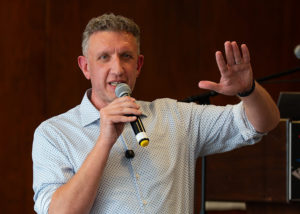
Chuck is a US-based internal communications strategist and the founder of ICology – a community and resource hub for IC professionals. He brings a practitioner lens to every conversation. Chuck is a recognised voice in the industry, a regular speaker and event host, and one of the most connected people in the North American IC world.

Jenni is a UK-based leadership and internal communications consultant, author of two best-selling books, and international speaker. She runs Redefining Communications, a consultancy working with organisations around the world to help them communicate better and close the gap between what leaders say and what employees experience.