
Madison Square Garden told staff their championship rings had arrived. The link led to a mandatory cybersecurity course. Chuck opens with it as a fair answer to a question the rest of the episode keeps circling: why is anyone surprised that trust inside companies is at a record low?
It’s a report-heavy week, and Jenni makes no apology for it. Edelman’s Trust at Work study finds trust in CEOs, managers and co-workers at the lowest point in its data. The Guardian reports on companies quietly walking back their AI rush. G-P’s World at Work survey of 7,100 people finds sky-high confidence alongside widespread job fear. And crisis comms specialist Amanda Coleman asks a question designed to annoy the profession: is PR damaging society?
Before the reports, Chuck asks Jenni whether news of the Madison Square Garden phishing test has reached the UK. It hasn’t. After the Knicks won their first NBA title in more than 50 years, MSG employees received an email announcing their “Employee Championship Ring,” with two designs to choose from and a link to reserve one. The link led to mandatory cybersecurity training instead. MSG Sports later called using the rings as a lure an unfortunate mistake, while standing by the exercise itself.
Chuck’s point is that the company chose this. It took one of the organization’s proudest moments and turned it into a trick, and now even a genuine email about rings is suspect. Jenni says it makes the whole thing trivial, and suggests Chuck start a hall of shame for phishing tests.
Edelman’s Trust at Work 2026 study, covered in Richard Edelman’s blog, surveyed more than 10,000 employees across ten markets. It is separate from the annual Trust Barometer. It records the first statistically significant year-on-year drop in trust in “my employer” since August 2024, with the largest falls in China and Germany. Trust in “my CEO” fell from 70% to 66%, in co-workers from 82% to 73% and in direct managers from 79% to 72%, each a record low in Edelman’s data.
Three in four people (76%) have been through at least one transformation in the past year, most often AI implementation, followed by strategy shifts. One in three say the experience wasn’t positive, and how it’s handled matters a great deal. Trust in the CEO is 82% among people who had a good transformation experience and 49% among those who didn’t, a 33-point gap. For managers, the gap is 25 points. People with a good experience are also far more likely to go above and beyond (83% vs 57%) and to plan a long-term career with the company. Elsewhere, three-quarters of workers fear losing their job, six in ten fear being monitored without consent, and employees feel less trusted by managers, executives and heads of HR.
Jenni asks what internal communicators can do to get trust back. Chuck’s honest answer is that he doesn’t think they can. He points to the job fear numbers, roughly three-quarters of people worried about losing their job, and says nothing good comes from a state of fear. What strikes him most is the co-worker drop: these are the people you chat with every day. People are still giving extra effort and still want to be part of something bigger, but they don’t trust the people they work with.
Jenni links the co-worker drop to the insularity theme in this year’s Trust Barometer, where people trust those who seem different to them less. If the relationship with work has fundamentally changed, she asks, what does moving forward look like? Chuck’s advice is to find out what these numbers are for your organization. Do your employees trust each other? How afraid are they of losing their jobs? He returns to The Gund Company, a manufacturer that has never had a layoff, where employees simply don’t carry that fear. Anywhere that has been through layoffs or reorgs will, especially when people now spend years, not months, looking for the next job.
The Guardian reports on employers dealing with the fallout from adopting AI too fast. Meta scaled back plans to cut staff and lean on AI agents after employees spent more and more time fixing technical and security errors. Having stripped out middle managers in 2023, it is now hiring managers again, and it has told staff that AI usage will no longer count in performance reviews. At Microsoft, an executive vice president admitted using AI to summarize a colleague’s AI-written document and getting nothing new from it. Walmart store and warehouse staff describe AI scheduling and monitoring tools setting impossible standards. Microsoft, McKinsey, Nvidia and others are now restricting employee use over cost and data security. In an Atlanta Fed working paper, around 90% of executives said AI hasn’t yet improved productivity.
Jenni asks what an organization should tell employees when it reverses a decision like this. Chuck says it’s easy: don’t say “we are reversing our decision,” say “we were wrong,” or at least “we didn’t get that right.” Companies got distracted by the shiny object, and now risk a knee-jerk swing the other way. Admitting a mistake quickly beats the sunk cost fallacy. He’s baffled that “token maxing,” rewarding people for burning through AI tokens, was ever a thing, and compares it to encouraging everyone to empty the snack room and then being surprised by the bill.
Jenni agrees, but wants to know how many leadership teams are actually taking time out to rethink their long-term strategy, rather than just agreeing on a narrative to tell employees. Chuck’s view: if a leadership team isn’t having those conversations, that’s literally its job.
G-P’s 2026 World at Work Report draws on 7,100 business leaders and professionals in the US, UK, Australia, France, Germany and Singapore. It finds 91% confident about handling tech innovation over the next year and 80% confident about the wider economy. Meanwhile, 64% of organizations expect to rely more on freelancers, contractors and fractional workers. Other highlights: 72% say working with colleagues in other countries is essential to their job, 35% name AI coworkers as the biggest workplace trend of the next decade, and the top human skills for the next two years are critical thinking (42%), creativity (37%), communication (35%) and leadership (34%). Worth noting: G-P sells employer-of-record and contractor services, so the flexible-workforce angle suits its business.
Jenni asks who internal comms is actually for if the workforce looks like that. Chuck says it’s a topic the industry rarely discusses. Many large companies already rely heavily on contractors, and in his experience rolling out new technology, they almost always get less access than full-time staff, even someone who has been there 20 years. We trust these people inside the business, he says, but keep them out of the tools over a paperwork checkbox. He also points to the report’s finding that 43% of employees already have a second income, and that 62% are actively looking or likely to look for a new job within six months, up from last year. Hiring more contractors won’t fix that fear.
Jenni can’t square the confidence with the fear. If 91% and 80% are confident, why is there so much worry about job security? Chuck notes that executives are far more confident about the economy than rank-and-file employees, and points to a viral video of a Red Baron worker in Michigan, pranked while stocking shelves late at night, telling the prankster he has four kids at home and can’t pay his mortgage. A GoFundMe for him has since raised hundreds of thousands of dollars. Chuck hopes, if nothing else, it earns frontline workers more respect.
In Influence magazine, crisis communications consultant Amanda Coleman asks whether organizations are so focused on reputation and how things look that they’ve lost sight of what matters. Are they “painting the shopfront” when nothing is happening inside, or when what’s happening inside isn’t what they’re painting? She explores the ethics of PR and the risk of communicators being handed only partial truths to share. Jenni connects it to how much budget and attention go to the outside compared with HR and internal comms.
Her question to Chuck: when comms people are handed partial information and asked to share it, where does their responsibility sit? Chuck’s first answer is no, PR isn’t damaging society, we’re doing that ourselves. Then: partial isn’t the same as dishonest. Communicators rarely have the whole picture. Share what you have, be truthful, and be clear that more is coming. He adds a related figure, that 92% of internal comms pros say AI summaries distort tone and intent, and asks whether communicators now need to write knowing their message will be summarized by AI.
Jenni agrees that PR isn’t damaging society, but argues the responsibility sits with communicators to ask questions until they understand the full picture. If leaders aren’t truthful with you, that’s a leadership problem. But too often, she says, internal comms takes what it’s given and sends it out without digging in. Chuck agrees: communicators who really understand how the business works are the ones who can spot the gaps.
Chuck is freq-ing out about ghosts. He felt a hand on his shoulder a couple of times at Jenni’s house in London, and since getting home his dog has barked at nothing in the middle of the night, a switch in his wife’s office has been turned off twice and the dryer stopped and opened by itself. Jenni, who says she can sense these things, insists her house isn’t haunted. Her verdict: something attached itself to Chuck in London and flew home with him. He needs a sage cleanse.
Jenni is freq-ing out about the festive season. Halloween has passed, the fall porch is done, and her weekends are filling up with food and drink plans with friends and family. She loves it, though she worries she hasn’t made enough room for being “festively plump.”
What does Edelman’s Trust at Work 2026 report show? Trust in CEOs, co-workers and direct managers has each fallen to a record low in Edelman’s data, and trust in employers has seen its first statistically significant year-on-year drop since August 2024. How organizations handle transformation, especially AI, makes the biggest difference.
Which relationship at work has lost the most trust? Co-workers. Trust in co-workers fell from 82% to 73%, a bigger drop than for CEOs or managers.
Can internal communicators rebuild trust at work? Chuck doubts trust can be won back to where it was. Jenni and Chuck agree the starting point is finding out what trust and job fear look like inside your own organization, rather than relying on global numbers.
What should a company tell employees when it reverses an AI decision? Chuck’s answer is to say plainly that you didn’t get it right and set out the path forward. Jenni adds that leaders need to rethink the strategy itself, not just agree on a new narrative.
Who is internal comms for if companies rely more on contractors? The hosts argue it should be for whoever does the work. Contractors and freelancers often lack access to the tools and information full-time staff get, even after years in the business.
Is it dishonest for communicators to share partial information? Not necessarily. Chuck says partial is fine if it’s truthful and people know more is coming. Jenni says communicators still have a responsibility to ask questions until they understand the full picture.
Chuck: Welcome to Frequency. I’m Chuck Gose.
Jenni: And I’m Jenni Field. Frequency is your go-to for real talk about comms, culture and employee experience, beyond the buzzwords and straight to what matters. And this week, because it’s me, I’ve got some reports for us to discuss.
Chuck: You do love your reports.
Jenni: I do, I can’t help it, just can’t help it. One is looking at Trust at Work and one is looking more broadly at the world of work. We’ve also got some insights into companies pulling back on AI, and a question that is definitely going to annoy some of the comms folk, which is: is PR damaging society? But that’s what I’ve got this week.
Chuck: Before we get into that subject, I’m curious about this news item. Did it reach over there, about the Madison Square Garden phishing scheme that they pulled on employees? Have you heard about this over there?
Jenni: No, I don’t think… no, I haven’t.
Chuck: Okay, so we’ve all heard of these, you know, IT companies or IT departments sending out phishing emails to try to test employees and test their knowledge. I think we’ve now reached a new low of companies doing this. So Madison Square Garden, who the New York Knicks are a part of, this is what they did. Madison Square Garden sent employees a phishing email test that said, quote, “Congratulations, your employee championship ring is here.” Calling back to the Knicks winning the NBA title. The employees were shown two ring designs to select from, with instructions to click a link. Instead of going to an order form or selection page, the link sent employees to a mandatory cybersecurity class that they then had to take.
Now, they’ve later come back and said using the championship rings in the simulated attack was a mistake, but they still stand by sending the message. We want to know why trust is at an all-time low inside companies. Who in their right mind… I get that they now realize it was a mistake, but they chose this path. They chose this mistake. I think this is like the hall of shame now for phishing emails.
Jenni: I think you should have a hall of shame now. I think you need to go and find all the phishing emails out there so you can have, like, your top five or your top 10. Because that is, yeah.
Chuck: Like, you’re going to take one of your organization’s highest, proudest moments and now sink it to this. Now the company’s come back and said, we’re going to give employees rings anyway. Well, how are they going to trust any email now? Like, what if this is now the official email that goes out? Now what are they supposed to do, click the link?
Jenni: Yeah. And you’ve made it trivial and meaningless now. You’ve taken away the value that that had. Oh dear. Oh dear. Well.
Chuck: You have. Yeah. Anyway, we’ve got a new one. Let’s get into the content for this week, Jenni.
Jenni: So we’re starting with the Trust at Work report. This is a report from Edelman, which I’ve read, and also Richard Edelman’s blog on it. And there are just a few points that are worth bringing to the conversation. This is a separate report to the Trust Barometer that Edelman do. It’s a specific report about trust at work. There’s lots of data in here. The headline summary is really around organisational transformation being done well, and that making all the difference to trust at work. But it’s also showing a bit of a shift in terms of how we feel about work, which has always been OK in the broader Trust Barometer.
So I’ve got, as we always like to have, some bulleted figures for us to talk about. I will start with the first statistically significant year-to-year drop in trust in “my employer” since August 2024. There are large declines in China and Germany. Workplace relationships are splintering. In the same time period, trust in “my CEO” has declined from 70% to 66%. In “my co-workers” it’s a decline from 82% to 73%. In “my direct manager” it’s from 79% to 72%. They are each a record low in the Edelman data series.
The workplace is in flux, with 76% of respondents saying they have experienced at least one transformation in the past 12 months. The most prevalent transformation that employees experienced is implementation of AI, followed by strategy shifts. The transformation is justified by tangible outcomes such as company competitiveness and survival, not by improved shareholder value or political headwinds. And they’re saying in the report that it must be presented as an opportunity for productivity and wellbeing, not a disruption or AI revolution.
The report goes on: not everyone is being brought along. One in three report that their overall transformation experience was not positive. This is more evident in developed markets such as Germany, Canada, Japan and the UK. Job loss fears have escalated, with three-quarters of workers fearing unemployment due to tariffs, automation, offshoring. There’s a 21-plus-point gap between what employees expect for compensation and internal mobility versus what employers actually deliver. Six in ten employees fear that they are being monitored by their employer without their consent. We’ve talked about that a lot on the podcast. Over the past two years, employees feel less trusted by leaders, with significant declines in feeling trusted by managers, executive management and heads of HR.
The poor transformation experience takes its toll on trust in leadership. There’s a 33-point drop in trust in “my CEO.” That’s from 82% amongst those who had a positive experience all the way down to 49% for those who had a negative experience. And there’s a 25-point drop in trust in “my manager,” which is 85% to 60%. Those with a negative transformation experience are two times less likely than those with a positive experience to embrace increased AI use in the workplace. And by contrast, with positive transformation experiences, employees will go above what’s expected to help the company succeed. That’s a 26-point increase in effort, from 57% among those who had a negative experience to 83% among those who’ve had a positive experience. And they’re committed to a long-term career at the company as well.
So the report goes on… I’m not going to read any more stats, because I know that you love it when I get reporty. But the report goes on to say that businesses have really been on a great run in terms of being the most trusted institution, but transformation is really this hinge point in trust. If the transformation goes poorly, it will go back to all the bad things once assumed about business: profits over people, employees are just numbers, all that sort of stuff. So that’s why at the moment this feels really crucial, because the business leadership challenge is the thing that everyone’s talking about at the moment.
So my question, whilst there’s a lot in this report, is: as trust at work declines across the globe, Chuck, what is the role of the internal communicator to try and get it back?
Chuck: Yeah, I don’t think we can. I don’t think we can get it back. I’m just wondering if this is just truly how things are. And there’s some other data that points to it. Not saying it’s quite a lost cause, but is it close to it? Where you’ve got 77% of people who fear losing their job. Eight out of ten employees fear losing their job. Nothing good comes out of a state of fear.
Then you’ve got another data point. We know about trust in leadership. We know about all those things being on the decline. The other data point was that the biggest drop was actually trust in your co-workers. And this is who you banter with, this is who you water-cooler with, this is who you’re chatting with on a day-to-day basis. That dropped from 82% to 73%. That’s still high, but there’s another drop to it.
And I think the sad part about all this is when you look at the data points, when it talks about the extra effort people give after a good transformation versus a bad transformation, people are still giving extra effort. They still want to be a part of something bigger. They still want to work hard, but yet they don’t trust the people that they work with. It’s a really sad state right now.
Jenni: Yeah, and it’s interesting, because I remember the Trust Barometer, the bigger Trust Barometer, talking about insularity, and this peer-to-peer piece in terms of your co-worker, which is: if I don’t feel that you have the same values as me, or I feel like you’re different to me, then I trust you less. And I feel like that’s what’s really playing out here. I think your point about “I don’t know that we can get it back”… is it a case, then, rather than thinking how do we get it back, of: what’s the answer to move forward if the relationships with work are now significantly different? Like, how do we do that? What do we need to do to move forwards?
Chuck: I think you need to find out what these numbers are for your organization. I think you have to find out: do your own employees trust each other? How much are they in fear of losing their job? Again, every company is going to operate a bit differently. We talked about The Gund Company last time, which I’ll make sure I pronounce the D, the D at the end. Gund Company. I guarantee those employees don’t fear losing their job, because the company’s never said anything to them about layoffs. They’ve never experienced layoffs. They don’t have that fear.
Any organization that’s gone through layoffs, redundancies, re-orgs, whatever fancy word you want to call it, that fear is going to be there, because there’s also rarely a safety net. And you hear about people now being out of jobs not weeks or months, but years. So this fear is not just losing the job, but then this fear continues to: am I ever going to get another job? So it’s important to look at what this looks like at your organization. These are broad numbers. How does it look, feel, smell at your company?
Jenni: Very good advice. Right, my next story is from The Guardian newspaper here in the UK, which is about companies rushing in on AI and now pulling back. So employers are dealing with the fallout from adopting AI too fast. Meta scaled back plans to cut staff and lean on AI agents after finding employees spent more and more time fixing technical and security errors. Having stripped out middle managers in 2023, it is now hiring managers again. It’s also told staff that AI usage will no longer count in performance reviews.
At Microsoft, an executive vice president admitted using his own AI to summarise a colleague’s AI-written document and getting nothing new from it. And he warns of an “ocean of sameness.” Walmart store and warehouse staff are describing AI scheduling and monitoring tools setting impossible standards, so people cut corners to keep up. Microsoft, McKinsey, Nvidia and others are now restricting employee use over cost and data security. Lots of change, lots of pulling back. So the returns, they’re saying, haven’t arrived. 90% of executives in an Atlanta Fed working paper said AI hasn’t yet improved productivity. Microsoft’s own transformation chief concedes that access and usage do not equal transformation.
So my question, Chuck, is: Meta has taken AI usage out of performance reviews after pushing hard on adoption. They won’t be alone here. So when an organisation reverses these sorts of decisions, what should it tell employees?
Chuck: This is really easy. They should not say “we are reversing our decision.” What they need to say is “we were wrong.” We have all gotten distracted by the shiny object syndrome. We talk about how cool things are and you get distracted by it. We kept hearing all these things about AI, and I think in our gut we knew: is it going too fast? Are people making too-big decisions too early into all this?
And yet here they are again, making what maybe is the right decision, but a knee-jerk decision to reverse. I guarantee they’re not going to say “we made a mistake,” though I would applaud any leader who says that. But even this, they’re not sticking with for very long. Not even a year, probably six months for some of these companies. Again, it’s better to admit you’re wrong more quickly than to do this whole sunken cost fallacy. So I don’t want to penalize that. But here again, it’s now the opposite of the shiny object syndrome. Now we’re just going back to the way things were, which maybe is the right way.
I just want companies to admit: hey, we didn’t get that right. Maybe they don’t want to say “we were wrong.” They could say “we didn’t get that right at the time, and here’s now the path forward. We’re actually going to stick to what we know is right.” And that’s going to feel good for those employees, because they know what is right.
And we saw those weird incentives that were even out there for employees, like the token maxing. I was thinking about that word. I don’t think I’ve ever maxed anything before. But token maxing, the fact that that was even a thing, where they’re incentivized to burn. Then they realize, like, oh my gosh, this costs money, wait a minute. That’s like if I’m always running and grabbing all the snacks from the snack room. Wait a minute, we’ve got to refill those snacks. We have to be encouraged to use it the right way. So you can reverse, just admit that you weren’t right. You made a calculation error. You made a judgment error. You made an emotional error. And just do the right thing for the business. It’s actually really simple. It’s really, really simple.
Jenni: Okay. I do wonder how many of the leadership teams are getting together to talk about that long-term strategy, or having that strategy conversation about what we’re trying to do. Because I agree with you on the “we didn’t get this quite right, we’re having to reset.” But how many of them are taking the time out of the organisation to make that plan, have that conversation? Because that’s the bit for me that you need to do. Not just to agree the narrative and how you’re going to tell employees, but actually to kind of go: God, you know, we ran off with the shiny thing, now we need to take stock, think about it, what are we doing, and then come back out. How many of them are actually going to take stock and do that? I don’t know.
Chuck: Yeah, if you’re a leadership team and you’re not having those conversations, what are you doing? What are you talking about? Because that’s what you owe back to the business. That is where we need leaders to step up and have those big, high-level strategy conversations. That’s literally your job.
Jenni: Yeah, yeah, totally. Totally. Right, I’m going to take us on to the next story now, which is the World at Work report, which I found. This report covers 7,100, to be specific, business leaders and professionals across six markets: the US, UK, Australia, France, Germany and Singapore. And it says in the article that “this study uncovers a workforce united by rapid technological transformation and the dismantling of century-old work conventions.” So I’m immediately in for this report. I was very excited.
There are five highlights from it that I want to bring here. The first is high confidence amid technological shift: 91% are confident their organisation can handle tech innovation over the next 12 months, and 80% are confident it can handle the wider economic conditions. The second point is the on-demand talent explosion: 64% of organisations expect to rely more on freelancers, contractors and fractional workers over the coming year. The third point is the borderlands of collaboration: 72% of professionals say working with colleagues in other countries is essential or critical to doing their job day to day. The fourth point is the rise of AI co-workers: 35% name AI teammates as the single biggest workplace trend of the next 10 years. The fifth point (can’t count today) is human centricity in an automated age. The most essential human skills for the next two years are critical thinking at 42%, creativity at 37%, communication at 35% and leadership at 34%.
So my question, Chuck, is: if 64% of organisations are going to rely more on freelancers, contractors and fractional workers, who is internal comms actually for?
Chuck: I think this is a really interesting topic to talk about, because it’s something that I don’t think gets discussed much in industry conversations. This data point of 64% are going to rely more… there are a lot of enterprise companies who rely a lot right now on contractors especially. It is a very common thing, and it is always a bit of a rub. It is always a bit of a challenge for internal communicators, because often, and I understand at times the reason why, contractors do not have the same access to tools that a full-time employee does.
As I have helped companies over the years implement new technology, it’s always been this: “Well, we have this group of people over here, and they’re not full-time employees.” But this guy’s been here for 20 years, and he’s a contractor, but he doesn’t have the same access. This has always been a challenge inside the workplace. We trust these people to be inside our house, inside the business, but we don’t give them the same access because of some paperwork checkbox. We don’t want to pay them benefits. I’ve never quite understood that reason. I guess employment law and all that kind of stuff comes into play.
But I think the more interesting data point here: I would like to know how many of your own employees are currently also freelancing or contracting to do some other work. Because it talked about how 43% of employees have a second income source already. That might not be the same type of work they’re doing for your company, but they are doing other things outside of your company to make money.
And then going to another data point, which leans into a previous one we talked about. This is what I love about this podcast, Jenni. We get to connect all these reports. We talked about 77% fear losing their job. Right now in this data, 62% of employees are actively looking or likely to look within six months. Two-thirds of your employees… four-fifths are scared, two-thirds are actively looking to leave, and that is up from last year. I assume the fear is also up. So what can you do to eliminate that fear? It’s not hiring more contractors and freelancers. That’s a separate conversation. Is it a bit of the gig-working mentality that companies now have, where we don’t need a full-time employee to do something, we actually just need this person for this little bit? Again, nothing wrong with hiring freelancers, nothing wrong with hiring contractors, but they just don’t have the same access. That is what should be changed.
Jenni: Yeah, and I think this whole report just paints a picture of so much unknown for me. But what I find really interesting in here is the confidence in the tech innovation. This report is saying that 91% of people are confident that their organisation can handle tech innovation over the next 12 months, and that also 80% are confident it can handle the wider economic conditions. But at the same time, we’ve got all of this fear and stuff going on around their jobs, the security, what’s going to happen. For me, those two things don’t really add up. If 91% and 80% of people are confident, then why is there so much fear, if that confidence is there? That’s the bit for me that I can’t balance out in this.
Chuck: Well, I think they might be confident in that, but what we learn in this report is they’re not confident about the economy in general. Executives have almost double the confidence of rank-and-file employees. And there’s a story that I saw here recently about a frozen delivery driver inside a store, stocking shelves, and these stupid TikTok influencer people were pulling a prank on him while he was working, pretending they used Apple Pay to steal money from his phone, that kind of thing. And this guy was very friendly until he realized what was going on. I’ll send you the video so you can watch it.
This employee’s just trying to do his job, while these kids (I’m going to label them, I don’t know what their ages are, but they’re kids to me) are pulling some prank on him. He doesn’t have time for it. He’s talking about how he’s working late and he’s got four kids at home and he can’t pay his mortgage. And you know, here he is doing the work. This is really hard work. And these kids, these TikTokers (I sound very old talking like this, I recognize that) are kind of harassing him while he’s just trying to do his job under immense stress, under immense pressure. So this is where some of that fear comes from. Employees do not feel secure. They do not feel safe.
Jenni: Yeah, send me the video, because it just sounds horrible.
Chuck: It really is. I feel really bad for that employee, because now he’s being spotlighted. Now, because not everybody is a jerk out there, there’s been a GoFundMe started to support this guy, which has raised tens of thousands of dollars, if not even more now, from the report that I saw. It’s sad that we have to do that, but that’s what GoFundMe is for. So there is a little bit of good for this individual. If anything, I hope it just has people respect those frontline employees more, the people that are doing the hard labor, the hard work, with all this additional pressure at home. That’s what I hope, if anything good comes from this.
Jenni: Yeah. So, talking of society and how broken it is, the final report or article is from Amanda Coleman, who’s a crisis and internal communications expert. She wrote a piece for Influence magazine with the title “Is PR Damaging Society?” And her question is really this. She says in the article: “Are businesses and organisations so concerned with their reputation and how things look that they are losing sight of what is important? Are they putting a focus on painting the shopfront when actually they are forgetting there is nothing going on inside, or worse, what is going on inside is not as they are painting it?”
Now, in the article she talks about the ethical side of PR, the dangers of only being shared partial truths as a comms function, and how you navigate that when you’re meant to be sharing the truth with the different stakeholder groups that you serve. Which has got me thinking about the focus on the outside and the lack of focus on the inside for HR and internal comms teams, in terms of budget, resource, focus, all that sort of stuff. So my question, Chuck, is: when comms people are handed partial information and asked to share it, where does their responsibility sit, in terms of truth, ethics and all of those things?
Chuck: Yeah, I want to first answer the question: is PR damaging society? No. We’re doing that ourselves. Not you and me. We own a collective responsibility for damaging society. Again, we can’t blame PR for this.
Jenni: Okay, okay, good.
Chuck: However, to me, partial is not the same as dishonest. There are times where you don’t have the whole picture. So you share what you do have. And as long as you let people know this isn’t the complete picture, there is more to come, I believe people do understand that. So as long as what you’re sharing is truthful, then you shouldn’t have any issues with it. To me, that’s the skill. There’s always more to come, and that is okay. I think that’s what a lot of internal comms people deal with on a daily basis. We don’t often get the whole picture. As long as we don’t paint it to say it is, then I think we’re fine.
The other data point that is worth mentioning is that, I think it said, 92% of internal comms pros say AI summaries distort tone and intent. Of course they do. Of course they do. They’re AI summaries. That’s just how it’s going to be. Now, we’ve talked about this inside ICology. Do we need to start writing knowing that there are going to be AI summaries? Knowing that these things are going to happen, I think there’s an element for us to think about. I’m not saying I know the answer to it. But it’s happening, and we don’t like that it’s happening, but guess what? It’s still happening. We’re not going to stop that.
Jenni: Yeah. Yeah, fair. I do think there is something in terms of that responsibility of internal comms to ask the right questions to get to the truth. So if you do feel like you’re only being given partial truth, or you don’t feel like you’ve got the whole picture, or you don’t understand that whole picture, for me the responsibility sits with you to ask the questions to get the picture that you need, right? If people aren’t going to be truthful with you, then that’s a different issue entirely. And if you’re then communicating something that you believe to be truthful but isn’t, then that’s not your fault, right? That’s just a byproduct of poor leadership, essentially.
But I do think we have a responsibility to ask the right questions. I do feel that sometimes internal comms folks can just take something as “this is fine, I’ll just go and communicate this” without really digging in a little bit. And I’d like to see more people doing that, more people asking more questions. Back to my rant on LinkedIn. It wasn’t a rant, it was a post on LinkedIn, about: what do we actually want people to do? Why aren’t we talking about that? Why do we keep talking about the thing and not the thing? And I think it’s because we don’t ask enough questions, and I think this plays into that.
And I will support your response in terms of “is PR damaging society?” No. But I like the provocative question. I mean, I always like a provocative question. But I think the point about focusing on your reputation and not the reality could end up quite damaging if you do that continually and the two don’t join up. I think that is just a little flag for people to maybe consider.
Chuck: Yeah, I like seeing when internal communicators specifically (because obviously those are my people) really dig into the business, really understand the mechanics of how their company operates. That’s when you know you don’t have a complete picture. That’s when you know you don’t have the full news. If you don’t understand the bigger picture, you might think what you’ve got is the complete thing. But when you do understand all of that, you can find those gaps. And it could be laziness, or just someone not following through, or they didn’t think that that was necessary. When you understand the business, you can ask those detailed questions.
Jenni: Yeah, yeah, 100%, 100%. Well, that is the end of our articles this week. We got through some reports. Thank you for indulging me. What are you freq-ing out about this week?
Chuck: So I’m freq-ing out about ghosts, Jenni. Like G-H-O-S-T-S, ghosts. So here, ’tis the season. I know when people listen to this, it’s after Halloween. However, I mentioned to you when I was in London a couple of weeks back, a month ago (man, what is time?), I asked you if your house was haunted.
Jenni: You did.
Chuck: And you said you weren’t aware of it. And I’m like, okay, because I felt a hand on my shoulder a couple of times in your house, but I’m like, okay, whatever. Not a harmful hand, not anything like that. Just the feeling of it.
Jenni: Nope.
Chuck: We’ve now had several instances in our home within the last week that are very odd, very peculiar. Which included our dog barking at midnight, in the middle of the night, at something, which he has never done in the time that we’ve had Alan. Four quick barks. Not a growl, just barks like he does when someone comes in the house. Twice, my wife’s office… she’s got things plugged in off a switch, which she knows to leave on. That’s been turned off twice at night. And then the other day, our dryer just stopped and the door opened on its own. So it’s been more of an annoyance than a fear. But I think we’ve got some spirits around us.
Jenni: Well, I think you do. So I remember when you said to me, “Is your house haunted?” And I said, “I don’t think so.” And for those listening who don’t know, I feel like I can sense these things, and I know when there’s something like that in the house. So I was like, no, I haven’t sensed it and I’m not aware of it. And I said to you then, maybe something has attached itself to you, and it’s not actually in this house. And I feel like you flew it home. You flew it home and it’s come with you, because it’s definitely not here. You need to do a sage cleanse in the house and let it go. Let it go.
Chuck: Right. Like a ghost hitchhiker. We have some guesses. We have some guesses as to the spirit. We’re not going to publicly talk about that here, but we’re seeing how this plays out. Again, not out of fear. We’re not afraid of what’s here, but something is here.
Jenni: Okay. Something is here, and you picked it up in London. My freq-out is a little bit festive as well. So you’re right, as people are listening to this, Halloween has just passed, which I get very excited about. And I’ve done an autumn porch this year, which I’m thrilled about, with lots of pumpkins and things. But my freq-out is really just that it’s getting into that festive fun season, which I love. I feel like my diary at weekends is full of food- and drink-related activities with friends and family, and I just love it. I’m just freq-ing out about the fact that I probably haven’t lost enough weight to make room for the festivities that will make me festively plump, which is coming. But I’m very excited about all the festive fun that is around the corner. This is the season. This is the season.
So that’s us for this week. Thank you for joining us. We hope that the articles will help you think about how to improve comms, leadership and culture in your organisation. If you don’t yet subscribe or follow, please do, as it helps make sure you won’t miss an episode. And you can grab links to all the stories we’ve talked about on our website, thefrequencypodcast.com, where you can find details about every episode we have done as well. We will be back with you on Monday with more news, insights and opinions about everything comms and leadership in workplaces today. So thank you for spending part of your week with us.
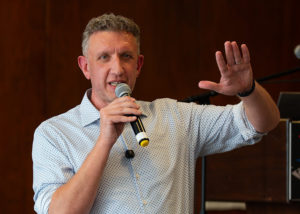
Chuck is a US-based internal communications strategist and the founder of ICology – a community and resource hub for IC professionals. He brings a practitioner lens to every conversation. Chuck is a recognised voice in the industry, a regular speaker and event host, and one of the most connected people in the North American IC world.

Jenni is a UK-based leadership and internal communications consultant, author of two best-selling books, and international speaker. She runs Redefining Communications, a consultancy working with organisations around the world to help them communicate better and close the gap between what leaders say and what employees experience.