
Seventy-eight percent of employees start a new role motivated. Sixteen percent say the work always feels meaningful. Everything in between is what this episode is about. Chuck brings four stories — the Predictive Index’s motivation report and its inconvenient finding that clarity of priorities beats recognition, autonomy and fewer meetings; Simon Cavendish’s argument that internal comms has grown addicted to alignment; four tech companies quietly abandoning AI adoption as a metric; and Rebecca Hinds on the narrative leaders encode before a rollout begins. Jenni opens on the fake urgency people invent to fill the space where priorities should be, and Chuck picks the one fight of the episode, refusing to accept that 97% adoption of anything means nothing.
Chuck’s first story is the Predictive Index’s Running on Empty motivation report, a survey of more than 1,000 US employees in 2026: 78% started their current role motivated, only 16% say their work always feels meaningful, clarity of priorities ranks as the number one thing that would improve motivation ahead of recognition, fewer meetings and autonomy, and only 35% say their priorities are actually clear on a typical workday. He layers in Gallup’s nine-point drop in clarity of expectations since 2020 — the largest decline of any engagement factor — and the finding that just 10% call their one-on-ones always productive, then does the thing the report does not, flagging that the Predictive Index sells a behavioral assessment tool and that every finding conveniently points at buying one. Separate the data from the sales pitch. Jenni’s answer to where motivation breaks is the report’s own line, that occasional meaning produces occasional motivation and consistent meaning is what keeps people engaged: organizations say it once, get bored of the story, and the direction shifts underneath it. She also wants the definition interrogated — what does an unmotivated employee actually look like — and notes the report’s admission that the problem has been building for years, which makes it no surprise to anyone paying attention. Chuck’s contribution is that clarity is the cheap fix, provided leaders hold a priority steady rather than replacing it weekly, and Jenni adds the individual half: sit down at the start of the week, name the three things, and if you can’t, that is the conversation to have with your manager.
The second story is Simon Cavendish’s LinkedIn provocation, written by the chair of IABC EMENA, arguing that internal comms has become addicted to alignment even when alignment is the wrong goal, that the profession’s identity as the conscience of the organization has softened into a way to stay nice rather than necessary, and that too many IC teams produce beautifully crafted messages for fundamentally bad decisions. Cavendish separates diplomacy from deference, says the profession is conflating them, and delivers the line both hosts adopt: being in the room isn’t the win, what we do in the room is the win. Jenni agrees, and enjoys that the piece is itself a beautifully crafted message for a good decision. Her diagnosis is professional development — without the work that builds enough belief in your own judgment to have a hard conversation, you get there, say nothing, and call it access. She also draws the boundary at scope creep, citing her own irritation at a professional body asking internal communicators to own how sick employees are looked after. Chuck ties it directly to the previous episode’s CEO discussion: access to leadership is a privilege, and nodding along inside it makes you complicit. His formulation is the one worth keeping — necessary, not nice — and Jenni’s closing point is that a communicator who wants the advisory seat does not have the luxury of niceness, because that is a leadership position and leadership means making the hard calls.
Charter’s Brian Elliott convened practitioners from Atlassian, Zapier, Udemy and others for a closed-door forum on AI measurement, and the write-up reports that the companies furthest along are quietly abandoning adoption as a metric. Microsoft’s version of the shift is that they used to pay attention to adoption and now pay attention to performance; Zapier’s chief people officer is blunter, saying 97% adoption rates mean almost nothing. Atlassian’s Ben Ostrowski notes most of the time saved was reinvested into admin work or correcting AI outputs, and ActivTrak found time on email, messaging and admin tools more than doubled among AI users while focused, uninterrupted work fell 9%. Jenni maps it straight onto every digital transformation she and Chuck have run, where adoption and engagement were the metrics and teams stopped at adoption: the question is always so what, to what end, and with AI most organizations cannot answer it because nobody set the business outcome before the rollout. Chuck takes the other side, and it is the sharpest disagreement of the episode. Ninety-seven percent adoption of anything is enormous, the metric is easy to abandon when you are the organization failing to hit it, and adoption remains a strong signal of interest — the real question is what it signals and whether it is quietly pushing people into the wrong work. Jenni half-concedes, keeping adoption as a short-term measure and insisting the business outcome gets defined first. Chuck also awards Brian Elliott provisional membership of a Frequency five-timers club, closing on Nick Bloom.
The closing story is Rebecca Hinds in Inc., arguing the real blocker to AI transformation is not the tools but the narrative leaders encode into the culture before rollout: tell employees their jobs will be replaced and they become passive recipients, tell early-career staff they are obsolete and they chase certifications instead of depth. Hinds and Bob Sutton’s AI Transformation 100 research supplies the harder finding — deploy AI in ways that strip craft and human touch from work and what remains is a hollow shell with little meaning — which Chuck notes makes this the same crisis as the motivation report. Jenni returns to her earlier claim that an AI change program is like any other change program, and the evidence she offers is that rollouts keep failing the same way, leading with features nobody can connect to their job, exactly as enterprise social networks did. She lands on the article’s sharpest idea, that beliefs calcify into labels and a label often inflicts more damage than the condition it described. Chuck says plainly that he told her she was wrong then and still thinks so: this is not a run-of-the-mill change campaign, because AI reaches people who never opt in. His distinction is between benefiting from AI and using it — his wife’s fundraising software produced a finished report overnight without being asked — and the education most organizations skip is explaining that difference. Jenni’s addition is the ethical layer, from new AI ethics guidance she has been reading for CIPR Inside members: disclosure of what was AI-assisted, and a human check that has to stay in the process. She also notes the unasked-for report is precisely what frightens people, because it takes away control.
Why do employees lose motivation after starting a new job? The Predictive Index found 78% start motivated and only 16% say the work always feels meaningful. Jenni’s explanation is consistency: occasional meaning produces occasional motivation. Organizations tell the story once, get bored of repeating it, and the direction shifts underneath — so the sense of purpose that people arrive with is never renewed.
What do employees say would most improve their motivation? Clarity of priorities, ranked number one — ahead of recognition, fewer meetings and more autonomy. Only 35% of employees say their priorities are actually clear on a typical workday, and Gallup has recorded a nine-point drop in clarity of expectations since 2020, the largest decline of any engagement factor it tracks.
Has internal communication become too comfortable? Simon Cavendish’s argument is that it has: the profession is addicted to alignment, conflates diplomacy with deference, and produces beautifully crafted messages for fundamentally bad decisions. Chuck and Jenni both agree, with Jenni tying it to professional development — the confidence to challenge has to be built before the moment arrives.
Is AI adoption a good metric? The companies in Charter’s forum say no, and are switching to performance. Zapier’s chief people officer says 97% adoption rates mean almost nothing. Chuck disagrees — 97% adoption of anything is a huge signal, and dropping the metric is convenient for organizations that never achieved it. Jenni’s compromise is to treat adoption as a short-term measure and define the business outcome first.
Does AI actually save employees time? Not reliably, on this evidence. Atlassian’s Ben Ostrowski says most of the time saved was reinvested into admin work or correcting AI outputs, and ActivTrak found time on email, messaging and admin tools more than doubled among AI users while focused, uninterrupted work fell by 9%.
What is the biggest threat to an AI strategy? Rebecca Hinds argues it is the narrative leaders set before rollout, not the technology. Tell people they will be replaced and they disengage; deploy AI in ways that strip craft and human touch and, in Bob Sutton’s research, what is left is a hollow shell with little meaning. That makes the framing an internal comms job, not a product launch.
Jenni: Welcome to Frequency, I’m Jenni Field.
Chuck: And I’m Chuck Gose. Frequency is your go-to for real talk about comms, culture and employee experience, beyond the buzzwords and straight to what matters. Jenni, this week we’re going to be talking about employees running on empty, a big choice facing internal comms, and then a couple of AI stories — one about how some now believe adoption is the wrong metric, and what the biggest threat to AI strategy is.
Jenni: I’m excited about the running on empty thing, because I keep seeing this quote on my Instagram this week. It’s come up on like seven different people’s stories, of people that I follow, which basically says I’ve just found my people on Instagram. But it was this quote which says, the fake urgency created in corporate life for absolutely no reason is one of the worst things humans have invented. And I have just enjoyed it immensely. When we talk about running on empty and stuff like that, it just got me thinking, why do we have this urgency? Even talking to clients today, I was like, we don’t need to rush. What’s the rush? What’s the hurry? So I feel like we’re all feeling that fake urgency in organisations at the moment. I don’t know if you feel any fake urgency.
Chuck: Or maybe it’s just real urgency, Jenni, and people need to be more urgent about things, about how they move through their life, and not just operate on their own time. There’s this guy on TikTok I saw talking about how he feels like in airports there’s this group of people that have no sense of urgency — they’re just sort of lollygagging around and taking their time, not realizing there are lines of people behind them. Fake or not, there is some value to some urgency.
Jenni: Yes. I think that’s just being a bit aware of your surroundings rather than urgency. But I love that you can always bring it back to a frustration at an airport. I feel like we haven’t had that from you for a while. It’s been building. Go on, kick us off this week with the first article.
Chuck: Yes. The Predictive Index surveyed more than 1,000 US employees in 2026 and found that 78% started their current role motivated, but only 16% say their work always feels meaningful. The rest experience meaning intermittently, or rarely at all. Clarity of priorities ranked as the number one thing employees say would improve their motivation, ahead of recognition, fewer meetings and more autonomy. Yet only 35% of employees say their priorities are actually clear on a typical workday. Gallup reported the largest decline in clarity of expectations of any engagement factor since 2020, which is a nine-point drop. Meanwhile, just 10% of employees say their one-on-ones with their managers are always productive. The most direct channel between leadership intent and employee experience is underperforming, and most organizations appear to be hoping that engagement programs will paper over it. Worth noting that the Predictive Index makes a behavioral assessment tool, and every finding in this report conveniently points to buying one. The insight that generic engagement strategies miss the people they’re designed for is legitimate, but the prescription from them is about as self-serving as it gets. We need to make sure we’re separating the data from the sales pitch. But Jenni, getting back to the report — it says 78% of people arrive motivated and then something in the organization erodes it. If that’s true, what do you think that specific moment or mechanism is, where it breaks down?
Jenni: So I really loved the data in the report. I less liked the sales pitch on them, but I think we’ve all been guilty of probably a bit of that. There was a line in the report that I really liked, which I think answers this question about where it breaks down. It said, occasional meaning produces occasional motivation. Consistent meaning is what keeps people engaged. And that’s the bit for me that I think is where it breaks down. There’s this sort of, say it once and then everybody should just carry on and know what they’re doing and keep going — which just isn’t real life. Organisations change, things happen, they change direction, things shift, and we almost get bored of telling that story. I think that lack of consistency of message is what’s driving this sort of lack of motivation for people. I also think there is a question about how we’re identifying motivation. When we say that, what does that show up like? What does that mean? What does that look like? Is it just that I want to sit on my sofa and watch Netflix all day and I can’t be bothered to show up to work? Or is it that I don’t want to do this particular work because I don’t like this? I think that’s quite broad and I would love to get more into that data. But there’s another line in the report where it says, this problem has been building for years. And that for me is the bigger issue here. This isn’t a surprise. We’ve talked about so many things on this podcast over the last year or so that track with this. And if it is a surprise, then people have been living under a rock. So I think it breaks down because of that lack of consistent messaging, that inability to really tell that story through an organisation, and the fact that people feel their managers don’t really care about them. I think that’s a huge one as well.
Chuck: I think it’s also worth calling out the danger of words like always and never. For someone to say my one-on-one meetings are always the best — they’re not. That’s an unrealistic expectation. The fascinating data point to me is the one I called out about clarity of priorities. That ranked as the number one thing employees say would improve their motivation, ahead of autonomy, fewer meetings, recognition, those kinds of things. That’s a relatively easy fix from a leadership standpoint. Just give people what they should focus on. The other part of this, which asks what ownership individuals have in it, is that it shows we have such high hopes and expectations when we start a new opportunity. Oh, it’s going to be different. Oh, it’s going to be better. And it turns out it’s just as crappy as everywhere else. It’s not any better. So, companies out there, just give your employees the focus. Give them the priorities. Let them know what they need to focus on. That sounds like where the motivation fits. Now, the interesting part is I would love to know, once that happens, is that the cure-all? Or does it become, okay, that’s in place, now we need fewer meetings, now I need more autonomy? Where does the need stop? But just focusing on priorities — if organizations can focus and settle on them, and not say this day this is the priority but next week is a different priority and next month is a different priority, that’s, I think, the frustration a lot of employees have.
Jenni: Yeah. And just to bring this into the average employee’s day to day, because I think there is some agency here that people can have over this. It’s not about waiting for the organisation to decide. If you sit down at the beginning of your week and think, right, what are the three big things I have to do this week — and if you don’t know that, that’s a conversation with your manager. But having that time to think about what are the things I need to do. And it’s easy not to do that, right? I can easily not do that. I shared on here a few weeks ago about my 1% diary that I bought, because I needed some help with what am I doing. I think it’s important to recognise that we can have a bit of control over this, in terms of what is it that I actually need to do today, this week, this month. I think we can all do a bit more of making time for that. If we don’t know, then talk to the managers. But that clarity, I think, with a bit of pause and stop, and this fake urgency going away, would probably help a little bit.
Chuck: Next up, we’re going to talk about a choice facing internal comms around leading or following. Simon Cavendish, chair of IABC EMENA and a senior IC consultant, published a bit of a provocative post on LinkedIn, and it centers around this: internal comms has become addicted to alignment, even when alignment is the wrong goal. The argument is that the profession’s identity as, quote unquote, the conscience of the organization has morphed into something safer and more comfortable than it sounds — a way to stay nice instead of necessary. One line in there is blunt: too many IC teams end up producing beautifully crafted messages for fundamentally bad decisions. Simon distinguishes between diplomacy and deference and says the profession is conflating the two. The goal of maintaining access to leadership, he argues, has become more important than actually using that access to push back. Being in the room isn’t the win. What we do in the room is the win. That’s the quote. He says the future of internal comms belongs to challengers, not caretakers, and that IC teams which operate as internal agencies are setting themselves up to be optional. This isn’t necessarily a new argument in IC circles, but I think Simon has made it a bit more bluntly than most have. My question to you, Jenni, is very simple: agree or disagree with Simon’s take?
Jenni: So I agree with Simon’s take, because I loved the way he wrote this. When I was reading the article, it was a beautifully written, beautifully crafted message for what is a brilliant decision. His use of language around things like being nice — I think that’s a huge issue for internal comms. This needs to be the conscience of the organisation. It tracks to something I was talking about a little while ago around, that’s not your decision in internal comms. I think I was having a freq-out about one of the professional bodies asking internal comms people to talk about how we look after employees who are sick. And I’m like, that’s not internal comms. That’s not the job. I think it’s got really confused about what it is. People are really worried about saying the wrong thing. And to me, a lot of this comes back to professional development, right? I’m a big advocate of professional development in whatever capacity that is. But if you’re not doing the work to have the belief in yourself to have those challenging conversations, or that judgement, or all of those things, then Simon’s right. Being in the room isn’t the win. It’s what you do in that room that is the win. So if you’re just focused on getting there, and then you get there and don’t say anything or do anything and just be nice and go, that’s a lovely idea, let’s go and do this — and inside you’re thinking, I’m not sure it is — that just isn’t the role of an internal comms person. And that has been, to your point, it’s not a new argument, it’s been a frustration for a number of years in the profession.
Chuck: Yeah, I love his point. I want to throw up in my mouth a little bit when I say seat at the table, because that’s one of those things people have talked about for way too long. But I like his point about being in the room. And this goes back to an article we talked about the week before, about disagreeing with your CEO, and how having access to leadership is a privilege. What do you then do with that privilege? So his point around being in the room isn’t the win, what we do in the room is the win — what are you doing with that access? What are you doing with that privilege? If you’re just nodding along and agreeing, again, to last week’s conversation, you’re complicit in it. And we end up being nice instead of necessary. I think that’s another good alliteration to play off the role of communicators: how to become necessary and not just nice. That conscience of the organization sounds really great, but if you’re doing nothing with it, then what are you doing?
Jenni: Yeah, and he makes such a good point about the fact that this is forgettable. You cannot have that. If you’re just playing that nice game and doing that, people are going to be like, we’re good without that, we don’t need you, we’re fine. Whereas you have to become necessary. And you can only become necessary if you’re talking the language of the business, you understand the organisation, and you can advise. And if you can’t do that, then that’s making it really difficult for you to do your job. I’m not saying that all internal communicators — there are a lot of internal communicators who are creating content, managing digital channels, they aren’t doing that leadership advisory piece, and you’ve still got to be brilliant at that and know what’s going on. But if you want to step into that space, that consultancy advisory space, working with leaders, you do not have the luxury of just being nice. And if you’re in that position, you are in a leadership position, and therefore it is your duty to make those calls and say those things. Otherwise you’re not leading, because you’re not making the hard choices and the difficult choices.
Chuck: Next up: why four tech companies say adoption is the wrong AI metric. Charter’s Brian Elliott gathered practitioners from Atlassian, Zapier, Udemy and others for a closed-door forum on AI measurement, and the conversation is that the companies furthest along on AI adoption are quietly abandoning adoption as a metric. Microsoft summarized the shift, quote, we used to pay attention to adoption. Now we just pay attention to performance. Zapier’s chief people officer put it a bit more starkly, quote, 97% adoption rates mean almost nothing. The collective diagnosis is that early AI ROI measurement got captured by vanity stats. Atlassian’s Ben Ostrowski noted that most of that time was simply reinvested into admin work or correcting AI outputs. Research from ActivTrak found that time on email, messaging and admin tools more than doubled among AI users, while focused, uninterrupted work fell by 9%. Quote, we never said once everyone uses a computer, we’ve solved technology. If you’ve spent the last two years building AI adoption campaigns, you may have been optimizing for the wrong outcome. The organizations now asking, is it making the business better, needed to get to mass adoption first before they could ask that question. What’s the lesson here, Jenni? Or is there a lesson here we can learn?
Jenni: So yeah, I think there is a lesson here. When I was reading this, it reminded me of all of the digital change programmes that you and I have probably done in several organisations, where I was always looking at adoption and engagement as the metrics for digital platforms. So we have got the adoption piece and then the engagement, and the engagement metrics can be made up of all sorts of different things. I’m not going to get into a digital measurement seminar today, but it was important to make that distinction, because a lot of teams just want to focus on adoption. Now, you can apply exactly that same logic to the AI stuff, which is exactly what they’re saying — adoption doesn’t mean anything. Like, yes, but what’s it actually achieving as an organisational business outcome? This is what we talk about all the time in the world of communications and channels and all of that stuff. So what? To what end? Why are we doing this? And I don’t think that question is asked enough before people run off and play. With the AI stuff, certainly with the clients I’m chatting to, a lot of people are using it, they’re using Copilot because that’s all they’ve got, but there’s been no talk about the impact that’s having on the organisation in terms of the benefit it’s bringing for the team. Because, to the point of this research, uninterrupted work fell by 9% and they’re spending more time on all the admin stuff, because it stops you having to do some of the big work so you’re free to do the admin work. So the lesson for me here is, I think you do need to look at adoption at the beginning, but I think it’s a short-term measure. And then you’ve got to have the business outcome before you even start the project, and then you move on to measure that. I think that is a lesson we’ve been trying to beat into people for years.
Chuck: I’m going to take a different approach on this, Jenni. First — I don’t know if you’re familiar, on Saturday Night Live, once somebody’s hosted it five times they get a special designation as a five-time host, and it’s this special club. I think Brian Elliott’s getting close to Nick Bloom on numbers of mentions on Frequency, so maybe we need to start a little special club where once you get to a certain level, you’re in this club of mentions. I like the approach on this, but the Zapier people officer’s quote — 97% adoption rates mean almost nothing — that’s false. You get 97% adoption in anything, we’re not talking AI, you get 97% adoption in something? That is massive. I think it’s easy to abandon adoption as a metric if you struggle with that metric. If you’re not getting the adoption you want, you can say, hey, wait a minute, guys, nope, adoption is not the thing, we don’t need to be going after that, let’s go after this other thing. Instead, I think adoption is actually a really strong signal of interest. Now, what does that adoption mean? I think that’s your point. Where does that then go? What’s the long-term impact? And is adoption ruining other things? Is it people spending more time in the wrong areas, or not the right time in the other areas? That’s another thing. So adoption actually, to me, does mean something. It’s easy to say it doesn’t mean anything when you don’t have it.
Jenni: So I agree and I disagree. I really like the quote about 97% adoption rates meaning almost nothing, because it comes back to the point of, so what? So what that 97% of people are using it? What does that mean in terms of what we’re trying to achieve? So I like your framing of what it signals, and I think that’s the bit that’s important. Because it is a big deal, you’re right — to get 97% of people doing something is definitely a good thing. But it signals something, and I don’t know whether it signals the right things for the outcome you’re looking to achieve. All of that comes back to what’s the end goal, and I don’t think people know that with AI. I don’t think they know what the end goal is, which is why there’s a lot of adoption but not a lot of outcome or output, and the ROI is not great, because people are still figuring out what it can do and how it can help. So it still feels like we’re quite messy. But I think it’s the right conversation to be having about why are you using AI, what are you hoping it’s going to achieve for your organisation. Is it going to allow you to go to a three-day work week because you’ve managed to give people time back? Absolutely not. They’re going to go, no, it means we can then make these people work harder and to the death and do this. But that’s the conversation that should be had. How does this change how we work? That’s the big goal, surely.
Chuck: And for our last article, Rebecca Hinds wrote in Inc. that the real blocker to AI transformation isn’t the tools made available, it’s the narrative leaders are encoding into their culture before the rollout even starts. The argument is that beliefs don’t stay abstract. A leader who tells employees their jobs will be replaced turns workers into passive recipients. A leader who tells early-career staff they’re obsolete sends them chasing certifications instead of building depth. Hinds and researcher Bob Sutton also surface a harder finding from their AI Transformation 100 report: when leaders deploy AI in ways that strip craft and human touch from work, what’s left is a hollow shell with little meaning. The motivation crisis from that Predictive Index report we talked about, and the narrative crisis in this one, sound a bit the same. Hinds acknowledges that AI tools alone don’t build skills, and that real fluency requires productive struggle. Jenni, Hinds argues that the narrative you build around AI shapes what employees believe is possible, which is squarely in the world of internal comms. So why do most AI rollout comms plans look like feature announcements rather than change campaigns?
Jenni: So I’m going to come back to a conversation we had a while ago where I said something like, AI change programmes are the same as any other change programme, we’re just making it sound worse and more complicated than it needs to be. And this for me is the essence of that. I look back at all the tech changes I’ve done — you’ve done way more than I have in your career — but all of those where we’ve either got it wrong and learnt from it, or the team have got it wrong because they’ve focused on the features. They’ve gone, look at all of these things it can do. Look, isn’t this amazing? Look, it’s magic. Look at all these lovely things this new enterprise social network can do. And people don’t do it, because it’s not relevant to them. They can’t understand which bits really make sense. They don’t understand how it helps them with their job, all of those things. This is the same. We are doing the same thing of, we’re just going to do a list of stuff and hope people just go and play with it, rather than really thinking about how is this relevant to you in your role and how is this going to make things easier or better. And I think the science behind that sort of labelling and messaging is important, because the article talks about the insight that beliefs don’t just stay in your head — it says they calcify into labels, and once a label takes hold, it often inflicts more damage than the condition it was meant to describe. And I think that’s so important, because we are holding on to labels in our society as a whole. When you think about that about AI, and the label of that, it becomes reality, and that’s not helpful at all. So for me it’s coming back to what have we learned over digital campaigns in the past, and how can we make sure we’re learning from those and not just doing a list of features? Because it’s not going to work, because the outcome is behaviour change.
Chuck: Yeah, I’m going to come back — we’re going to find out, I don’t remember what episode that was, but I know which one you’re talking about, because I said you were wrong in that episode. And we’re going to link to that so people can go back and listen to it. Because to me, this isn’t just your run-of-the-mill average change campaign. It’s just not. It’s massive. And so it’s not just, like you said, it’s not just about feature announcements and hey, you can now do this faster and this faster and click this button and do that. It is changing every aspect of everything that we do, whether or not you’re even actively engaging in AI. And this is where I differentiate between people that are benefiting from AI and people that are using AI. There are a lot of people benefiting from it without even necessarily knowing, or having to trigger AI to get involved. Then there are people actively seeking it and using it. I think even getting into an organization and explaining, like, you never have to click this button, you never have to go to this other place, this system is built to push information to you, to give information to you. I use the example of my wife, who uses a fundraising software. She uploaded some data into it, and then the next day went in there and this beautifully crafted report was done. She never had to ask it to do that report, it just did it on its own. So there’s the benefit from it versus actively saying, hey, go create this report. I think that’s the education that is missing from a lot of companies — not going through and explaining, this is how, as an organization, we’re going to benefit from it. I want to call out the quote they had about when leaders deploy AI in ways that strip craft and human touch from work. I think that’s the part a lot of comms people are worried about, that it’s going to strip away that human element. So how do we keep that in the process? And I don’t know that leaders are even thinking about that or focused on it. So again, going back to Simon’s conversation we had — when you’re in the room, what are you saying in the room about the role of AI in your organization?
Jenni: And I think it’s just still — and we’ve talked about this, I feel like, for about a year now — about still being in this messy state with AI, in that you’re trying to build something while learning about it, and everyone’s in the same boat doing that at the same time. I know there are experts out there and there are people who have been doing this a lot longer, but in the majority of organisations it feels like it is still just quite messy, and we’re doing that all at once. You’ve touched on some stuff there about what are you doing in the room, what are you saying, and the role of the comms person. And there is this ethical piece to this, which is a bit top of mind for me, because I was just reading some new AI ethics guidance that we’re putting out through CIPR Inside for our members. There was a lot of stuff in there about this human touch piece, which is really important in terms of saying whether something’s been assisted, or who’s been involved. But that human check has to be there in order for it to actually work and do what we need it to do. Without that human bit, it’s still not there. And I think we’re still not getting it quite right. I think there’s still a lot of fear, which is what this is, with that narrative — the fear is still there. And I think there’s even a fear, if you take your example from your wife, around, she didn’t ask it to do that, it just did it. That’s a little bit scary. It’s just done it, no one asked. And I think that in itself is scary. Even though that’s what’s possible, it’s still taking control away. That is one of the biggest fears, I think, for humans — not having that control.
Chuck: Jenni, that wraps up our articles for this week. Let’s move along into our freq-outs. What are you freq-ing out about?
Jenni: So I am freq-ing out this week — I was having a little think about this and I was going to talk about an Instagram account that I adore, but actually, as we got on the call today you were like, how are you doing? And I was like, my bathrooms are finished. And I’m so excited, which is probably a bit sad, but for the last four weeks we’ve had our bathrooms demolished and redone, because when we moved in five years ago it was the only bit we didn’t get around to doing. And I cannot tell you how excited I am to have a bath. I have washed in the four weeks, before you go there. And also to play and put all my little stuff in my little drawers and find new homes for things. I’m so excited. I’m off to B&Q, which I don’t know if you have, but we’re off there after we’re recording this, to look at paint, and I’m giddy. Giddy about the whole thing.
Chuck: Well, it’s good to know that you did shower or bathe in the last four weeks. I’d assume that it happened. But I didn’t see on LinkedIn, like, here’s the five comms lessons I learned from having my bathrooms redone or anything, Jenni.
Jenni: Do you know, I feel like I should just have a whole parody account of that kind of crap. But yeah, maybe I have got five comms lessons from having your bathrooms done. It’s great.
Chuck: Yeah. Well, my freq-out is a very exciting one, and I posted about this on LinkedIn and Instagram — we have adopted a new senior dog in our home. So we have a new four-legged friend in our house. His name is Alan. He’s a 10-year-old senior pittie, and the image that was posted of him said, a senior with a heart of gold, and we could not have described him any better. In fact, even this morning we went to his first vet appointment, and we walked in and the vet tech lost her mind over seeing him, because she’d seen his journey on social media. She saw Taffy’s Touch, the rescue here in central Indiana that we got him through. She saw all the posts about him, and he has just been such a gift to our house. We’re thrilled to have him here, and this is what we do — we adopt senior dogs and give them their remaining years, the best life they can have. It’s just great to have that energy back in the house, because we’ve missed it the last several months.
Jenni: Yeah. I am in love with his name. When you sent me the message, I was like, Alan. What a solid name that is for a dog. I just thought it was excellent. I don’t know many dogs called Alan. I just really enjoyed it. I feel like Alan Oram’s going to be delighted that we’ve said that about his name today.
Chuck: It’s just a perfect old dog name. Well, I did email Alan to say, hey, are you cool with there being another Alan in our world? And of course, yes, he accepted. Thank you all for joining us this week. All the articles that have inspired this conversation are in the show notes, and don’t forget to rate and review after you’ve listened. Subscribe so you don’t miss another episode, and pass this along to someone you think would enjoy listening or watching, because you can also find Frequency on YouTube. Thank you to my friend Poet Ali for contributing music to the show. We’re back every Monday with more news, insights and opinions about everything comms and leadership in workplaces today. Keep tuning in and turning up.
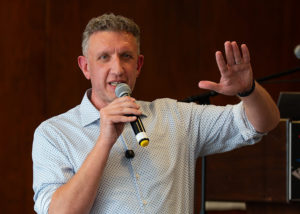
Chuck is a US-based internal communications strategist and the founder of ICology – a community and resource hub for IC professionals. He brings a practitioner lens to every conversation. Chuck is a recognised voice in the industry, a regular speaker and event host, and one of the most connected people in the North American IC world.

Jenni is a UK-based leadership and internal communications consultant, author of two best-selling books, and international speaker. She runs Redefining Communications, a consultancy working with organisations around the world to help them communicate better and close the gap between what leaders say and what employees experience.