
Recorded live on stage at Unily’s Unite25 conference in Nashville — Frequency’s first ever live episode — Chuck Gose and Jenni Field share their keynote takeaways, react to new research on AI trust and courageous leadership, and take questions from the audience on AI-generated content and delivering bad news well.
Frequency goes live at Unite25
Recording their first ever live episode from Unily’s Unite25 conference in Nashville, Chuck and Jenni open with some good-natured ribbing about Jenni’s Taylor Swift T-shirt before sharing their own takeaways from the event: persistent digital noise, content sprawl, and empowered talent markets as top concerns for internal comms and HR, plus the launch of Unily’s new AI assistant, Indy. Jenni highlights Dr. Mae Jemison’s keynote line, “give people room to tell their story,” while Chuck shares Microsoft’s Jane introducing the term “frontier firms” — organizations where human and AI agents work side by side — and Vanessa Van Edwards’ warning that “sterilizing our communication is ruining our communication.”
Covering a SAS and IDC survey of nearly 2,400 leaders, Chuck lays out the mismatch: two-thirds of organizations already use AI and eight in ten say they completely trust it, yet only 40% report advanced trust practices like governance and explainability. Jenni argues that employee trust in AI is layered on top of trust in leadership — if people don’t trust the leader saying “we trust our AI,” they won’t trust the AI either — while Chuck uses the now-infamous “Will Smith eating spaghetti” AI videos to illustrate how trust tends to rise as AI output looks more realistic, whether or not that’s actually warranted.
Discussing Brené Brown’s conversation with Adam Grant on the Re:Thinking podcast, Jenni shares Brown’s four skill sets of courageous leadership — living into your values, rumbling with vulnerability, building trust with others and yourself, and learning to reset after setbacks — and her line that “playing not to lose is always losing.” Chuck connects the “reset” skill to football halftime adjustments, and both hosts argue comms professionals default to playing it safe rather than risking a genuinely courageous stance, particularly around US corporate leaders staying quiet on current events.
Presenting Yale Budget Lab research asking whether AI is meaningfully reshaping US employment since ChatGPT’s release, Chuck shares the finding that occupational shifts and unemployment show no detectable AI-driven acceleration so far, though the researchers flag it as an early, evolving picture. Both hosts agree the right response is not to deny change or predict a jobs apocalypse, but to be transparent about where AI is already augmenting work, treating updates “like a weather report, not a prophecy” — and Jenni adds that most fear comes from simply not knowing, which is best countered with small, safe spaces for employees to actually play with the tools.
Covering a Guardian report on IPPR research finding a third of UK workers have called in sick after work drinks — including 41% of 18-24 year-olds and 47% of 25-34 year-olds who’ve been too hungover to work — Jenni asks whether this is a distinctly British problem. Chuck argues the US has similar social pressure to spend personal time with colleagues after hours, even if the “pub culture” itself looks different, and both hosts reflect on how the reasons for after-work drinks have shifted since the pandemic toward specific celebrations rather than a default nightly habit.
Taking live questions from the Unite25 audience, Chuck and Jenni field one from a Microsoft-house communicator frustrated that Copilot-generated content from different executives all sounds the same, with Jenni citing past Frequency research showing employees trust content less when they believe it’s AI-written, even when they can’t actually tell the difference. A second audience question on encouraging leaders to be courageous when sharing bad news prompts Jenni to describe coaching leaders to find their authentic voice and match tone to how employees are feeling, while Chuck adds that avoiding bad news is simply “the ostrich effect” — a leadership problem, not a courage problem, since employees find out regardless.
What did Chuck and Jenni take away from Unily’s Unite25 conference, including the idea of “frontier firms”? Persistent digital noise, content sprawl, and empowered talent markets emerged as top concerns for internal comms and HR, alongside the launch of Unily’s new AI assistant, Indy. Chuck shares Microsoft’s Jane introducing “frontier firms” — organizations where human and AI agents work side by side — while Jenni highlights Dr. Mae Jemison’s keynote line, “give people room to tell their story.”
Why do so many organizations say they trust AI without having the governance to back that trust up? A SAS and IDC survey of nearly 2,400 leaders found two-thirds of organizations already use AI and eight in ten say they completely trust it, yet only 40% report advanced trust practices like governance and explainability. Jenni argues employee trust in AI is layered on top of trust in leadership — if people don’t trust the leader saying “we trust our AI,” they won’t trust the AI either.
What are Brené Brown’s four skill sets of courageous leadership? Living into your values, rumbling with vulnerability, building trust with others and yourself, and learning to reset after setbacks, per Brown’s conversation with Adam Grant on the Re:Thinking podcast — she argues “playing not to lose is always losing.”
Is AI actually eliminating jobs yet, according to Yale’s research? Not detectably yet — Yale Budget Lab research finds occupational shifts and unemployment show no detectable AI-driven acceleration since ChatGPT’s release, though researchers flag it as an early, evolving picture. Both hosts agree the right response is treating updates “like a weather report, not a prophecy.”
Why do a third of UK workers call in sick after work drinks, and what can comms and HR do about after-work social pressure? A Guardian report on IPPR research finds a third of UK workers have called in sick after work drinks, including 41% of 18-24 year-olds and 47% of 25-34 year-olds who’ve been too hungover to work — Chuck argues the US has similar social pressure to spend personal time with colleagues after hours, even if “pub culture” looks different.
Why does AI-generated content from different leaders often sound the same, and does that matter to employees? Yes, it matters — a Microsoft-house communicator in the live audience raised frustration that Copilot-generated content from different executives all sounds the same, and Jenni cites past Frequency research showing employees trust content less when they believe it’s AI-written, even when they can’t actually tell the difference.
Jenni: Welcome to Frequency, I’m Jenni Field.
Chuck: And I’m Chuck Gose. Frequency is your go-to for real talk about comms, culture, and employee experience — beyond the buzzwords and straight to what matters. What matters today is we’re live here at Unily’s Unite event in Nashville, in our first ever live episode. [Applause.] Thank you. Unedited, unfiltered, we’ll do our normal share of what’s interesting to us, and at the end you’ll have the opportunity to ask questions and share what you’re freaking out about — that’s F-R-E-Q-I-N-G, freaking out about. You can use the app, or come up to the mic, because we’d love to hear your voices as part of this episode. We always trade off kicking things off, and we had a list of things planned — then Jenni surprised me with something when we showed up today. Somebody please Google “the Taylor Swift of internal communications” right now. She shows up flaunting a Taylor Swift T-shirt — proof that artists don’t wear their own merch. We’re done with the charade!
Jenni: Just Google it, you’ll find the truth. Kicking off from our keynote this morning — welcome to the charisma zone, we feel like we bring a lot of warmth and competence to this profession. Jenni, this is your first trip to Nashville, and I’ve learned you’ve been watching the show Nashville — has this lived up to what you thought it would be?
Chuck: A hundred percent. I’m a bit sad Rayna James isn’t real, because I’d have loved to see her perform. But it’s awesome — I’ve got cowboy boots on that I bought at Frye’s, I’ve had fried chicken, we’ve done bourbon tasting. Tick, tick, tick.
Jenni: You’ve done a good job of crossing off the list. We’ll get you to Vegas at some point, but Nashville’s a step in that direction. Let’s go into our takeaways from what we’ve taken in so far at Unite. Chuck, you go first this time.
Chuck: Sure. I’ve got three takeaways from yesterday. First, top of mind for internal comms and HR right now is persistent digital noise, critical information trust, and empowered talent markets. We heard the three big challenges for digital employee experience are getting business-critical information out fast enough — capacity always lags demand — content sprawl making it impossible to keep everything updated, and dashboards that never quite connect content to outcomes. We also heard about the launch of Indy, Unily’s new AI assistant — we’ll share links in the show notes. Two quotes stood out: Dr. Mae Jemison said, “give people room to tell their story — people cannot hear you until you’ve given them space to share what they have to say.” And Kim England-Goodber said the democratization of employee voice has created noise in organizations — I loved that.
Jenni: I loved that too, no surprise we’ve got wildly different takeaways — or maybe we’ll see. What I really liked on the main stage was Jane from Microsoft talking about Copilot, who shared a term I hadn’t heard before: the rise of “frontier firms,” organizations where human and intelligent agents operate side by side, moving beyond simple AI assistance to autonomous agents that can act on decisions themselves.
Chuck: She asked the room how people feel about having coworkers that aren’t human, and how they’ll communicate with them — I saw some iffy hands. She outlined this unfolding in phases, happening differently across organizations at different paces, but each one demanding clarity and trust. That’s a key part of any AI adoption, and that’s where communicators come in — it’s not just about explaining what AI does, it’s about helping employees believe in this new partnership between human judgment and machine logic. I also want to share two quotes from this morning’s keynote by Vanessa Van Edwards. One: “sterilizing our communication is ruining our communication” — I think we’ve all been guilty of that, stripping out the human warmth and competence. And the other: “don’t ask it, state it” — we have to stop asking permission to share ideas; she just gave us permission. Those were our takeaways from the event — we know you all have your own, which is the beauty of events like this. Now we’ll go into our normal format, where we each bring a couple of things we’ve read — articles, podcasts, research, whatever it is.
Jenni: I’ll kick off with one that feels very timely for this audience: the trust gap is the AI story. SAS and IDC surveyed nearly 2,400 leaders across regions and industries and found a classic mismatch — belief outruns proof. Adoption is already mainstream, with two-thirds of organizations using AI and another third planning to within 12 months. Inside that surge, eight in ten respondents say they completely trust AI, yet only 40% report advanced trust practices like governance, explainability, and ethical safeguards. So we’re trusting it without the frameworks to support it. The report visualizes this as a trust dilemma, with about 46% of organizations sitting in misalignment — trustworthy systems underused, unproven systems over-relied on. The authors note a practical path forward: companies plan to increase investment in responsible AI, with more than half moderately increasing spend and a quarter increasing it significantly, especially around explainability. So where does this land for communicators? The message is pretty blunt: you do not sell trust you haven’t earned. Spell out where the model is used, who reviews outputs, and what recourse exists when the system is wrong. Treat governance like a product feature, not an appendix. Jenni, when leaders say “we trust our AI,” what do we put in front of employees on day one to make that trust credible?
Chuck: I think this is a bigger question about how we interpret trust as individuals, because there are layers — you have to trust your leaders saying they trust it in order for you to trust it yourself. If I trust my leader and they say we trust the AI, I’m more likely to believe it. If I don’t trust my leader, I’m probably not going to trust the AI either. What we put in front of employees depends a lot on personality type — some people will just play with it and not worry, others, like me, will want to know where’s the bias, what was done to build this, how does it work. I’d want all of that up front. So there’s your own personality layered onto the human trust that then layers onto digital trust.
Jenni: I think there’s also the average employee, and whether or not their leader is trusted plays in, as you said. But there’s a way to build trust through experience — using a platform, seeing the results, refining it. I like this example: back in 2023, someone made a fully AI-generated video called “Will Smith eating spaghetti” using the internet’s endless creativity — it’s haunting, terrifying, you can’t tell where his hands end and his face begins, spaghetti everywhere. A year later, another version looked more realistic, with actual sound effects. Now, flash forward to 2025, and a new “Will Smith eating spaghetti” video just looks like Will Smith eating spaghetti. As AI evolves, that trust builds in because we see the results — when it looks comical we don’t trust it, when it looks real we start believing in its capability.
Chuck: That’s more dangerous, though — we saw so much misinformation during COVID, and “seeing is believing” isn’t actually true. If something feels more real, we can’t just believe it; there still has to be critical human thinking to verify it, because obviously Will Smith isn’t really eating spaghetti.
Jenni: Well — he might. We don’t know. Let’s move along.
Chuck: My story today is a Re:Thinking podcast episode from about a week ago, where Adam Grant interviewed Brené Brown on courageous leadership — a great conversation. I’ve been fortunate enough to see Brené and Adam speak in person in the Netherlands with Advita Patel, and it was brilliant. In this one, they talk about mindset — whether you’re playing to win or playing not to lose. Brené describes a conversation with leaders where she says, “I just ask: what’s more important to you, protecting your ego or winning? If you want to win, we’re going to have to have these hard conversations. And if you can’t have them and keep playing not to lose, let me tell you what that looks like, on a field and in an organization: playing not to lose is always losing.” I loved that, because it’s something we can take into conversations with leaders — asking what winning actually looks like, and what we need to do to get there.
Jenni: She goes on to say you play back what you heard, combine it with the action you’re going to take, and confirm the permission to actually go do the work — which is important. She also shares the four skill sets of courageous leadership: living into your values; the ability to rumble with vulnerability, meaning you can stay grounded and emotionally regulated even amid uncertainty and exposure; building trust with others and self-trust; and being able to reset — taking responsibility for your own bounce-back after a failure or setback. What do you think of the four, and is anyone actually doing courageous leadership, even though it’s talked about more?
Chuck: I like all four, but the one that stood out most to me was resetting. I often see, especially in comms, that one bit of failure becomes the whole bar — instead of asking, how do we reset and go back out? Like halftime adjustments in American football: you’ve learned something in the first half, how are you adjusting to go back out? I see people treat halftime like they’ve already lost, when it’s actually the chance to reset and win the second half. Playing not to lose is what I see most people doing — there’s a quote attributed to Guy Kawasaki, not sure if he actually said it, but “if you’re not pissing someone off, you’re not doing enough.”
Jenni: I embrace that. We both do. I’d like to see communicators take more of that on — we know we’re never going to make everybody happy, but we don’t want to make anyone mad, so we default to playing it safe, playing not to lose instead of playing to win, and therefore we don’t win. Taking a more courageous approach means knowing you might rub some people the wrong way sometimes, but you’re never going to make everyone happy anyway. We default to the baseline instead of shooting further out. Reflecting on the panel before this session — the future of internal comms — there was a conversation about moving from channels toward leadership communication. What’s the role of the communications professional in helping leaders build that courageous leadership across the four areas?
Chuck: For me, it’s speaking truth to power — having the trust to know there won’t be retaliation, being able to communicate to a leader what’s really happening out there. If you’ve listened to past episodes, you know I hold leadership to a high standard. Especially here in the US right now, I’m not seeing much from corporate leaders — they’re mostly going with the flow of everything happening in this country, which I think is a mistake. There’s a real chance for them to stand up and do what’s right for their employees, put a flag in the ground and say, this is what we believe in, we’re not backing down. I just don’t see a lot of that.
Jenni: For me it also links to integrity, which I talk about all the time as part of credible leadership — I think people say a lot of this, but don’t actually do it, whether because they don’t know their own values or don’t have the self-trust to build trust with others. It’s easy to say “I’m going to be more vulnerable, more courageous” without really thinking through the behaviors that back it up.
Chuck: Good point about the role vulnerability plays in being courageous — we always think of courage as rushing forward and taking a stand, but there’s also an element of being vulnerable in doing that.
Jenni: Next, one of my favorite things is debunking myths and defeating cliches people recite in the echo chamber we all live in. This is a report from Yale’s Budget Lab widening the lens on the whole US labor market since ChatGPT’s release. They asked two questions: is the occupational mix changing faster than in past tech waves, and are there economy-wide employment effects tied to AI exposure or usage? Simply put: are jobs going away, and how are jobs changing? Their answer for now is not really — nothing’s changed much. There’s a perception that jobs are disappearing, and with any new tech there’s always some shift, but the mix has only shifted a little faster, and that acceleration actually began before late 2022. Measures of AI exposure, automation, and augmentation show no detectable relationship to employment or unemployment changes. The researchers do flag a possible early-career wrinkle and caution the data is still maturing, so they’ll keep updating the analysis — this isn’t a forever conclusion, just a point in time. For internal comms, this is a calm voice in a noisy room: don’t deny change, but don’t declare a jobs apocalypse either. Define the time horizon for impact and explain where AI is already augmenting work inside your company. I like this line: treat it like a weather report you update, not a prophecy — forecast change, prophecies don’t. Jenni, how do you talk about AI and jobs with employees in a way that reduces anxiety but still prepares them for shifts that might come?
Jenni: It’s really refreshing to read a report actually trying to make us less scared, because so much out there is designed to inject fear. It reminds me of the book The Science of Fear — I’ll put a link in the show notes — which makes you realize everything is designed to scare you and then make you behave fearfully. I happened to read it in February 2020, which was very well timed, and it made me feel so much better during a period of huge uncertainty. On your question — it’s all about education and creating time to play. There’s real fear that junior jobs are going, and I think it all comes from not knowing; fear comes from the unknown, our brain’s need to predict and feel safe. If you can create space for that, it’s really important. Just the other week I was with senior internal comms people, sharing how we use Claude and ChatGPT together for analysis and projects, and Google’s NotebookLM, which generates a podcast from your content — they were all amazed, then emailed me afterward saying they’d tried it and it was so cool. We created a small space of education and then a space to play, and that’s what we have to do — but it requires making time at work for development, which generally doesn’t exist even outside AI. We have to be honest, open, and transparent about where AI has a role in shifting your job. I think back to my own career, faxing press releases to the media, then cutting newspaper clippings and gluing them into a binder I’d measure with a ruler — no one does that now, it’s ridiculous. But the role of doing that media assessment, that analysis, hasn’t gone away — it’s just different. That’s how I try to think about it.
Chuck: I think that’s the virality of negative news — once it got out that AI is going to take away jobs, people personalized it, made it about their own job potentially going away. I spoke at an event framed as “plumbers or AI,” and I guarantee plumbers are using AI too — I called one and confirmed it, they’re using it in all the ways every other business is. Everyone’s taking advantage of it. The opportunity is exactly the education you’re describing. People say, “I don’t want AI to write my emails, I don’t want it writing my subject lines” — then don’t. It’s not going to do anything you don’t ask it to. It’s not secretly trying to beat you to the punch — it only does what you ask. Get creative: if you don’t want it doing certain things, don’t have it do them. But it can do things I genuinely can’t — I now look like an Excel genius because I don’t actually know Excel formulas, but it looks like I do, and that’s saved me tons of time and sweat equity.
Jenni: There’s also the mindset piece from the Adam Grant and Brené Brown conversation — are you playing to win, or playing not to lose? Sit with that about your own career for a minute, because if you’re playing to win, what are you doing to invest in yourself and learn, versus sitting back just trying not to lose? I think a lot of people are there because they don’t know where to go to ask questions, or it feels too overwhelming. I’d say to anyone listening or here in person — use the people around you. Ask us, ask the other experts here, ask Unily, they’ve got loads of tech experts. Don’t be afraid to use your network on LinkedIn or in person; somebody will point you in the right direction.
Chuck: I think the other miss is that everyone focused on the efficiency side of AI first, which is where job-threat fears came from, instead of the creative side — the things it lets me do that I couldn’t do otherwise. Whether it’s OpenAI’s Sora, Google’s Nano Banana image tool, or Veo 3 for video — it’s remarkable what it lets you do. At an event I ran this past August, I had still images and played around, adding movement to them using Veo 3, so they became actual videos — one attendee appeared to catch a beach ball overhead and throw it back at the camera. It’s clearly not perfect, clearly not meant to fool anyone — but it added a fun element to something that was static before. That’s a small example, but it really comes down to playing and exploring, and the beauty is a lot of these tools are free to use, even if usage is limited. Go out and responsibly play and experiment.
Jenni: Thinking more broadly about the organization as a whole, and where comms and HR share responsibility for employees in the wider world of work — there’s also a need for real conversations at the leadership level. I’m just not convinced those conversations are happening as much as people assume, with leaders actually making time for that depth.
Chuck: Let’s head over to the UK for the next story — a recent Guardian article: “One in three UK workers have called in sick after work drinks, survey finds.” Many staff feel pressured to drink in work settings against their wishes, despite a real shift among younger adults away from drinking as much as their predecessors. A study by IPPR, based on a representative survey of just over 2,000 working-age UK adults, finds that even as drinking habits shift, cultural pressure in the workplace continues to drive harm. 32% of workers had called in sick the day after drinking at a work event or with colleagues in the past year — 41% of 18-24 year-olds and 47% of 25-34 year-olds had been too hungover to work. 22% of staff in education and 24% in health and social care had called in sick the day after drinking at or after work in the past six months, and a fifth in both sectors had turned up late the next day.
Jenni: And 28% — nearly a third — of workers think drinking at work events excludes non-drinkers and creates cliques. My question — this can feel like a very British cultural problem, so I’m curious whether it happens over here in the US too, and what alternative social events people can offer so nobody feels excluded. What can you do that doesn’t involve drinks?
Chuck: Pub culture is definitely real in the UK, I’ve personally witnessed that. But I don’t think it’s that different here — I’ve heard the same social pressure from coworkers in the past, feeling like they need to be part of things. I’ll give the hospitality industry some credit for improving — it’s not just drink-or-nothing anymore, there are a lot of mocktails and non-alcoholic options so people can still feel included. The bigger issue, which we’ve discussed before, is the after-work pressure to spend personal time socializing with people you may not actually want to spend more time with than necessary — maybe drinking compensates for that. But we know drinking around coworkers brings its own problems, and you never know why someone’s opting out — family history, health, whatever it might be. I don’t think it’s that different, it’s just a good awareness point for all of us.
Jenni: I remember in a comms director role, joining a company and feeling old, thinking, where are all the grown-ups? Everyone was young, and it was constantly “are you coming for drinks, are you coming for drinks” — I kept saying no, I want to go home, I’ve got friends there I want to see. I never went until my leaving drinks, and then I got properly smashed.
Chuck: I think the reason for after-work drinks has shifted since COVID — people now do it for a specific leaving party or celebration, rather than the old culture of just going for drinks constantly because that’s what you do. I don’t think “let’s go bowling” as a send-off would get people as excited.
Jenni: Bowling was always my go-to. The bigger data point here, combining a few of these numbers — roughly half of 18-34 year-olds have been too hungover to go to work. That speaks to a different problem.
Chuck: It depends on your version of hungover, too — you could be a little hungover but just hate your job and can’t be bothered to go in, or you could be sick in a toilet.
Jenni: That’s also true. And then there’s the other data point about excluding non-drinkers and creating cliques — by the way, we had an argument earlier today about what to even call that table. We call it very different things.
Chuck: Every day’s a school day in our world. I call it a cocktail table.
Jenni: I called it a poser table, someone else called it a bar table — get one person to agree with you and suddenly it’s confirmation bias, that’s what that is. So no, I don’t think the Brits are special here, Jenni, sorry.
Chuck: I’m sorry, that’s the bias talking. I’ll take it — honestly, relieved.
Jenni: That’s our run through the articles. If you want to submit a question, we’ve got a few coming in, then we’ll get to freak-outs — F-R-E-Q, freak-outs. Jenni, what are you freaking out about this week?
Chuck: I’m freaking out about American portion sizes. I’ve traveled here a lot, so I’m aware of it, but I forget every time — menus are sneaky, calling things “small plates.” Case in point: a spinach dip and pita bread. For me a small plate would be a small dip and one or two pieces of pita. What we got was a dip this big, and four deep-fried pita breads.
Jenni: We were doing bourbon tasting, so it was welcome, but it was not a small plate. Then another evening we had dessert — two desserts, a crème brûlée and a chocolate cake, each person. I don’t understand it, I’m rolling home. We don’t do a lot of things right here in America, but portion sizes, we’ve got you covered.
Chuck: My freak-out — I woke up this morning thinking about things I shouldn’t stress about, then did anyway. I saw the Nashville airport was shut down for a while yesterday because of the government shutdown, and I fly almost weekly, so I take accessibility for granted — delays, sure, but not a shutdown, not losing access entirely. I immediately got online, saw it on TikTok first, and started thinking, Indianapolis is a five-hour drive, could I rent a car — no cars available anywhere. I got into full anxiety mode because I need to get home tonight, since tomorrow I’m flying to Vegas, not for work. Whether it meant Ubering to Louisville and renting a car there or whatever — but just to calm everyone’s fears, everything is fine at the Nashville airport for now. Don’t jinx it. I’ll get home tonight, and anyone flying tomorrow should be fine too. That’s my unfortunate freak-out for this trip.
Jenni: Now let’s look at what’s been submitted, or you can raise your hand and ask live, which is more fun. We’ve got some anonymous ones — I’m going to go to Kim Graham. Kim, hi.
Audience member (Kim): We use Copilot, we’re a Microsoft house, we’re encouraged to use it, we’re selling AI internally, and I’m essentially forbidden from critiquing it — but I get messages from different stakeholders and it all sounds the same, because it’s pulling from our own content. I spend a lot of time trying to make things sound less like that, giving everything a unique voice. How much does the average employee actually care whether it all sounds the same coming from the CEO versus the COO versus the CHRO?
Chuck: I’m going to go back and look at a previous episode where we covered a report on trust in AI-generated content from CEOs, whether employees could tell it was AI and how much they trusted it — I’ll dig that out and send it to you, you don’t even have to listen to us again. From memory, the summary was that people didn’t trust content if they thought it was written by AI. If everything sounds the same, it gets a bit vanilla and people just tune it out — like a teacher who’s always shouting, eventually the students just stop hearing them. People need the personality, because even in an age of technology, people buy from people — the relationship is people. If I don’t feel like that’s really you, I’m probably not going to connect with it as much.
Jenni: The actual study split content — half written by humans, half by AI — and employees couldn’t reliably tell which was which. But if they thought something was AI-generated, they trusted it less, and some genuinely human-written content got mistaken for AI and distrusted as a result. I think a lot of communicators experience proximity bias — we’re so close to this every day, seeing and noticing things employees will never pay attention to. There’s an opportunity to be creative and make content stand out, but employees aren’t nearly as close to it as we are — I’m not saying it doesn’t matter to them, just that it matters more to us. One more piece of advice — search “Copilot for comms,” Unily has an on-demand session showing all kinds of creative ways communicators are using Copilot in their work, it’s a good resource. We’ll put it in the show notes too.
Chuck: We’ve got a few more questions on the app, but does anyone in the room want to grab the mic?
Audience member: [Question, partly inaudible] — about the point on courageous leadership, and how to encourage our leaders to be courageous, especially sharing bad news, when all they want to do is lean into the positive and end up not sharing the parts that would really build trust with employees.
Jenni: I can talk through an example I’ve worked on recently with a CEO, exactly this — how do you deliver bad news and build trust by leaning into that courageous side. Some of it is helping them uncover their own voice — if they’re using very corporate channels that don’t enable real connection, that makes it harder, because it doesn’t feel like their voice. It depends on your channel mix; if you can find channels where they can be genuine, that helps. The other thing is looking at how employees are feeling and finding the right response — are they disengaging and going quiet, or getting angry? If people are angry and rejecting the message, that’s often because they don’t feel supported, so you dial up supportive language, empathy, and care, and coach leaders to find the words that work for them. Not every leader will take that coaching, but having those conversations and really knowing your leader — their personality, what platform suits them — is genuinely useful. My colleague Advita is an expert in that specifically, in how we help leaders communicate.
Chuck: Quickly — that’s the ostrich effect in play, burying their heads when the news is bad. But employees still see the bad news regardless. So I’d ask leaders directly: do you want employees finding out from you, or from someone else? If they don’t want it to be them, that’s a leadership problem — that has nothing to do with courage, that’s a pure leadership failure.
Jenni: A hundred percent. I know we’ve run out of time — thank you all for joining us for this special episode. All the articles and podcasts that inspired this conversation are in the show notes. Don’t forget to rate and review after you’ve listened, subscribe so you don’t miss another episode, and pass this along to someone you think would enjoy listening or watching — you can also find Frequency on YouTube. Thank you to Poet Ali for contributing the music to the show.
Chuck: We’re back every Monday with more news, insights, and opinions about everything comms and leadership in workplaces today. Keep tuning in and turning up. Thank you.
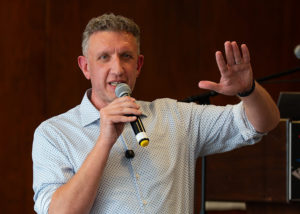
Chuck is a US-based internal communications strategist and the founder of ICology – a community and resource hub for IC professionals. He brings a practitioner lens to every conversation. Chuck is a recognised voice in the industry, a regular speaker and event host, and one of the most connected people in the North American IC world.

Jenni is a UK-based leadership and internal communications consultant, author of two best-selling books, and international speaker. She runs Redefining Communications, a consultancy working with organisations around the world to help them communicate better and close the gap between what leaders say and what employees experience.