
Chuck Gose plugs the iCology mentorship program and settles the “is Die Hard a Christmas movie” debate before Jenni Field takes the wheel on a report-heavy week: the UK Government’s RESIST framework for misinformation, new wellbeing data from Reward Gateway, a Gallup event on UK disengagement, and a “human work” model from Fauna and CultureCon.
Chuck opens with a plug for the iCology mentorship program (applications close December 15), sharing how mentee Ashley Hickson’s growth reflects the program’s impact, before settling — over Jenni’s objection — that Die Hard is not a Christmas movie, citing Bruce Willis’s own on-record ruling. Both hosts then discuss the discomfort of seeing a rise in layoffs during November and December, with Jenni noting her LinkedIn feed is unusually full of open internal comms and employee experience roles in the US.
Jenni introduces the UK Government Communication Service’s RESIST 3 framework, developed by Dr. James Pamment, which offers six steps — recognize, early warning, situational insight, impact analysis, strategic communications, and tracking effectiveness — for building resilience against misinformation, disinformation, and foreign interference. Chuck says the framework’s real shift is treating misinformation as inevitable rather than something to be stopped, while Jenni notes that even though the language of “threats” feels strong for an internal comms context, identifying pockets of internal sabotage is still worth naming directly.
Covering a Reward Gateway and Edenred survey of 4,000 employees and 500 HR managers, Jenni highlights that 84% of workers would stay longer at a job for better wellbeing support, and that 48% now rank work-life balance above pay (45%), while raising concern that the report blurs together deeply personal things like diet and sleep with genuine organizational responsibility. Chuck introduces the buzzword “human sustainability” as wellbeing’s likely next rebrand, and both hosts discuss the gap between leaders who say wellbeing matters and what employees actually experience, including Jenni’s own realization she’d taken only 18 days off this year and is deliberately blocking more time off for the year ahead.
Recapping a Gallup and Institute of Directors event, Jenni shares the striking statistic that 90% of UK employees are disengaged or not actively engaged, and reads Gallup’s definition of engagement, which requires basic needs, a sense of contribution, belonging, and growth opportunities to all be met simultaneously. Chuck argues that definition alone explains the low UK numbers, since most companies fail to deliver on every element at once, while Jenni questions whether the room full of company directors was really looking for a genuine culture shift or just a quick-fix framework to roll out.
Closing on a joint Fauna and CultureCon report drawing on more than 6,000 people across 11 countries, Jenni outlines a six-part “human work” model — including leaders in your corner, safe to struggle and grow, valued beyond impact, real help in real time, seen and known, and life-centered flexibility — noting that only 49% of workers who say their workplace “feels human” actually receive active support. Chuck picks “leaders in your corner” as the element that’s mattered most in his own career, while Jenni favors “real help, real time,” reflecting on the harm caused when workplace policies fail to flex around genuine personal crises.
Chuck’s freak-out is a birthday trip to Hawaii to mark his 50th, which he frames as a continuation of a trip his late father never got to take with his mother, having passed away at 46. Jenni’s freak-out celebrates a listener, Shona, whose YouTube Wrapped featured Frequency, which both hosts take as a meaningful sign the podcast is genuinely part of people’s routines.
Jenni: Welcome to Frequency, I’m Jenni Field.
Chuck: And I’m Chuck Gose. Frequency is your go-to for real talk about comms, culture, and employee experience — beyond the buzzwords and straight to what matters. Jenni, I’m going to be a bit selfish and kick things off this week — I want to talk about the iCology mentorship program. This is something I never would have guessed in a million years we’d run as part of iCology, but it was brought to us by our friend Elizabeth Wang, who ran a mentorship program at our current company and wanted to bring it to iCology. There really wasn’t a strong, structured mentorship program for communicators, at least here in the US. It’s been an absolute crown jewel of our program to see the level of attention, detail, and personalization in matching mentees with mentors based on their needs. I did a bit of a brag post on LinkedIn about my mentee from a couple of years back, Ashley Hickson —
Jenni: I saw that.
Chuck: — and it was so ironic that the same day I posted about her wanting to find her voice and present at conferences, she was actually presenting as part of her master’s degree that same day. It just shows what happens when you get the right match, and people who come to us and say, I need help here, I want to grow here — we can match that up. Anyone who wants to grow, go to joinicology.com/mentorship, the deadline is December 15th. I wanted to get that out there because it’s genuinely good. We were talking a bit before recording about the holidays, and I’ve got an important, maybe even divisive question in our relationship: is Die Hard a Christmas movie?
Jenni: Well, I watch it every Christmas Eve, so…
Chuck: Answer the question, Jenni — is Die Hard a Christmas movie?
Jenni: Yeah.
Chuck: No. The answer is no, I’m sorry, you got that one wrong.
Jenni: I think it depends on how you define a Christmas movie.
Chuck: We’re not getting into definitions — I already know it’s not a Christmas movie because Bruce Willis said so himself on record, there’s video of it. So I’m going with the man behind John McClane on this one: Die Hard is not a Christmas movie. But thinking about this time of year, I’ve been seeing a lot of layoffs on LinkedIn. I know November and December aren’t really any different from any other months on the calendar, but it feels particularly brutal when companies lay people off then — there’s been a real uptick the last couple of weeks.
Jenni: That’s so interesting, I’m with you on that — it’s really horrible when it happens around Christmas. But my LinkedIn feels full of jobs, mostly in the US — more than half the internal comms and employee experience roles coming up on my feed are American. There’s loads, or at least it feels like loads.
Chuck: That’s a good thing for us at least. I don’t know that it’s impacting comms more than any other function — layoffs seem to be happening broadly. Hopefully the people out there job-searching get a bit of a holiday miracle. It’s already a pressured time of year for a lot of people, and losing your job on top of that is especially painful. On that note, Jenni, what do you have teed up for us this week?
Jenni: We’re a little report-heavy this week, which wasn’t intentional — I know it’s on me — but it’s because they’re good reports. I’ll kick us off with a report from the UK Government’s Communication Service about misinformation, then we’ve got one from Reward Gateway on wellbeing in the UK. I also went to a Gallup event recently called “Do Brits Really Hate Working?”, so we’ll dive into some engagement stats. And there’s a report from Fauna and CultureCon on the human side of work, called “the future of work has a heartbeat.” It is report-heavy, but as I keep telling people, there’s so much content out there, and part of why I love doing this is reading these reports and sharing the highlights for people who don’t have time in their day job. So, the UK Government’s framework for communicators to tackle misinformation — we have what’s called the Government Communication Service, everyone working in communications across government. I’ve worked with them for years as a guest speaker and facilitator, and their frameworks are always really good and often referenced. This one, about misinformation, felt particularly relevant for all communicators. It’s called the RESIST 3 framework, developed by Dr. James Pamment, and it offers six practical steps: recognize — identify and assess information threats; early warning — monitor risks to priorities and audiences; situational insight — turn data into actionable insight; impact analysis — prioritize and escalate by impact; strategic communications — implement effective strategies; and tracking effectiveness — evaluate for improvement. It’s aimed at government teams, but it applies to any communication function. Two things stood out to me: first, you don’t respond to everything — strategic silence is valid, not all misinformation requires a response, and they suggest a prioritization matrix to help decide. Second, build resilience proactively, not just reactively — the most effective approach combines long-term resilience-building with reactive response, through trusted partnerships and transparent communication. So my question: this report focuses more on external comms, but misinformation is a huge internal challenge too — do you think these frameworks apply to internal comms folks?
Chuck: What’s interesting about this approach is it’s not really about stopping the threat of misinformation, it’s about building resilience to it — almost acknowledging this is going to happen, period, so how do we build resistance rather than trying to stop it entirely. That’s a complete shift in perspective — even I’ve always thought of misinformation, disinformation, or foreign interference as things to stop rather than resist. It also puts some personal ownership on it, since building that resistance comes down to you. I’m a sucker for a good framework, especially one that spells out a word like RESIST — I think this is a great chance to highlight the real risks out there, because any company of any size is being attacked by hackers constantly, domestic or foreign.
Jenni: Yeah, and even the first step — recognize, identify, and assess information threats — that language can feel strong in an internal comms environment, because really you’re thinking about who might be a threat to truth and transparent communication. But I think it’s important to talk about it, because there will be pockets in organizations trying to sabotage or undermine things — identifying those areas, or even individuals, is worth thinking about, since, as you said, you can’t stop it, so how do you manage it internally?
Chuck: I actually love that they use the word “threat” — I’d bring that word into company communication because it gets attention, not for drama’s sake but because it’s accurate. You’re not sugarcoating or softening the stance, you’re saying what it is.
Jenni: Yeah, I love that. Let’s move on to some wellbeing chat — this is a report from Reward Gateway, a UK workplace wellbeing piece done with Edenred. They surveyed 4,000 employees and 500 HR managers, and it reveals that employee wellbeing has become a business imperative. Reading it, I started questioning what we even mean by wellbeing at work — I still have that question — but some of the data: 84% of employees would consider staying at a job longer with more mental and physical wellbeing support, and 26% believe their employer is responsible for their wellbeing — though the report clarifies in brackets that this is “after themselves,” which I’m glad they clarified, because the headline graphic made it sound like a quarter of people think their employer alone is responsible. It also breaks down how people are prioritizing wellbeing: 67% make time for themselves, 55% exercise regularly, 54% ensure enough sleep, 46% manage their diet, and 35% make sure they take all their annual leave. The report goes on to say it’s “the end of the era of salary” — nearly half, 48%, now say nothing is more important than work-life balance, surpassing the 45% who prioritize pay. That’s a shift worth noting. There’s a consistent theme connecting employer support and employee loyalty, which connects to the book Culture Shock we’ve discussed before — after the pandemic began, the percentage of employees who felt their organization cared about them nearly doubled, reaching 49% before dropping back to around 21% by 2024, roughly where it was pre-pandemic. There’s so much here, but my big issue is this interchangeable use of “work-life balance” and “wellbeing” — I don’t think they should be used interchangeably. How do organizations get this right, when things like managing your diet and getting enough sleep are big human things that aren’t really about work?
Chuck: That’s exactly what I felt reading it — I’d love to see the full list of tick-boxes people could choose, because I don’t think it’s a company’s responsibility to make sure you exercise regularly or get enough sleep or manage your diet. That’s a personal reflection on wellbeing versus the company’s actual responsibility. In researching this, I found a new buzzword that’s apparently replacing “wellbeing” or “workplace wellbeing” as people grow weary of the term: human sustainability.
Jenni: Oh my god. Get in the bin.
Chuck: I also found some US research — let’s hope this one doesn’t catch on either — showing around three-quarters of US workers report moderate or high concern about their workplace wellbeing, even as employers expand their offerings, suggesting those initiatives aren’t enough when workload, culture, and job design aren’t addressed. Part of the issue is a massive gap between what leaders say and what employees actually experience — leaders say wellbeing is important and pass it down, but that’s not what’s landing with employees, especially with that middle management layer being eroded in a lot of organizations. It also points to the fact that if companies really cared about wellbeing, we wouldn’t be seeing so many return-to-office mandates, which clearly does impact it.
Jenni: I’d encourage people to look at that “make sure I take all my annual leave” point, because it really matters. I’ve had a reflection this year — I had a couple of unusual bouts of tonsillitis, and when I looked back at how many days off I’d actually taken, it was only 18 this year, which is low, even with flexible Fridays. So I’ve proactively blocked out time for next year to get back up to around 30 days. I think we can be quite bad at this individually — especially running your own business, it’s easy to just keep going.
Chuck: That’s what I was going to ask — how much annual leave do you actually gift yourself?
Jenni: We have fully flexible working and unlimited leave, but I’m very indoctrinated to work, so I aim for about 28 to 30 proper days off. I’ve got a two-week holiday next year, a week off at home, and probably another week planned, plus a break over Christmas.
Chuck: The annual leave conversation gets tricky when companies pitch unlimited PTO, because it works well for the company and not for the employee — you don’t earn anything concrete to actually take. I’ve experienced that mindset of “it’s unlimited, I don’t need to take it now, I can push it later.” Taking a proper break, and actually feeling like you’re on one when you do, is a real challenge. When you say 18 days, a lot of Americans listening are thinking, three and a half weeks, Jenni, that’s amazing — which shows some real cultural differences around holidays and paid leave.
Jenni: I’d encourage everyone to aim for 28 if they can. What are you going to aim for next year?
Chuck: Not everyone has that choice, Ms. Field. I don’t even know — that’s why I was asking you. One thing we’ve talked about at home is needing some kind of quarterly stretch of unplugged time, not avoiding work exactly, just a real break, both together and separately.
Jenni: I love that, every quarter is a nice cadence — as someone who’s run a business for eight years, I know how easy it is to get sucked into not doing that, as I’ve just demonstrated. On the note of British people supposedly having so much holiday, the Gallup event I attended was called “Do Brits Really Hate Working?” — great clickbait title. It was run with Gallup and the Institute of Directors, which I’m a member of. They shared data and insights from their strengths work. The question of whether Brits really hate working isn’t straightforward, but what was staggering is that 90% of UK employees are disengaged or not actively engaged. That sounds awful, but it raises the question we’ve discussed before: is engagement really the right measure of organizational success? I’m not convinced it is, since the numbers don’t seem to move no matter how much we focus on them. I wanted to share Gallup’s actual definition, since we’ve talked before about the distinction between work engagement and organizational engagement from a report I did on valuing communication — Gallup smooshes it all together. Their definition: employees highly involved in and enthusiastic about their work and workplace are psychological owners who drive performance and innovation and move the organization forward. Employees become engaged when their basic needs are met and they have a chance to contribute, a sense of belonging, and opportunities to learn and grow. Sounds marvelous, doesn’t it? They also shared that Europe is the lowest globally for engagement, female managers under 35 have seen the biggest engagement drops, and 50% of global employees are actively job-seeking or watching the market — 30% in the UK. There was a general sense that people feel stuck, and work-life balance and flexibility came up repeatedly as what drives people to look elsewhere, which tracks with the wellbeing research. Engaged employees are 71% less likely to feel burned out often or always, and 67% more likely to be thriving in life overall, and wellbeing appears to be the single biggest driver of engagement on their chart. When I asked why we should focus on engagement at all, their answer was that an engagement-focused strategy builds a culture of high development and sustainable performance, even amid disruption, because employees have fundamental psychological needs that must be met to sustain high performance — true for remote workers just as much as in-office ones. I left the event feeling really reflective, with a lot of questions about what leaders are actually trying to understand by measuring engagement in the first place. So — what do we really want to know when it comes to organizational effectiveness? What are we really trying to achieve?
Chuck: Going back to Gallup’s definition, it perfectly explains why UK employees are disengaged — that last sentence has no “or”s in it. It’s basic needs met, and a chance to contribute, and a sense of belonging, and opportunities to learn — all of those need to be true simultaneously for someone to be engaged. Someone could feel their basic needs are met but not have a chance to learn and grow, and they’re still not going to be engaged. We shouldn’t be surprised these numbers look the way they do — we have this expectation that because employees get a paycheck they’ll be engaged in exactly what the company wants, and we know that’s a fallacy. That definition alone explains why people aren’t actively engaged, because companies aren’t delivering on all those things simultaneously. And to your question about what leaders really want to know — I think it’s “do people like us, are we doing the right things,” because when the data doesn’t come back favorably, it gets explained away — “oh, that’s because of this team” — rather than acted on. There’s a lot of confirmation bias in wanting to know you’re having the impact you think you’re having. I’m not sure employee listening is really the driver behind measuring it, even if it happens on the back end.
Jenni: Yeah, I’ve got so many thoughts, I’ve been scribbling trying to make sense of them since reading the book Culture Shock. I think there’s an issue with this definition because you can’t possibly deliver it for everybody — it’s so tied to managers, and investment in managers isn’t there, because that layer keeps getting stripped out everywhere. So how are we supposed to actually create an engaged organization?
Chuck: And do managers themselves feel like they have a chance to contribute, a sense of belonging, opportunities to grow? Because if they don’t, none of that is going to trickle down to their teams.
Jenni: Exactly, and it’s everybody. What struck me in the room — full of company directors — was this real sense in the questions of “just give me a framework I can put in place across my whole organization to fix this.” I was actually saying on a podcast interview earlier today, you can’t short-circuit this, it’s consistent ongoing work, not a case of “give me a framework, push it out, fix engagement.” That’s never going to work, because we’re too complex, messy, and individual. People still want a quick fix, when the definition itself points to how much genuine work is actually required.
Chuck: What was the vibe in the room — what were the directors’ questions and expectations?
Jenni: There was a lot around wanting frameworks, some people sharing the need for coaching, someone who just liked the sound of their own voice — not me — and one person made a genuinely good point: that this is basically on leaders, that companies used to do all this stuff and then stopped, and need to go back to doing it. I thought that was a reflective moment on how leadership investment and development programs have been pulled out over the last decade as companies try to cut costs.
Chuck: That connects back to that Reward Gateway data point — people’s sense that companies cared about them went up during the pandemic and has since dropped back down. If employees don’t feel like companies care about them, why should they care about the company?
Jenni: Exactly, and I don’t think it’s a new problem — years ago I used to write a blog called Confessions of an Internal Communicator, and one post was literally titled “Why should I care about you when you don’t care about me?” Clearly having a bad day as a head of internal comms at the time, but it’s genuinely true, and it’s the crux of it for leaders and managers. Anyway, moving us along, because we could spend hours here — the last report I wanted to cover is from Fauna and CultureCon, called “the future of work has a heartbeat.” They surveyed over 6,000 people across 11 countries and gathered around 4,000 stories. The data shows 89% say their workplace feels human, but deeper analysis finds only 49% actually receive active support, and 38% just feel acknowledged. They identified the three most “human” industries as technology, then media and creative, then professional services, which surprised me. When support is bad, 57% want to leave; when support is good, only 2% do — that gap is huge. They offer a model for the human employee experience with six elements: leaders in your corner, leading people not resources; safe to struggle and grow, the humanity of mistakes; valued beyond impact, recognition of your whole contribution; real help, real time, action when life gets real; seen and known, belonging in our differences; and life-centered flexibility, making our lives work. What do you think of the model — could leaders actually pick this up and move the “future of work is human” idea from buzzphrase to reality?
Chuck: When you said “the future of work is human,” I immediately thought of “human sustainability.”
Jenni: Oh my god!
Chuck: And while I’m a big fan of frameworks, I’m not the biggest fan of wheels, I’ll just put that out there. But going back to the engagement conversation — if you feel leaders are in your corner, you can struggle and grow and make mistakes, you’re valued beyond your output, you get real help in real time, you feel seen and known and you belong, and you’ve got life-centered flexibility, that’s when you get engaged employees, people genuinely dedicated because they feel supported. Right now companies expect employees to deliver all of that without providing the support. This is exactly what leadership teams — and, God forbid, HR — should be focused on, because if employees don’t have these things, they end up disengaged, or looking to leave, or just not giving their full effort. If you deliver these six things, whether it’s a wheel or a chart or whatever shape, you’ve absolutely nailed it.
Jenni: My favorite is “real help, real time, action when life gets real,” because that’s the crux of blending your outside life and your work life — they collapse into each other because we’re only one person. I’ve heard horror stories of people being told, “well, the policy is five days,” when something horrendous has happened in their personal life, and I just can’t comprehend treating people that way. If I had to pick one, and I’ll ask you to pick one too, I’d pick real help, real time.
Chuck: If I had to pick the one that’s mattered most in my career, it’s leaders in your corner — I don’t think leaders often realize what that does for an employee, knowing you’ve got their back. It’s almost the reverse of the org chart: this is your space, we’re here to support you. That signals belief and trust, and it’s always mattered to me, sometimes to a fault — which is part of why I’m so critical of leaders, because I expect a lot from them and don’t think they always understand what it means when an employee genuinely feels that support.
Jenni: Nice call-out. That wraps up our articles for today. What are you freaking out about?
Chuck: My freak-out is a positive one, Jenni — tomorrow, the day after we’re recording this, my wife Kristin and I are flying to Hawaii to celebrate my 50th birthday. Neither of us has really been — she went as a kid, which doesn’t really count. When I shared with my mom that we were going, months ago, she told me a story about how my dad and her had always wanted to go, and actually had plans to go around a joint wedding anniversary with my aunt and uncle. My father passed away before they could make that trip, at age 46. Once I passed my dad’s age, I’ve felt like I’ve been living for both of us in some ways — we share the same name, temperament, and sense of humor, and I keep his name badge on my desk every day. This trip feels like a continuation of that, like I get to carry that torch forward, a life he didn’t get to live. So I’m really looking forward to it, not just because it’s Hawaii, but because of what it represents.
Jenni: I love that, and I think it’ll make it so much more meaningful — it’s already meaningful because it’s your birthday and an incredible place, but having him with you in that way while you’re there is going to be lovely. I hope you find some time to chat to him on the beach or something. My freak-out is also a positive one this week — the “Wrapped” feature that’s everywhere right now, your Spotify Wrapped, YouTube Wrapped, Apple Wrapped, showing what you’ve listened to and how many hours you’ve spent. Someone tagged us after their YouTube Wrapped featured our podcast, which I thought was incredible, and I’ve had several friends message me today after I posted about it on Instagram, saying it felt like a real level of achievement to be on someone’s Wrapped. I wanted to celebrate it, because otherwise we wouldn’t talk about it, and I think it’s genuinely cool. Thank you to Shona for sharing that she’s been listening to us on both YouTube and Spotify — it’s worth celebrating being on someone’s Wrapped.
Chuck: I was pretty blown away seeing her post and tagging us in it — just to show up anywhere on someone’s top list, let alone near the top, is a point of pride I’ll carry forward, because we put a lot of work into this. We don’t do it to get attention, though we both love attention, we won’t deny that. But knowing there’s an audience out there that isn’t just listening but genuinely on this journey with us really does mean a lot. Thank you, Shona, for tagging us and sharing that.
Jenni: It really does. Well, that’s it for this week — thank you for joining us. All the articles that inspired this conversation are in the show notes, and we’ll pop a link to the iCology mentoring scheme Chuck mentioned at the start. Please don’t forget to rate and review after you’ve listened, subscribe so you don’t miss another episode, and pass this along to someone you think would enjoy listening or watching — we’re on YouTube too. Thank you to Poet Ali for contributing the music to the show, and we’re back every Monday with more news, insights, and opinions about everything comms and leadership in workplaces today. Keep tuning in and turning up.
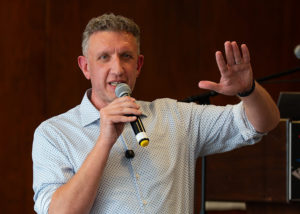
Chuck is a US-based internal communications strategist and the founder of ICology – a community and resource hub for IC professionals. He brings a practitioner lens to every conversation. Chuck is a recognised voice in the industry, a regular speaker and event host, and one of the most connected people in the North American IC world.

Jenni is a UK-based leadership and internal communications consultant, author of two best-selling books, and international speaker. She runs Redefining Communications, a consultancy working with organisations around the world to help them communicate better and close the gap between what leaders say and what employees experience.