
Episode two opens with a thank-you: the response to Frequency’s debut had been bigger than Chuck Gose and Jenni Field expected, and they don’t let it pass without saying so. From there, two bits of news — Jenni is bringing Comms Reboot, the communications unconference, to Toronto in June with Contact Monkey, and a running joke about which Spice Girl each of them would be (Fun Spice and Grudge Spice, if you’re wondering) — set a looser tone before the week’s stories.
The real conversation lands on three things: a new McLean & Company report on what’s actually driving disengagement, a LinkedIn debate over whether a departing Chief Communications Officer should be replaced, and a Harvard Business Review piece that has Jenni rethinking whether “change fatigue” is even the right diagnosis.
Jenni’s starting point is a new Employee Engagement Trends Report from McLean & Company. She’s long been skeptical of engagement scores on their own — an 86% doesn’t tell you what it’s actually measuring against a business outcome — and the report’s four drivers of disengagement (manager work-life balance, leadership competency gaps at early-career level, stalled career advancement, and compensation pressure tied to cost of living) don’t feel new to her. Her question: what’s the point of measuring engagement if the same four issues never move?
Chuck isn’t surprised compensation tops the list — he doubts anyone in history has ever felt adequately paid — but zeroes in on the manager data specifically: nearly twice the reported stress of individual contributors, and only six in ten managers reporting any work-life balance at all. His read is that work-life balance is ultimately a boundary-setting issue on the employee’s side, but managers are stuck in an unusually hard spot to set those boundaries from — squeezed between leadership expectations above and employee needs below, often without support from either direction.
Jenni pushes back gently with her own experience as a global head of communications, commuting on a 6:15am train and not getting home until 7pm — and the courage it took to simply leave at 4pm once nothing in the business was in crisis. Once she did it, it became normal. But she agrees managers are stuck in what she calls the “messy middle,” often asked to communicate decisions they don’t understand or agree with, and notes that line-manager communication is consistently the missing piece in the comms strategies she works on.
Chuck adds a second data point from the same report: only around 10% of first-time leaders are proficient in the human-centric skills — coaching, empathy, resilience — that the role actually demands, which he sees as an opening for learning-and-development providers to go beyond performance reviews and spreadsheets. Jenni ties it back to her own book, Nobody Believes You, and its eight practices of credible leadership — including a favourite practical tip: use your out-of-office message to say where you are (on holiday with family, at a conference), a small, low-risk way to be personal without being intimate, and to build connection as a new manager.
Jenni brings a LinkedIn post she’d already commented on: someone describing a company that chose not to backfill its departing Chief Communications Officer, and arguing this overlooks the strategic value a talented CCO provides. The post drew a wave of agreement in the comments. Jenni’s actual comment asked something different — what was the real impact on the organization afterward? She isn’t disputing the value of the role, but flags that comms and HR professionals often talk about their own importance to each other without checking whether that belief holds up outside the profession’s own echo chamber.
Chuck doesn’t read it as an attack on the profession’s validity — organizations eliminate CHRO roles when downsizing too, and that’s not an indictment of HR either. He’s more interested in what we don’t know: was the person not effective, or did leadership responsibilities simply get redistributed? He references their first episode’s point that “HOMS” (Head of Marketing/Comms-type roles) means something different in every organization, so it’s hard to judge one data point without more context. The real risk, he argues, isn’t the role disappearing — it’s what that decision reveals about whether the organization valued communications in the first place.
Jenni connects it to her own career: a communications director role that, within six months, made clear the organization didn’t actually want strategic advice at that level — it was later replaced with a more junior, execution-focused position, and that’s not automatically a failure of the function. Chuck raises a separate but related irritation: if you post something provocative enough to draw a comment asking a direct question, the responsible move is to engage with it — broadcasting without dialogue isn’t using social media socially.
The closing story comes from Harvard Business Review, built on a survey finding that 85% of senior leaders have observed an “explosive increase” in transformation projects over the past five years. The article draws a distinction Jenni finds clarifying: change fatigue comes from frequent alterations to how people actually work day to day, while strategy fatigue comes from leadership repeatedly shifting an organization’s stated direction, leaving employees unclear on purpose and priorities. Her read, from her own client conversations, is that most organizations are living the second problem — asked to build a comms strategy against a business strategy that’s “still being reviewed” far more often than it should be.
Chuck complicates the split by layer: for frontline employees, he argues it genuinely is change fatigue — constant shifts in how the job itself gets done, login systems, reporting processes — while strategy fatigue is more a manager-and-leadership phenomenon, where the job stays the same but the reasoning behind it keeps moving. He illustrates with an old Apple Pay story: a Panera cashier who had no idea how the new payment system worked because nobody had told her — her job changed that day, and nobody communicated it.
Jenni disagrees on the frontline point specifically, drawing on her own experience communicating with 8,000 frontline staff serving food and drink in transport hubs: restructures at head office rarely change what that job actually looks like day to day, which is where she still lands on strategy — not change — being the more accurate word for what’s exhausting people. She commits to running a LinkedIn poll after the episode airs to test the distinction with her audience, while acknowledging Chuck’s fair point that a LinkedIn audience skews away from frontline workers.
Why don’t engagement scores tell the full story? A single percentage like 86% doesn’t reveal what’s actually driving engagement or disengagement, or connect to a specific business outcome — without that context, the number is close to meaningless.
Why are managers more stressed than individual contributors or senior leaders? Managers sit in a structurally difficult middle position — accountable to leadership above and their teams below — often without the training, support, or air cover either group receives.
Is work-life balance the employee’s responsibility or the organization’s? Chuck argues it’s fundamentally a boundary-setting issue for the individual, though he acknowledges managers are rarely given the organizational support to set those boundaries in practice.
Does eliminating a CCO role prove communications doesn’t matter? Not on its own — Chuck and Jenni agree the more telling question is why the decision was made and what happens to trust and alignment afterward, which usually only becomes clear over time.
What’s the actual difference between change fatigue and strategy fatigue? Change fatigue comes from frequent shifts in day-to-day workplace processes; strategy fatigue comes from leadership repeatedly changing an organization’s stated direction and priorities.
Does change fatigue affect frontline workers the same way it affects office-based teams? Jenni and Chuck disagree — Jenni’s frontline experience suggests the day-to-day job changes relatively little during head-office restructures, while Chuck argues frontline roles feel change more acutely through shifting tools and processes.
Chuck: Welcome to Frequency, I’m Chuck Gose.
Jenni: And I’m Jenni Field. Frequency is your go-to for real talk about comms, culture, and employee experience — beyond the buzzwords, and straight to what matters.
Chuck: Before we get into our news items of the week, three things. First — thank you to everyone who’s given us feedback about our very first episode, shared it on LinkedIn, all of it. We really do appreciate the support as we begin this journey. Second, bigger news: Jenni, you announced you’re bringing Comms Reboot to North America — to Toronto, specifically.
Jenni: Yeah, I’m really excited. Comms Reboot is the communications unconference — people get together and set the agenda for the day based on the challenges they actually want to talk about. I’m bringing it to Toronto in partnership with Contact Monkey, their first in-person event, which is really cool. We’re hoping for 50 to 60 people covering employee experience, internal comms, leadership, culture. It’s on the 25th of June, all day — fingers crossed for a good turnout.
Chuck: The last thing is more conversational: there’s a rumor — including in my own house — that the Spice Girls are getting back together for a tour. So, important history lesson: Scary, Sporty, Baby, Ginger, and Posh. What would your Spice Girl name be, Jenni?
Jenni: God, that’s hard — I grew up with them, so I kind of adopted Posh, though I’m not sure why. Actually — Fun Spice. I always want to do stuff, embrace life, do whatever. What would yours be?
Chuck: I’ve given this real thought. Grudge Spice. Let’s get into what we want to talk about this week.
Jenni: I’ve been reading a few things this week that got me thinking about senior communication roles, the language we use to describe organizational challenges, and engagement scores specifically. I’m not a big fan of engagement scores — if your score is 86%, I don’t really know what that means or what business outcome it connects to. There’s a new report from McLean & Company on shifts shaping the workplace, and rather than one big issue, they found four: work-life balance for people managers specifically, leadership competency gaps at early-career level — things like empathy and emotional intelligence — stalled career advancement, and general compensation pressure tied to cost of living. None of that feels particularly new, which is part of what I want to get into today — if these challenges never really shift, what’s the point of measuring engagement at all?
Chuck: The compensation part doesn’t surprise me — I don’t think there’s ever been a point in history where people felt adequately paid. But I think it’s worth focusing specifically on managers here, not the C-suite, not frontline — they each deserve their own conversation. The data point that got me was managers being roughly twice as likely to report high stress, and only six in ten reporting any work-life balance at all. I do think work-life balance comes back to boundaries — that’s on the individual to set, even though I know that’s easier said than done. But managers are stuck in a genuinely difficult spot: hearing from leadership above, hearing from their teams below, expected to deliver outcomes, with no air cover.
Jenni: I think you’re right that it’s on the individual to some extent — when I was a global head of communications, I was getting a 6:15am train, working the whole way, home by 7pm most nights, and it got to the point where I couldn’t get to the gym anymore. I eventually had the conversation with my boss — nothing in crisis at the time — and said I’d leave at four, still contactable, but home at a reasonable hour. It took courage to do that first time in an office where everyone else was still there, but once I did it, it just became normal. You’re right about that messy middle for managers though — in nearly all the work I do with comms teams, line-manager communication is the piece that’s consistently missing from the strategy.
Chuck: One more thing from that report — first-time leaders’ proficiency in the actual skills of the role. Only around 10% rated themselves proficient. That feels like an opportunity for anyone in learning and development — coaching, resilience, empathy training — that goes beyond performance reviews and spreadsheets.
Jenni: And we need more of that in a world where people who used to be office-based all the time are now hybrid or remote — you’re not picking things up by osmosis anymore. There’s actually a book on leadership credibility on my shelf I’ll mention — Nobody Believes You. I’ll pop a link in the show notes.
Chuck: Let’s talk about that — say you’re a first-time manager. What can they learn from it?
Jenni: The thing about being a first-time leader is you’re probably going to get it wrong at first, which isn’t very comforting, but you have to be given the chance to learn. The book covers eight practices of credible leadership — trust, integrity, empathy, being supportive — but the point is making those big words practical. For vulnerability, for example: to create connection, you have to be personal without being intimate. My go-to tip is using your out-of-office message to say where you actually are — with family, at a conference, taking a day to rest — as a small tool for connection.
Jenni: Right, the second thing — a LinkedIn post from last week or the week before, that I commented on and then sent to you. Someone wrote that they’d heard about a company choosing not to backfill a departing Chief Communications Officer, believing the remaining leaders could manage fine — and argued this overlooks the fundamental strategic value a talented CCO brings. Loads of comments agreed. My comment was: I’d love to know what actually happened to that organization afterward — was there a real impact, or did the belief in the role’s importance not match the reality? For me it comes back to what we talked about last episode — we can talk to ourselves about the value of these roles, but if nobody outside the profession sees that value, we’re just in an echo chamber.
Chuck: I didn’t read it as an attack on the validity of communications as a function. We don’t know a lot of the context — was the person not effective? Was the organization downsizing generally? I’ve seen CHR roles eliminated too, and that’s not an indictment of HR. I think the more interesting question is what we don’t know about the actual value that specific role delivered — as you said last episode, “HOMS” means something different in every organization. The real danger is if it turns out the organization simply doesn’t value communications — that’s an indictment of the organization, not the profession.
Jenni: It’s making me think about my own career — I was a communications director where, within about six months, it became clear they didn’t really want a director-level function, they liked the idea of one. That role ended up being replaced with something more junior because of where they sat in the wider organization. And that’s okay — not every comms role has to be senior-level strategic work. A lot of people enjoy, and thrive in, the content-and-channels end of things, and it’s madness to assume everyone in the function needs to be at the top table.
Chuck: Hearing that a CCO role’s been eliminated feels like one of those hand-grenade decisions — you don’t know the impact for a while. Does trust erode? Does the organization feel more siloed? We won’t know for some time whether it was the right call.
Jenni: And the original poster never actually answered my comment, so I still don’t know. I don’t love commenting without enough context to really judge it, but there has to be a measurable business or organizational impact eventually — you’re right that it takes time to show up.
Chuck: Quick related point — if you post something like that on LinkedIn and someone leaves a genuine question in the comments, engage with it. It’s called social media for a reason — broadcasting and then disappearing isn’t using it socially.
Jenni: I do wonder if that’s a generational shift — whether people increasingly use it as a broadcast channel rather than engaging with the social part.
Jenni: Last article — Harvard Business Review, and this one felt timely given how much change fatigue came up in the Gallagher State of the Sector research we mentioned last episode. The piece draws a distinction between strategy fatigue and change fatigue: change fatigue comes from frequent alterations to workplace processes — the sheer volume of changes to how people work — while strategy fatigue comes from frequent, capricious shifts in an organization’s strategic direction, where leaders keep flip-flopping on priorities and employees lose track of purpose. Reading that, I had a bit of a lightbulb moment — I think most of what I see with clients isn’t change fatigue, it’s strategy fatigue. When I ask clients about their organizational strategy so we can build a comms strategy against it, the answer is almost always “we’re not sure” or “it’s under review.” That’s maybe 95% of the conversations I have.
Chuck: I’ll gently call that a statement of privilege — for a lot of frontline employees, I think it genuinely is change fatigue. Their question is simpler: how do I do my job today? If leadership keeps changing how that job gets done week to week, that’s exhausting in a very direct way. I think strategy fatigue is more the manager-and-leadership-layer experience, where the job itself stays the same but the reasoning behind it keeps shifting — it’s less “how do I do this” and more “why am I doing this.” There’s a story I keep coming back to from when Apple Pay first launched — I tried to use it at a Panera and the cashier had no idea what it was or how it worked. Nobody had told her. Her job changed that day and nobody informed her.
Jenni: I’d actually disagree on the frontline point — I spent a lot of my career communicating with around 8,000 frontline staff serving food and drink in train stations and airports, and restructures at head-office level rarely changed what their actual job looked like day to day. I think the fatigue Chuck’s describing is coming from people in the office who are living the strategy churn, not from frontline roles. I might have to run a LinkedIn poll on this after the episode airs — change fatigue or strategy fatigue — and see what people actually say.
Chuck: I know what they’ll say, and I’ll point out the LinkedIn audience skews away from frontline workers.
Jenni: True — but in the research I’ve done with deskless workers, they’ve never described their day-to-day as changing dramatically. If anything, the routine can feel monotonous. That’s my hypothesis, anyway, rather than a full research piece.
Chuck: That wraps our main discussion. Time for freq-outs — what we’re each freaking out about this week. If you’re listening Monday or Tuesday, I’ll be in Nashville for Jon Acuff’s Remarkable You event, alongside my ICology mentee Ashley Hickson — we used Acuff’s book Soundtracks as the basis for our mentorship, so it felt right to be there together.
Jenni: I’m so jealous — I’ve since read Soundtracks and All It Takes Is a Goal and loved both. Can’t make it to Nashville, but say hello from me. As for my freq-out — I fell over on a run yesterday and sprained my ankle, which isn’t work-related, but it’s genuinely annoying given how much of an outdoors person I am.
Chuck: Given how dramatic your Instagram story about it was, I was fully expecting an amputation. Glad it’s just a sprain — and thanks for pushing through the injury to record this.
Jenni: Thank you all for joining us this week. All the articles we’ve referenced will be in the show notes, so do check those out. Please subscribe, leave a review — it really does mean a lot — and if you think someone else would enjoy this, share it with them. Thanks as always to Poet Ali for the music. We’ll be back next week with more news, insights, opinions, probably some disagreement, some fun — but always leadership and workplace culture at the center of it. Keep tuning in, and keep turning up.
New episodes every Monday. Subscribe wherever you listen, and if Frequency is a regular part of your week, a review goes a long way.
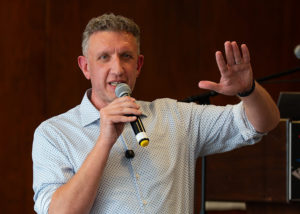
Chuck is a US-based internal communications strategist and the founder of ICology – a community and resource hub for IC professionals. He brings a practitioner lens to every conversation. Chuck is a recognised voice in the industry, a regular speaker and event host, and one of the most connected people in the North American IC world.

Jenni is a UK-based leadership and internal communications consultant, author of two best-selling books, and international speaker. She runs Redefining Communications, a consultancy working with organisations around the world to help them communicate better and close the gap between what leaders say and what employees experience.