
A pharmaceutical company’s patient service team looked fine on the engagement survey. Nearly two-thirds of them were actively job hunting.
Structured interviews found it. They also surfaced the phrase employees kept reaching for to describe how they felt about the company: “behind the glass.” Close enough to see the business, not allowed to touch it.
Jenni Field and Chuck Gose open Episode 72 there and never really leave the theme, which is the gap between measuring something and doing something about it. Also up: Gary Grates’ manifesto against the “pomp and circumstance” of internal comms, Nick Bloom’s argument that working from home built the startup boom AI keeps getting credit for, the hidden hours of “botsitting” eating most of AI’s weekly time savings, and a study of 7,700 employees where the fully remote group reported the highest well-being.
The opener comes from Constance Noonan Hadley and Deborah Lovich in Harvard Business Review. Hadley runs the Institute for Life at Work, Lovich is a managing director at BCG, and their argument is that frontline people already know what’s broken while the standard survey apparatus is built to miss it. Their alternative is a six-step process: structured interviews, targeted surveys, collaborative problem solving, rapid experimentation.
In the pharma case, roughly 100 employees, the changes were small. Widen the window for patient refill reminder calls. Give managers a clearer coaching framework. Medication adherence held steady and people got some control back.
Jenni checked the Gallup data before recording and confirms the correlation between low engagement and job hunting is real. Her point is what happens after. “It’s the action that was important in this, and I think that’s always what’s missing in so many of the things that we do in internal comms.” A survey isn’t rich enough for the nuance of human language. Talk to people, then act.
Chuck’s read is about where insight lives. The person doing the job minute by minute sees things a leadership team structurally cannot, and most organizations have no route for those observations to travel upward. The fixes aren’t glamorous and they’re rarely expensive, which is exactly why they get skipped.
Jenni put the harder version of it plainly: sometimes it’s giving people more than a week to run an automated chaser. Not revolutionary. Just important.
Gary Grates argues internal comms isn’t evolving and names what he thinks it actually is: critical thinking, not content, motivation, events, stunts, or research. Seven critical success factors, reading more like a manifesto than a framework.
Both hosts agree with factor four, that internal comms metrics are the same as business metrics with no separate set. Jenni’s example: if the business objective is cutting accidents by 60%, that’s the communicator’s measure too. Chuck’s caveat is that agreeing is the easy part. You still have to connect what you’re doing to the number rather than claiming credit by proximity, and it leaves you with nothing separate to point at in budget season.
Factor one is where it gets uncomfortable. Grates says he’s never accepted an assignment, in-house or agency, unless he reported to the CEO or a C-suite leader. Jenni doesn’t dress it up: “I enjoy the privilege that he has of saying, I’m not going to take a job unless I report to the C-suite.” Most practitioners sitting three layers down inside HR or marketing don’t have that option, which turns the whole model into either a lever or an excuse depending on who’s holding it.
She also pushes back on the premise. A lot of what Grates lists is organizational communication, employee experience, and culture, which isn’t the same thing as internal comms, and dismissing content, channels, intranets, and the digital workplace as not-the-job is too flippant when that’s what most functions are actually doing.
Then the contradiction Chuck flags: factor two says information flows from executive leadership and the board, factor six says internal comms is dialogue, discussion, and debate rather than propaganda. If the flow only runs one way, the debate is decorative.
On the title itself, Chuck takes the opposite side of the argument. Things are vanilla enough already. Employees would probably welcome a bit more pomp and circumstance, or at least a few rituals worth showing up for.
The New York Times credited AI with the post-2020 surge in US business creation, citing a Gusto survey where 60% of founders said they use it. Nick Bloom isn’t buying the causal leap and points at working from home instead.
His case is timing, geography, and mechanism. The surge started in 2020, two years before generative AI arrived. Much of it happened in the suburbs where remote work concentrated. And working from home is what hands people the time, flexibility, and physical space to start something. In the comments he extends the same logic to negative attribution, where AI takes the blame for a brutal graduate job market that lockdown and a tech hiring slowdown also explain.
Jenni adds a factor Bloom doesn’t: the barrier to entry collapsed. People run businesses through TikTok now. That’s a different world from ten years ago regardless of where anyone sits.
She’s also skeptical that location determines much. Someone at an office desk can be running a side hustle just as easily. What she does wonder about is what happens to entrepreneurial energy when free time gets taken back, and whether the people with something genuinely worth starting just make the time anyway.
The tangent that follows is the more interesting one. Chuck names the expectation that a hobby has to become a business, or at least a tax advantage, to count. Jenni’s version is posting a photo from the driving range with her dad and immediately getting messages about clubs to join and skills to develop. “I’m okay being really bad at this and just having a nice time.”
Seventy-five percent of workers say AI made them more productive. Thirteen percent say it meaningfully improved their organization’s performance. Rebecca Hinds, drawing on Glean’s Work AI Index survey of 6,000 digital workers, has the number that explains the gap: AI automates around 11 hours a week per person and takes back 6.4 of them in “botsitting,” the supervising and error cleanup that lands downstream. Net gain, a little under five hours.
Hinds pins the loss on coordination neglect, from Heath and Staudenmayer’s 2000 paper on our chronic habit of underestimating the work of fitting the pieces back together. The sharpest data point is a 2025 METR trial where experienced developers using AI took 19% longer to finish while believing they were 20% faster. People are unreliable witnesses to their own productivity, which should make anyone nervous about self-reported AI ROI, including the survey the article opens with.
Coordination is largely a comms problem, so is this internal comms’ strongest business case? Both hosts got there independently and said the same word. It’s a trap.
Jenni’s reasoning: coordination is bigger than internal comms, everybody will think comms can fix it, and it can’t. “It’s an operational challenge and it needs to be fixed by somebody who’s in charge of that.” She’s seen the self-report gap before, in pandemic productivity research where people felt more productive at home while the actual output said otherwise.
Chuck’s open question is the one worth running: everyone who uses AI for a first draft and then re-edits it feels faster. Where does the rewrite time actually land? Jenni’s already got a piece to send him about a PR writer who spent so long restoring the human essence to AI copy that the draft cost more than it saved.
Stefanie Johnson expected hybrid to win. It didn’t. Across 7,704 employees at a large healthcare organization, fully remote reported the highest well-being, hybrid second, fully onsite last. The study, co-authored with colleagues at the MD Anderson Leadership Institute, ran in Frontiers in Psychology in July 2026.
The finding that should trouble return-to-office advocates is about connection. Asked to describe their organization’s culture in a few words, remote workers were slightly more likely than onsite peers to reach for teamwork, inclusion, and support. Isolation is the load-bearing argument in nearly every RTO case and this data doesn’t hold it up.
Johnson’s own line is the one Chuck keeps coming back to: “Leaders are not making decisions based on data. I think they’re just returning to what they are used to.” What they’re used to is command and control, and comfort isn’t where anything improves.
Jenni’s caveats are real. One organization, one sector, 2023 survey data matched to turnover records a year later, and the study didn’t test why remote workers fared better. This could simply be a company that invested well in remote. Johnson still thinks face time helps early-career employees, and her qualifier is “remote works better after you know people,” which is a tenure answer rather than a policy one.
That’s the bind Jenni lands on. If everyone with five years in goes fully remote and every new hire comes in wanting to learn from someone, the people who need to be in the room aren’t. That’s how you end up with two days a week, and it’s the compromise a genuinely flexible policy has to make.
Chuck’s ask is narrower and more useful: get the data for your own organization. Find out how your onsite, remote, and hybrid people are actually doing instead of guessing.
Jenni’s closing thread ties it back to well-being as the biggest driver in the engagement research, which may be what’s really moving these numbers. And Chuck ties it back to the first story. Don’t just run a survey. Talk to people.
Why do engagement surveys miss employees who are about to quit? Surveys capture sentiment at a scale and a distance that flattens it. In the HBR case, 63% of a patient service team was job hunting and the survey didn’t register it. Structured interviews did, because people will say things in a conversation they won’t tick on a scale.
What does “behind the glass” mean? It’s the phrase employees in that pharmaceutical team kept using to describe their position: close enough to see the business, not allowed to touch it.
What is botsitting? Rebecca Hinds’ term for the supervising and error correction that AI output creates downstream. Glean’s Work AI Index puts it at 6.4 of the 11 hours a week AI saves, leaving a net gain under five.
Did AI cause the post-2020 startup boom? Nick Bloom argues it didn’t. The surge began two years before generative AI existed and concentrated in suburbs where remote work took hold, which points at working from home as the more likely driver.
Do remote workers really report better well-being than hybrid or in-office? In this study of 7,704 healthcare employees, yes. Fully remote reported the highest well-being, hybrid second, fully onsite last. It’s one organization in one sector, and the study didn’t test why.
Should internal comms have its own metrics? Gary Grates says no, and both hosts agree. The catch is that adopting business metrics means proving your contribution to them rather than claiming credit by association, and it leaves you nothing separate to defend a budget with.
Jenni: Welcome to Frequency. I’m Jenni Field.
Chuck: And I’m Chuck Gose. Frequency is your go-to for real talk about comms, culture, and employee experience. Beyond the buzzwords and straight to what matters. Jenni, every week you like to do four articles a week. Me, I’m doing five again, but don’t worry, it is not a competition. This week we are talking about frontline employees, the pomp and circumstance of internal comms, our old friend Nick Bloom returns, is the math mathing on AI and productivity, and remote workers are winning.
Jenni: Winning! Before we get into that, I wanted to talk about the benefits of programming, which sounds really boring, but this week I have finally managed to hit a milestone after having my shoulder injury last year of being able to hang on the rig at CrossFit. And I had a little joke with my trainer there about, you know, who knew that programming works? And I also ran my first 10K. So I’ve been doing quite a lot of stuff and it just got me thinking about how the benefits of programming could probably be applied to other parts of our lives. And I don’t know where I’m going with this, but it just made me think there is something about having a set program that you follow to achieve a goal. And I feel like I need to apply that to other parts of my life. And I just wondered if you did any programming of anything, whether it was fitness or like other bits of stuff.
Chuck: I also was wondering where you were going with this when I saw it in the notes. And I don’t know if this is more of a British term, but I was thinking of more like commitments and systems. And there’s a ton of benefit to it. And I would say I fail on every part of this entirely. Largely because of, not so much the chaos of my life, but the inconsistency of week to week and where am I and what am I doing? And I think it’s really hard. And that’s a really poor excuse because you can always come up with ways.
So maybe it’s just what I’m committing to is maybe the thing, that knowing that hey, you can’t commit to doing something because you’re not in that physical location all the time. So no, I think we all agree that it’s the commitment to it that we see every time, you see the long-term benefits of it. Sort of like whether you subscribe to the 10,000 hours or not, there is something around doing something in a repetitive manner, over and over, building, improving, all in those ways. Agreed.
Jenni: Yeah, yeah, totally. And I think that’s why when I started running and learning to run doing the Couch to 5K program, like now I can go for a run wherever I am traveling without having to worry about is there a gym and is there this? Like I can still just chuck my training in and go for a run, which is quite nice.
Chuck: It’s funny you mentioned that because I’d heard people talk about how, you know, the old adage you never forget how to ride a bicycle. There is apparently some truth to that, but people do actually forget how to run. And they’re talking about as you age, when you’re a kid, you run. Because that’s just what kids do. As you age, you don’t run, unless you’re like into running. And they’ve talked about the importance of being able to run. Like we kind of forget how to do those things.
Jenni: Yeah. I definitely forgot, but I’ve learnt now and I can do it. Anyway.
Chuck: Also, there’s some really funny videos of people being challenged to skip. And also people have forgotten how to skip.
Jenni: I keep seeing those! They are fun! When we’re next together in person we are going to skip, we’re going to put a video out of us skipping and see if we can nail it. That’s going to be our challenge.
Chuck: We’re gonna skip. Love it. Love it. All right, let’s get started in this stuff.
Sixty-three percent of a pharmaceutical company’s patient service team was actively looking for another job, and the engagement survey didn’t catch it. A round of structured interviews did, along with the phrase employees kept using to describe how they felt about the company. Quote, “behind the glass.” Constance Noonan Hadley from the Institute for Life at Work and Deborah Lovich, managing director at BCG, argue that frontline people already know what’s broken, and the standard survey apparatus is built to miss it. Their alternative is a six-step process, including structured interviews, targeted surveys, collaborative problem solving, and rapid experimentation. In this pharmaceutical case, roughly 100 employees, the fixes were largely unglamorous. Widen the window for patient refill reminder calls, give managers a clearer coaching framework. Medication adherence held steady and people got control back.
So, Jenni, my question to you, is there a link between job hunting and engagement, or lack thereof?
Jenni: So I did a little research on this to find out if there was a link between engagement scores and job hunting, and there is. Obviously Gallup have done the two measures and it shows that, not, you can’t say that the less engaged you are the more likely you are to look for a job, but there’s definitely a correlation between low engagement and job hunting.
What I thought was interesting about this article from an internal comms perspective was this feels like the textbook of what we want people to do inside organisations when they do any kind of audit around communication or anything around employee experience, because they followed that method. You know, they spoke to people, they then did a survey to go a bit deeper, then they spoke to people again, then they had a working group. It’s the action that was important in this, and I think that’s always what’s missing in so many of the things that we do in internal comms, is we can go out and find all this data and insight that isn’t necessarily a comms problem to solve, but there’s no action taken.
But I think for me, what this highlights is the need to have that conversation. You can’t just do things based on a survey. That’s not rich enough in terms of the nuance of human language. There has to be conversation. And I think if you took anything away from reading this article, I’d hope people would think, okay, we’ve done the survey, now let’s have the conversations and let’s see what’s really going on.
Chuck: And I think what people do is they go straight from the survey results and try to figure out what needs to be done. What I liked about this was the reminder to all of us that the nuggets of wisdom and insights that exist at the frontline, the people that are doing the job on a minute-by-minute, hour-by-hour, week-by-week basis, they have insights that you’re not gonna have sitting on a leadership team. You’re gonna have different insights for the business. So often there’s not a way for those ideas and insights to level up or bubble up throughout an organization. This is a reminder of that. And like it says, the fixes aren’t glamorous fixes and they’re rarely expensive fixes, but ultimately these are where businesses make a difference. This is where problems get solved.
Jenni: Yeah. And I think the thing for me, like you said, is that it’s like the basic stuff. And I think sometimes we want it to be something shiny and new and it’s AI and it’s this. But sometimes it’s the really mundane, boring things like giving people more than a week to do an automatic chaser to patients in this example. And like, that’s not glamorous or exciting or something revolutionary, but it’s really important. And I think we often lose sight of that. Like just do the simple things really well. It doesn’t have to be something shiny and new.
Chuck: Next up, Gary Grates says internal comms isn’t evolving the way it should, and then names what he thinks it actually is: critical thinking. Not content, not motivation, events, stunts, or research. He lists seven critical success factors and it reads a bit less like a framework and more like a manifesto from someone who’s run out of patience.
The one that will start the argument is number four. Internal comms metrics are the same as the business metrics, and there are no separate ones. That’s either liberating for some of you or a great way to have nothing to point at in budget season. Number one is nearly as critical. Grates says he has never accepted an assignment, in-house or agency, unless he reported to the CEO or a C-suite leader. Most people reading this aren’t going to have that option.
There’s also a bit of a contradiction in the middle we were chatting about. Factor two says that information flows from executive leadership and the board. Factor six says internal comms is not propaganda, it’s dialogue, discussion, and debate. Both can’t be true at the same time. If the flow only runs one way, the debate is decorative at best.
Jenni, the thing that stood out to me in this, he said he wouldn’t take a job unless he reported to the CEO or a C-suite. So if you’re three layers down inside HR and marketing, is this whole model unusable, or is this the thing that we’ve heard, the quote unquote “I don’t have the access,” the excuse that keeps internal comms where it is?
Jenni: I have lots of thoughts on this one. I enjoy the privilege that he has of saying, I’m not going to take a job unless I report to the C-suite. There’s bits of this I really like, and there’s bits of it that I’m just a bit confused about.
So the title is, “Can We Eliminate the Pomp and Circumstance of Internal Communications,” which is then not referred to anywhere else in terms of what that pomp and circumstance is. Also, I think he’s wrong in his assertion that internal comms is not about content, motivation, events, and it’s about critical thinking. Not just the critical thinking, but he goes on to list loads of other things which are much more aligned to broader organisational communication, employee experience, culture, bigger things that a lot of internal functions aren’t doing, because they are doing the tactical channels, the content, the intranets, the digital workplace, all those other important things. And I don’t think it’s fair to say that internal comms is not that. I think that’s just a bit too flippant.
You can see I’ve taken notes because I’ve printed it out. I’ve been taking it very seriously this week. I also think his list of things is talking about organisational balance. That’s not the same as internal communication. So what I’m not sure, again, what we’re talking about here. Organisational balance is one thing and has certain elements. Internal communications is something else.
But I do agree with the point that IC metrics are the same as the business. And I do think that we get caught up in trying to find measures of success outside of that when actually if the business objective is reduce accidents by 60%, then that is your measure as an internal communicator, to make sure you’re having that impact. I do think that that is true.
Chuck: Yes, I agree with you. We have to connect what we’re doing though to those business metrics. We can’t just say, we’re part of the business and therefore we get to contribute to this.
What stood out to me about this, and I’m glad you mentioned it, was this pomp and circumstance phrase. I think he’s talking about the events and, what do you call, stunts. I don’t know, I would love to do a stunt at work. Motivation. I actually think we need more pomp and circumstance in what we’re doing. Things are so vanilla and basic sometimes. Why not throw in a little pomp and circumstance to get people’s attention? I think employees would actually like to have a little pomp and circumstance in the world of internal comms and what their employee experience looks like on a day-to-day basis. I think we’re missing out by not coming up with those moments.
Jenni: All I can think about when we say pomp and circumstance is like sort of the royal parades that we get over here in the UK when it’s like the trooping of the colour and there’s all of that stuff. I feel like we have none of that in what we do at all.
Chuck: People love it. Right. Well, I think it speaks to a bit of rituals. Like what are the fun rituals that could be seen as pomp and circumstance inside a business?
Jenni: Yes. Yeah, I think I agree with you. I do also think that the contradiction is fair that you call out around, you’re saying it has to come from the top, but you’re also saying there’s discussion and, like, which is it? Because you can’t say it has to come from the top, but then it’s also about conversation and discussion. It’s not so sort of clinical or an either/or situation. You can have both of those things. There’s just some absolutes in here that I think are just probably a little bit misguided.
Chuck: Up next, Nick Bloom returns, one of our favorite guests, though we did maybe not know that he has guested so often. The New York Times has credited AI with the post-2020 surge in US business creation, citing a Gusto survey where 60% of founders said they use AI. A little bit shocking, I will say, that it’s only 60%.
However, Nick Bloom isn’t buying the causal leap and offers a different suspect: working from home. His case is timing, geography, and mechanism. The surge started in 2020, two years before generative AI made its way into our lives, good or bad. Much of it happened in suburbs where work from home concentrated, and work from home hands people the time, flexibility, and physical space to start something. In the comments of his post, he extends the point to negative attribution, where AI gets blamed for the brutal graduate job market. But lockdown, work from home, and a tech hiring slowdown are all plausibly also in the mix. I highly recommend reading the full link in the post because there’s a lot of extra comments in there for even more arguments from other people about this.
My question, Jenni, though, is if work from home really did drive a decade’s worth of business formation, what does that suggest about the companies currently mandating five days back in the office?
Jenni: I have two thoughts here. The first is that I think Nick’s right in terms of the other factors that have played a role here. I don’t think we ever really disagree with him to any extent. But I also think that the barrier to entry in terms of starting a business is lower and has been lower probably over that time period. I think people have got more access to things like social media. There’s different businesses now that didn’t exist before in terms of people being able to run businesses through TikTok. It’s just a very different world to what it was 10 years ago. And I think that barrier to entry is also part of this conversation.
In terms of the people going back to the office, I’ve always had the view of people can be doing other things wherever they are. Just because you’re sat at a desk in an office and on a work computer doesn’t mean that you’re doing the work that you’re meant to be doing. If you’ve got a side hustle going on and you’re doing that, then you can be doing that at the same time. I don’t think it matters where you are. But I do wonder what’s going to happen to some of that maybe entrepreneurial spirit that people have if their free time is taken away again. Maybe they use the commute, maybe they don’t, maybe they really want to do it and they’ll make the time. I don’t know. But I think where you work shouldn’t be a hindrance if you’ve really got something you think is worth starting.
Chuck: Yeah, I think that’s, how do you channel this entrepreneurial spirit, which again is a word we talked about last week that I struggle with the number of E’s in it? So thank you for bringing that back in, Jenni. Bringing that spirit into work, and is that enough to then satisfy that craving that people have if they do have side hustles or work on the side? But if they also work on the side, that doesn’t mean they’re not doing the work.
I just think we tend to give AI so much credit for things. This is where Nick Bloom was like, no, wait a minute, let’s pause here. Clearly there’s a contributing factor that it has a play in this. And there is probably an accelerant to some degree where you can do things so much more quickly or have reach and access into things. But again, it shows the value that work from home delivers. When you’ve got an environment where so many people are now having the surge of startup businesses or building their own thing, that’s really only a good thing. The bad thing is when people feel handcuffed or stuck in a job or stuck at a business instead of channeling that entrepreneurial spirit that they have.
Jenni: Yeah. And I know quite a lot of people through my various entrepreneur networks that are still doing a side hustle, that still work full time, but have got various different side hustles. There are a significant number of people that seem to be travel agents on the side of a full-time job, which I don’t know if it’s the same in the US, but certainly in the UK, there seem to be loads of people doing that as a side business. And I think it’s finding the stuff that’s going to kind of maybe be a hobby that you’re going to then turn into something else. And I think that’s probably where it’s come from. It’s, I’ve got this hobby and interest, how can I monetise it? And I think that gets harder to do when your time is crunched, but if you really do love it, I think it does become easier because I think you make the time.
Chuck: I think there is now this expectation of people that a hobby can’t just be a hobby. That if you’re not making money or getting some kind of tax advantage out of it or something, it’s got to be a business. There’s probably a lot to that about the death of just the hobby, of people just doing something on the side that they enjoyed without this pressure of it being deemed a success or not.
Jenni: Yeah. But also just having a hobby that can be a hobby. I remember about two, three years ago, putting a photo up on Instagram at the driving range with my dad playing golf and immediately got messages from people saying, oh my God, did you know this? Like a women’s club and you could join this and you could do this. And I was like, I don’t want to do any of those things. I literally came down to have a bucket of balls with my dad for an afternoon and a drink in the bar. And I don’t ever need to come again unless I go with him. Do you know what I mean? But it was this immediate need to make it a skill and develop it, not even monetise it. It was just, you could learn this and be brilliant at it. I’m okay being really bad at this and just having a nice time. I should have done the five things I learned at the driving range. I think that there’s just so much wealth in that knowledge to share.
Chuck: Did you write a LinkedIn post about the five things you learned from the driving range? Yeah.
Moving along. Seventy-five percent of workers say AI has made them more productive, and 13% say it has meaningfully improved their organization’s performance. Rebecca Hinds, drawing on Glean’s Work AI Index survey of 6,000 digital workers, says AI is now automating around 11 hours a week per person, and then takes back 6.4 of them in what she calls quote unquote “botsitting.” That’s another buzzword for us to add to our list, Jenni. This is supervising the output and cleaning up the errors that land in the resulting work. So the net gain is a little under five hours.
She pins the loss on something called coordination neglect, a term from Heath and Staudenmayer’s 2000 paper describing our chronic habit of underestimating the grunt work of fitting the pieces back together. A key data point in here is a 2025 METR trial where experienced developers using AI took 19% longer to finish while believing they were 20% faster. People are unreliable witnesses to their own productivity, which should make anyone nervous about self-reported AI ROI numbers, including, awkwardly, the survey this article opens with.
Hinds says the problem is coordination, not the tool. And coordination is largely a comms problem. So, Jenni, I’m curious, is that the strongest business case internal comms has, or is it a trap? Once again, a trap where we take ownership of something we can’t fix. It’s a trap.
Jenni: It’s a trap. So I was reading it and I thought 100% it’s a trap, because coordination is so much bigger than just internal communication, unless you’re looking at organisational communication and the broader stuff about how things happen and get done and all those kinds of things. But this is not something internal comms can fix, but it’s absolutely something that everybody will think they can fix and help. But it’s not. It’s an operational challenge and it needs to be fixed by somebody who’s in charge of that.
And I think the important thing here, which I think we do forget, is the point about the fact that people are unreliable witnesses to their own productivity. I remember writing about productivity in the pandemic, because I found a study when it was all the work from home stuff, and it was showing about how people felt like they were much more productive at home. But actually, when you looked at proper productivity in terms of things that happened, it was much worse. So we’re not very good at that. We do it all the time. It’s a part of being a human being. And I think we have to remember that. But please, if you work in internal comms, don’t feel that you can come in and fix this issue. It’s an operational leadership issue to fix.
Chuck: Yeah. Was it Admiral Ackbar from Star Wars that’s like, it’s a trap? I think this is exactly what this is. I think it’s just more important to self-reflect. This is that reminder of, just because we think we’re more productive doesn’t mean that we are. And I think even in the developer side of things, they felt like they were, which maybe that matters. Maybe that’s not a bad thing, but it’s also worth recognizing that the numbers aren’t mathing on this for everyone.
Jenni: Yeah, and for me, with any kind of productivity conversation, there has to be intention. Like I can have a really busy, productive day, you know, going through my emails and applying to it. Does that mean I’ve been productive? Well, to a sense, probably yes, but does it mean that I’ve achieved the things that maybe I needed to achieve to move things forward? Probably not. So I think you’ve kind of got to define that as well. But I don’t want to get into a productivity rabbit hole because I’ll be here all day.
Chuck: It would be interesting to know, because you hear a lot of people, and maybe you’re in this camp or not, where they talk about using AI as sort of like the first draft. Well, it helps me get the first draft down of my ideas. And then they go back and do all the re-edits and all that kind of stuff, versus if you had just done it your way the first time. Is this an effort where we feel like we’re more productive because the first draft is there quicker, but the resulting work, where does that time fit? I would love to see some data or research around that.
Jenni: Yeah. I will send you something on that, because I was reading something earlier today which Ben Verinder shared on LinkedIn, which was a piece from somebody who was talking about the fact they’d had to edit and rewrite some AI content in the PR world, and how it took so long to do it because there were so many, sort of the essence of the human writing that was missing, that it just took so long. So I’ll send you that, because I might bring it to the podcast in a future episode, because I think again, it’s like this false belief of, I’ve been so productive, I’ve got all these drafts, but it’s going to take you three days to unpick it.
Chuck: Last discussion, Jenni. Stefanie Johnson expected hybrid work to win. It did not. Across 7,700 employees at a large healthcare organization, fully remote workers reported the highest well-being. Hybrid landed second, and fully onsite came last. The study, co-authored with colleagues at the MD Anderson Leadership Institute, ran in Frontiers in Psychology in July 2026.
The finding that should trouble all the RTO advocates out there is about connection. When asked to describe their organization’s culture in a handful of words, remote workers were slightly more likely than onsite peers to say things like teamwork, inclusion, and support. Isolation is the excuse of nearly every return-to-office case, and this data doesn’t hold it up. Johnson’s summary is quote, “Leaders are not making decisions based on data. I think they’re just returning to what they are used to.”
The setup here matters a bit. This is, of course, just one organization, one sector, survey data from 2023 matched against turnover records a year later. The study didn’t test why remote workers fared better. Johnson still believes that face time helps early-career employees, and this is useful. Quote, “Remote works better after you know people.” Location itself wasn’t a strong predictor of turnover, while well-being was, with remote work feeding into it.
Jenni, my question with this quote, “remote works better after you know people,” is a bit of a tenure-based answer. And we’ve talked about tenure recently on the podcast. Not so much a policy-based one. So what would a genuinely differentiated flexibility policy look like for an organization like this?
Jenni: So first of all, it is, as you have pointed out, one organisation. And again, the absolute belief that this is going to be the same everywhere, I think needs to be taken with a little pinch of salt, because this could be a phenomenal organisation in terms of how they communicate, how they’ve invested in that remote, all of those things. And I think that’s important.
But I think the flexibility piece is at the core of this, again, which is what we keep coming back to with the return to office. It’s not necessarily about forcing everybody to work remotely because they’ll feel better. It’s about letting people have that flexibility.
And I think that’s where it gets difficult, because of the tenure-based issue of remote works better when you’ve already gotten to know people. So if all of the people who have been at work for five years decide they’re all going to work fully remote, but then all the new people want to come in the office because they want to get to know stuff, that’s where it doesn’t work, because you haven’t got the right people together to share. Which is how you end up with the policies of come in the office two days a week, because it’s about being a collective group in an organisation, not your individualistic nature.
I think that’s probably the crux of this issue. If you really want to build a flexible policy that is considering all of the different elements to this, there has to be some compromise and there has to be some of this coming together a few days a week for the greater good of the broader organisation and the younger people and society at large.
Chuck: My ask on all this is, I agree with you, as I called out, this is one organization. Find out what it is for your organization. Get these numbers, get this data for your organization. Because I’m gonna go back to the quote where she talked about that leaders are not making decisions based on data, they’re just returning to what they are used to. So they are used to command and control. That is where they are comfortable. But we know we don’t get better out of comfort. And so find the data for your organization, find out how onsite employees are doing, or remote, or hybrid, or all the different classifications, and learn from that data instead of just going by what they think is best, basically.
Jenni: Yeah. And I think the other point that was sort of just towards the end of what you were saying was the well-being piece. And I think in all the stuff we’ve talked about from Gallup and engagement, the well-being piece is almost, I mean, they’ll talk about the manager a lot and that is very important, but in terms of the well-being piece, that was like the biggest driver of the engagement, was people feeling like their well-being was being considered and cared for at work. Like that was the biggest thing. So actually, is it just a byproduct of that? And that’s what links to it. So there’s, to your point, always find out what’s going on inside your organisation, but it could be that this is linked to the well-being piece and that’s actually what’s driving that as part of a bigger piece.
Chuck: And going all the way back to our very first story, don’t just do a survey. Talk to people, have the conversation with them.
Jenni: Yes, please.
Chuck: That wraps up our discussion for this week, Jenni. Let’s move along to freq-outs. What are you freq-ing out about?
Jenni: So I am freq-ing out this week about women’s health. Rabbit hole is my favourite phrase this week, it seems, but I’ve been investing some time in listening to Dr. Stacy Sims, who’s an expert in women’s health. And I’ve been listening to her own podcasts and I bought her book last week. So I decided that it was time for me to learn a bit more about women. And she has the tagline that women are not small men, and therefore talks a lot about the science that hasn’t been done on women and how we respond to nutrition and how we need to train differently and all this kind of stuff. So I’m kind of just generally freq-ing out about stuff that I’m learning around don’t train without food, and that men’s metabolism keeps going for 18 hours I think after you exercise and women’s is only three, and I feel that’s really unfair. So I’m gonna have loads more freq-outs about it as I go, but I’m on a little education journey at the moment on that, which is good.
Chuck: Yeah, I was at a Las Vegas bar this weekend sitting between a friend on my right side and my wife on my left side. And he made somewhat of a flippant comment about, I don’t know why women, blah blah blah, are different than men. And my wife was like, huh, it’s almost like our bodies are different. Huh. Who would have thought?
My freq-out is not important. It’s women’s health, Jenni. My freq-out is, I’m just really bothered, and I don’t know why it is, I actually I do know why it is. I’m bothered by this word “follower.” And I see this where people do these posts on LinkedIn celebrating some random number of followers: 5,000, 10,000, 50, whatever the number is. And it just feels very culty to me. I’m gonna use, like, C-U-L-T-Y, not the other word. Culty to me.
Celebrating that, because what does that even mean? We know in our life that vanity metrics, that’s why they’re called vanity metrics, they don’t really mean anything. That is the definition of a vanity metric, yet it’s being oddly celebrated when it really has zero meaning whatsoever. You could go out and initiate 20,000 LinkedIn connections and have people accept it, and now they’re followers, even though you are more connected with them than following them. I just don’t like it. And I wish people, and no one’s gonna change because of this, it just feels culty and unnecessary and it just bugs me every time I see it.
That is what we are freq-ing out about this week. Thank you for joining us. The show notes have all the articles and links from today’s conversation. If Frequency is a regular part of your week, a quick review goes a long way. Subscribe wherever you’re listening, and share this with just one person who’s interested in what we talked about this week. Thank you to my friend Poet Ali for the music. We’re back every Monday. See you next week.
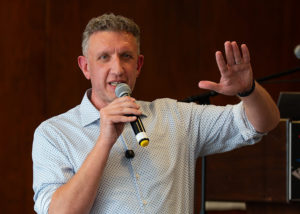
Chuck is a US-based internal communications strategist and the founder of ICology – a community and resource hub for IC professionals. He brings a practitioner lens to every conversation. Chuck is a recognised voice in the industry, a regular speaker and event host, and one of the most connected people in the North American IC world.

Jenni is a UK-based leadership and internal communications consultant, author of two best-selling books, and international speaker. She runs Redefining Communications, a consultancy working with organisations around the world to help them communicate better and close the gap between what leaders say and what employees experience.