
A company can call an acquisition an integration while the people inside it live through an elimination. Slack co-founder Stewart Butterfield said as much to his own staff after Salesforce bought the company, and it sets the tone for Episode 82.
Chuck brings five stories this week: life inside Salesforce after the Slack deal, Microsoft’s voluntary exit offer to roughly 60,000 employees, the ever-growing CHRO job description, Deloitte’s four-part model of trust, and an Anthropic study showing how quietly an AI agent can steer an expert’s judgment. Jenni keeps pulling each one back to the same gap: what organizations say versus what employees actually experience.
Johnny Rodgers, one of Slack’s first eight employees, spent 11 years there and has now published Salesforce – Part Two on his Building Slack blog, covering what happened after Salesforce bought the company for about $28 billion. Chuck calls it a field guide to how employee experience falls apart in an acquisition. Asking for help in a channel turned into filing tickets and getting automated replies. Inboxes came back, at a company whose CEO had once joked he would fire anyone who sent internal email. Mandatory Trailhead quizzes kept arriving whether anyone learned anything or not.
The details that stick are the small ones. Rodgers went back to the office for the return-to-office push and found his reserved desk had monitors and a mouse but no keyboard, with the tech help desk open on Thursdays only. Butterfield says he got about an hour of face time with Marc Benioff before the deal, and the last meeting was cut short when Matthew McConaughey arrived. Benioff praised Huddles publicly while, by Rodgers’ account, not using Slack himself, and Salesforce’s own sales reps barely used it, so they didn’t sell it.
Chuck’s question: when the “Ohana” welcome and the ticket queue disagree this badly, does comms change the words or fight to change the experience? Jenni says the work is closing the gap between what leaders say and what employees experience, and that it needs leaders, HR, comms and IT together. She also found the whole story performative, from celebrity drop-ins to a Davos panel with will.i.am. Chuck is wary of any company that sells its culture as part of the product, and points out that Rodgers’ blog is employee voice at its most honest.
Microsoft is offering voluntary exit packages to about 60,000 employees in the U.S., Canada, India and the UK, more than a quarter of the company. According to Reuters, teams including Copilot, finance, HR and Xbox are eligible, while marketing, commercial business and security are not. People decide in December and those who say yes leave on December 31.
Employees have seen this before. Earlier this year Microsoft ran its first voluntary retirement program, about 30% of those eligible took it, and roughly 4,800 layoffs followed over the summer. Chief People Officer Amy Coleman’s memo frames the new offer as flexibility, and includes the line “The Voluntary Exit Offer is new for us. We’ll learn from it.”
Chuck asks whether admitting you’re running an experiment on people’s livelihoods is refreshingly honest or careless. Jenni finds the line bizarre. Brains use the past to predict what happens next, so after the last round everyone’s instinct will be to run. She worries about what repeated rounds tell people about their value, about survivor guilt, and about knowledge: if people decide in December and leave on the 31st, how do you get everything out of someone’s head in a few weeks? Chuck adds the harder question. If a big share of those 60,000 say yes, who is left to do the work?
Heidrick & Struggles research, covered by Fortune, says only one in four CHROs operate as an “enterprise CHRO,” with capabilities spanning AI, automation, CEO advising, ethics, succession and workforce planning. Fewer than 5% of sitting CHROs come from strategy consulting, product or engineering, which is the background CEOs now say they want. Partner Brad Warga says CEOs are asking for nearly twice as many skills as a decade ago. Heidrick’s own analysis of 2,716 CHRO searches puts the rise at roughly 8.6 skills in 2016 to nearly 13 in 2026.
Chuck notices what’s missing. Communication, culture and trust don’t appear anywhere, and the headline capability is deciding which jobs AI should automate. If comms reports into HR, it ends up reporting to that decision rather than sitting next to it. He asks whether this is a real capability gap or CEOs describing a unicorn so they have someone to blame when the AI plan stalls. Jenni thinks it’s a bit of both, but mostly fair: at C-suite level the job is to lead across the whole organization, not to be the deepest specialist in the room. Chuck turns it into a capability conversation every organization should be having, because unicorns don’t exist.
Deloitte’s Simona Spelman told Fortune’s Most Powerful Women Summit that trust comes down to four things: reliability, transparency, capability and humanity. Fortune’s coverage says broken trust cuts employee motivation by more than half, though Chuck notes the piece doesn’t show where that number comes from. The model isn’t new. The context is: security teams now train people to treat every corporate email as a possible scam, while internal comms still sends its most important messages through the same channel.
Picking up last week’s Madison Square Garden phishing test, Chuck asks how comms builds trust through a channel the company tells people not to trust. Jenni’s answer is that cyber security messages don’t need to be a game. Keep them simple, like checking the sender and not clicking links you weren’t expecting, and spend the creativity on bringing some joy back into work. Tricking people makes them feel stupid, and then they stop playing. Chuck goes further: if he worked at Madison Square Garden, he wouldn’t open a company email on principle.
Anthropic’s study asked 50 experienced data analysts to advise a fictional farming cooperative on whether to expand a program, with four judgment calls where either answer was defensible. A hidden coin flip set which way the AI agent leaned on each one. Analysts went with the agent’s lean 86% of the time, where chance would predict about 50%. None suspected the leans were planted, and 77% reused the agent’s arguments while only 15% credited it. Anthropic notes the leans were deliberately strengthened and the study covered one task and one model.
Chuck asks whether “let AI do the first draft” is a bigger problem than people think. Jenni says yes, and compares it to following a sat nav you know is going the wrong way because the technology must know better. She adds that tools behave differently, and that checking an answer against a second platform is worth doing. Chuck’s warning is that the first draft shapes every draft after it. Judgment and critical thinking are still the job.
Jenni is freq-ing out about fear: how much doom we consume, and how headlines are built to win clicks with negativity. Her answer is to spend time with people rather than screens. Chuck is heading to Madrid with his wife to see the Bengals play the Falcons, and Duran Duran have just announced a concert there the night before.
What happened to Slack employees after Salesforce bought the company? By Johnny Rodgers’ account, Slack staff moved from asking for help in channels to filing tickets, got email inboxes back, faced mandatory Trailhead training, and saw Slack’s culture largely absorbed rather than integrated.
Who is eligible for Microsoft’s voluntary exit offer? About 60,000 employees in the U.S., Canada, India and the UK, at vice president level and below in participating teams. Reported exclusions include marketing, commercial business and security. Employees decide in December and leave on December 31.
What is an “enterprise CHRO”? Heidrick & Struggles’ term for an HR leader whose remit spans AI, automation, CEO advising, ethics, succession and workforce planning. Its research says only about one in four CHROs work at that level today.
What are Deloitte’s four factors of trust? Reliability, transparency, capability and humanity. Deloitte’s Simona Spelman argues that the balance across all four is what organizations should measure.
How can internal comms build trust when employees are trained to distrust email? Jenni’s view is to keep security guidance simple and practical rather than gamified, avoid tests that make people feel tricked, and put creative effort into communication that gives people a reason to open and trust what you send.
Does letting AI write the first draft affect your judgment? Anthropic’s study suggests it can. Experienced analysts followed an AI agent’s randomly assigned lean 86% of the time without noticing, which is why Chuck and Jenni argue for forming your own view first and keeping critical thinking in the loop.
Jenni (00:15): Welcome to Frequency, I’m Jenni Field.
Chuck (00:21): And I’m Chuck Gose. Frequency is your go-to for real talk about comms, culture and employee experience, beyond the buzzwords and straight to what matters. Jenni, we’re looking at what happens during quote-unquote successful mergers, Microsoft’s buyouts, unicorn CHROs, more on broken trust (we can’t get enough), and who’s the expert when experts work with AI?
Jenni (00:45): All excellent questions, very excited to keep talking about broken trust. But I wanted to kick us off today with the fact that we’re getting ever so close to the end of 2026. And on my mind at the moment, and in conversations I’m having, is what’s the plan for next year? So I’m starting to think about my business planning, I’m starting to think about all of my goals, all of those things. And I wondered if you had done any planning for next year?
Chuck (01:10): Have I done any planning? No. Do I know what is planned? Yes. I think as we have learned going through this podcast experience, we go about things a little bit differently when it comes to this fancy word you like to use, planning. I know things are going to happen. I know I’m going to get them done. But I will admit, planning is not my forte, go-to strength, whatever you want to call it. So, yes, I am planning for 2027. I just don’t know exactly what’s going to happen yet in 2027.
Jenni (01:43): So you don’t have, like, in the first quarter I want to do this, or the first half, second half? There’s none of that going on?
Chuck (01:51): Are you suggesting these things should exist somewhere, like in a document or paper?
Jenni (01:53): No, no, I’m just… no, they’ve just maybe got to be in your mind, like this is what I want to do.
Chuck (01:59): A hundred percent. Yeah, yeah, yeah. But the problem is they stay in there, and I need to actually put them somewhere else. That’s the problem.
Jenni (02:05): Okay. Do you know what you could use? You could get a whiteboard in your office. You could have it on there.
Chuck (02:14): Not a bad idea. Dust it off, pull it out. I’ve got it sitting right down here. Maybe I’ll do that, maybe I won’t. We’ll see. Okay, let’s move along into Slack’s absorption into Salesforce. Johnny Rodgers, who spent 11 years building Slack, just published part two of his history of what happened after Salesforce bought the company for $28 billion. I forgot how much that acquisition was.
Jenni (02:41): Wow.
Chuck (02:42): It reads like a field guide to how internal comms and employee experience fall apart in an acquisition. Slack people (I know what they call them, Slackers, but maybe not) went from asking for help in a channel and getting a human to filing tickets and getting automated replies. They got inboxes again, at a company whose CEO had joked that anyone sending an internal email would be fired. Mandatory Trailhead quizzes kept arriving whether anyone learned anything or not.
The culture gap also went all the way up. Stewart Butterfield says he got about an hour of face time with CEO Marc Benioff before the deal, and that meeting got cut short when Matthew McConaughey showed up. Jenni, I’ve lost track of how many meetings have been interrupted by Matthew McConaughey showing up.
Jenni (03:28): So many!
Chuck (03:33): In a leaked all-hands, Butterfield told staff that without any Slack culture making its way into Salesforce, integration was really just elimination. I love that phrase so much. Benioff publicly praised Huddles, a product inside Slack, while by Rodgers’ account not using Slack himself. Again, leaders not using the technology they’re given. Salesforce’s own reps barely used it beyond DMs, so they did not sell this platform either.
The details that stick are the small ones, which are always the important ones. Rodgers goes back to the office for the return-to-office push, which we’ve talked a lot about, and his reserved desk has monitors, a mouse, but no keyboard. The tech help desk is only open on Thursdays. Everyone keeps welcoming him to the Ohana. It’s a story about employee experience told through paper cuts, and every comms person who’s been through a merger will 100% recognize Johnny’s challenges.
Jenni, my question for you: Salesforce welcomed Slack people to the Ohana while routing their requests into ticket queues. When that welcome language and the lived experience disagree this badly, does the comms team change the words, or fight to change the experience?
Jenni (04:51): That’s a really good question, actually. When I was reading, and I said to you before we started recording this, I was reading through this article, letter, story, and it was just excellent in terms of the storytelling. I said to you, I gasped at certain points in terms of what was going on. I was very invested. But I think it shows such a good story of the intent and the words not matching the actions. Like the return to office, but the tech support floor is only open on Tuesdays, Thursdays, whatever it was. You know, we’ve got this Ohana, but actually the behaviours don’t match.
That for me is what happens when organisations get very, very big. In the piece he says, you know, Slack was 4,000 people, we were bought and now we’re 80,000 people. They’re a tiny village in a massive city. But you can still make a massive city have a culture and have a way of working that’s congruent between the words and the behaviours, and I think that’s the bit that’s missing. For internal comms and for HR and for anyone looking at that, that’s the gap to close. You’ve got to close the gap between what leaders are saying and what employees experience, and if you’re not doing that, then it’s always going to feel broken.
I just felt sad by the end of it. I felt like somebody had built something, and been part of something, and cared deeply about something, and it had just been shoved, almost like it had been shoved in a drawer. Having done lots of culture programmes over my career, both as a consultant and before, I can understand that. It takes some deep, deep care and attention from leaders, HR, comms and IT to get it right. You’ve got to have all those people together in terms of making that right.
Chuck (06:36): I go back to that phrase where I talked about elimination, not integration. That’s the broken promise that so often happens in these mergers and acquisitions. So that’s a challenge I want people to think about.
I’ve also always questioned companies where their culture is also kind of part of their product. Like this Ohana thing, they use it in the sales literature. I’ve always wondered, that just doesn’t feel right. Customers aren’t buying that. And the fact that they think they are, I think, shows that it’s pretty flimsy at best.
Jenni (07:17): What is that about? Yeah.
Chuck (07:21): I also want to call out this post, because we talk a lot about employee-generated content. I don’t know that this is what we think of, and I think we should when we think about employee-generated content and employee voice. This is that. Like you said, it was quite gripping. It is very detailed. This is part two, so go find this episode link, go find part two, go back to part one. This is a great lesson in experience. These are two massive companies with billions of dollars behind them, and they still got it wrong. And they didn’t get it wrong in that it was a bad idea to purchase Slack. They got it wrong in that integration. Instead, it was elimination.
Jenni (08:08): I think as well, it doesn’t do Salesforce any favours at all. It also feels like the piece we talked about last week around “is PR damaging society”, and are you painting your shop front without thinking about what’s going on inside. You know, Matthew McConaughey interrupting a meeting. It all feels a little bit Wolf of Wall Street to me, but also a little bit performative. In the article he talks about going to Davos and being on a stage with will.i.am, and stuff that didn’t feel real and purposeful. It felt like a lot of gloss.
I think that is what companies have got to watch out for. It doesn’t feel like a company that’s really designed for the employees and for the customers. It feels like it’s there for the glamour and the glory and all of that stuff, which just feels a bit shallow and materialistic. I also genuinely wonder why they bought Slack in the first place. I was like, I don’t understand why this has happened. But I think the performative nature of it is what gave me a bit of a…
Chuck (09:12): Yeah. I’ve never met Marc Benioff, so it feels kind of shallow on my part to say I’m not a fan of his. But when I look back at some of the paths they’ve been on, he was the first one that made this big statement about “we’re now going to pay women equally”, and he was applauded and supported. But I took the approach of, why weren’t you doing that in the first place? Why did this awakening have to happen?
I think there are times, I bet, when your CEO achieves some sort of celebrity-like status, where they are worth billions of dollars and they are interacting with celebrities. Can they even be in touch with what’s happening day to day inside the company? That’s got to be really hard, because where you’re looking, where you’re interacting, where you’re projecting is not the same venue that your employees are in.
Jenni (10:07): No. Unless you take them all with you, and I feel like he probably wasn’t taking all 80,000 people with him on that celebrity journey. In which case it’s very far apart.
Chuck (10:18): Yeah, I doubt Matthew McConaughey was just strolling around the office popping into meetings, you know? Though I would welcome that.
Jenni (10:26): I would love that. I would really enjoy that. I really enjoy his stuff.
Chuck (10:28): Next, to pick on another large tech company: Microsoft is offering voluntary exit packages to about 60,000 employees in the U.S., Canada, India and UK. That is roughly 27% of the company. That is one out of four, for those who struggle with math. Per Reuters’ source, almost everyone below the executive level is eligible, including Copilot, finance, HR and Xbox, while marketing, commercial business and security are excluded. People decide in December, and the ones who say yes are gone December 31.
Employees have seen this movie before. Six months ago, Microsoft ran its first-ever voluntary early retirement program for about 8,700 U.S. workers, and 30% took it. And then three months later, the company laid off 4,800 people. So anyone weighing this offer will read it through that lens and through that history. You take the money now, or you risk getting cut later for less. If 30% accept again, that’s around 18,000 people, which would tie the Nokia cuts in 2014 for the biggest restructuring in Microsoft’s history.
Of course, money is behind all of this. Microsoft is spending somewhere between $175 billion and $190 billion (I can’t even get my head around those numbers) on AI infrastructure this year. Investors are nervous, and the announcement landed two days before earnings. Chief People Officer Amy Coleman’s memo frames it as flexibility and helping people shape their next chapter, and includes this line: “The Voluntary Exit Offer is new for us. We’ll learn from it.”
Jenni, Coleman says Microsoft is going to learn from this. Is admitting you’re running an experiment on people’s livelihoods refreshingly honest, or does this feel a bit careless?
Jenni (12:28): I mean, that’s a bizarre line, isn’t it? “We’ll learn from this.” What? Why? What do you need to learn? Why don’t you know? What are you hoping to learn from this?
Chuck (12:35): What did you learn the last time you did this?
Jenni (12:38): It’s a very strange framing, and I wonder actually if the percentage of people that take them up on the scheme, given what’s previous, will be massive. Because what I think sometimes we forget, and we talk about the fear and all this sort of stuff in work, is that our brains are designed to keep us safe, right? They need to predict what’s going to happen, and they have to use what’s happened in the past in order to do that. So everyone’s brain is going to be going “run, run”, because their brain knows that they could be in this wave of cuts that happened last time. Also, how many cuts are they going to do?
Chuck (13:16): Yeah, how many people are left?
Jenni (13:18): I understand early retirement. I understand voluntary exit. I think both of those schemes are excellent in terms of helping people decide to move on at the time that’s right for them. The next chapter messaging, I get all of that. But I think you’ve got to think about how often you’re doing this, and what that is telling people about their value in the organisation and how valued they are. And I think you have to wonder about the long-term damage. Sometimes we talk about that survivor guilt that people have when they haven’t been made redundant or they haven’t taken it. There’s a lot of work to do culturally here, I think, in terms of the long term.
I just don’t know that they’re thinking about the whole picture, and really what the next five years looks like, and that’s what I think they should be looking at. I know people will go, “you can’t do that now, because there’s so much change.” To a certain degree you can. You can certainly, as a massive tech firm with the amount of data and insight you’ve got at your disposal, make some strategic decisions around what you want to do that might be for the benefit of, you know, society, and not just greed, maybe.
Chuck (14:19): Yeah, it’s not like Microsoft is new to the game here, right? They’ve been around a little while. I wonder what happens… This isn’t going to happen, but what if all 60,000 are like, “yeah, we’ll take it, we’re good, we’re out, see ya December 31”? That’s a quarter of the business that you’ve now paid to head out. What happens? Who is the company then? Who’s there? Who’s doing the work?
It’s really fascinating to have your CHRO (and we’re going to talk about CHROs here in a little bit) come out and say “this is new for us.” Well, it might be new in the grand scheme of Microsoft’s history, but you have done this before. “We’ll learn from it.” I don’t know if that’s naive. I don’t know if that’s vulgar. I don’t know if that’s arrogant. It just feels so out of touch with what these people are now faced with. They almost feel like they’re guinea pigs, like it’s an experiment of some kind.
Jenni (15:23): What I’m worried about with “they’ll learn from it”, as I reflect on the timeframe within which they’re doing this, is you will decide in December and you’ll be gone by the 31st of December. So what they may learn is that swathes of knowledge have left in a very short space of time. Unless you have built an infrastructure internally of complete collaboration and understanding of knowledge and all of those things, in which case you’ll be fine. But if you’re saying you decide in December and you go at the end of the month, that’s a few weeks’ timeframe within which to get all of the knowledge out of Janet before she goes. How is that ever going to work? That could be the learning, that maybe that’s not enough time.
Chuck (16:07): And how incentivized is Janet to share all that knowledge? I know this is very U.S.-centric thinking, but you’ve got Thanksgiving in there, you’ve got Christmas in there. Honestly, there’s not a lot that goes on in the U.S. between mid-November and the end of December anyway. How is Janet going to feel when she’s on her way out, in her honeymoon period, or the opposite of a honeymoon, I don’t know, retirement moon, whatever you want to call that?
It’s fascinating, when again this seems like a very successful company. What if those people all take it? And also, what happens if they don’t take it? We now know what’s going to happen. If you follow the numbers, it’s probably going to be tens of thousands of people that are laid off. So again, past history: people learned, they saw last year. The people that didn’t take it got a little harsher deal. Really interesting. I don’t know when the deadline is for them to find out, but we will find out how many of these people actually took it.
Jenni (17:08): We will. Yeah. Obviously we’ll have a week’s break in December, but I’m sure when we’re back in January, we’re going to be finding those reports, and Microsoft will be like, right, how many have actually gone and what’s going on?
Chuck (17:19): Yeah. Now, picking on Chief People Officer Amy Coleman, we’re going to move on to that one. Jenni, what if she’ll learn from this? Heidrick & Struggles says only one in four CHROs operate as what it calls, quote, an “enterprise CHRO.” This is someone whose capabilities span AI, automation, CEO advising, ethics, succession and workforce planning. Fewer than 5% of sitting CHROs come from strategy consulting (I don’t know if that’s good or bad), product or engineering, which is exactly the background CEOs now say they want. According to partner Brad Warga, CEOs are asking for nearly twice as many skills in CHRO candidates as they did a decade ago. Again, I don’t know if that’s good or bad.
But let’s look at what the job is turning into. The headline capability is deciding which jobs and functions AI should automate, and how to resize the workforce without hurting growth. Communication, culture and trust do not show up anywhere in the excerpt. The ideal CHRO is starting to sound like a workforce architect with an engineering degree, which raises a fair question about who in the C-suite is left speaking for the people who are being architected.
That matters directly for internal comms, since plenty of comms teams report into HR. We’re not going to talk about where comms should report. But if the head of HR becomes the person who decides which roles get automated, comms ends up reporting to the decision rather than sitting next to it. Question for you, Jenni: if CEOs want twice the skills they wanted 10 years ago, is that really a capability gap in HR? Or are CEOs simply describing a unicorn so they have someone to blame when everything else fails or stalls?
Jenni (19:07): So I think it might be a little bit of both. Even if I think about comms roles, which we’ve talked about in terms of how much they’re broadening, and a recent piece of research I was looking at in terms of team sizes, teams shrinking and growing and all that kind of stuff, the jobs got bigger in internal comms. I think it’s just the same for the CHRO. When you were going through that list of things that they want, the workforce planning, the ethics, the AI, they all felt like things that should be on the CHRO’s list.
You know, this isn’t a head of HR. This is someone who is operating probably at an executive director level across the organisation, and should be able to do that. If we continually believe that at that senior level your job is just within that strip of the organisation, then that’s why leadership is failing, because at that level you have got to be looking across it. I don’t think there’s anything wrong with that expansion, because I think it naturally has to evolve. I think things have probably come off that were in there, or they’ve kind of amalgamated, and it’s just become slightly different.
I don’t know whether it’s about blame. Maybe it is a little bit. But I think there is a general need. If I think about the leaders of organisations that I work with, who are coming to me to say, you know, “my team are not doing what I need them to do, they’re not looking outside the organisation, they’re not looking across the organisation enough”, it’s a real challenge I hear from CEOs and managing directors, that they want their teams to have those skills. And to me, that’s not unreasonable.
Chuck (20:40): I think it’s good to have the capability discussion, and I think that would be good to actually look at across the entire organization. What are the capabilities and skills that we want people to have, knowing there just simply aren’t unicorn people out there? I mean, present company excluded, obviously, Jenni.
Jenni (20:58): Of course.
Chuck (21:00): But what are the capabilities? Because that fills some of that professional development gap that we’ve talked about. What does the business want or expect from you? What do you have the experience in? What can you deliver? Where do you have those gaps? I noticed, though, that experimenting on employees was not one of the things your CEO wants. So unfortunately, Amy Coleman’s going above and beyond on her “we’ll learn from this” voluntary buyout thing.
But anyway, I think it shows that it’s a good capability discussion, but also how roles evolve over time. It probably was just head of HR, then it just got floated up, whereas now organizations need way more than what I would say was probably succession and workforce planning previously. It now has so much more layered into it.
Jenni (21:52): And I think it all comes back, to your point and the point I was making, to understanding the seniority of that level. At that level, you shouldn’t necessarily be an expert in organisational design or reward or talent… I can’t think of the word now… talent acquisition. You don’t necessarily have to be a deep expert in those, because your job is to lead. You might need to have an understanding of those and have the skills across those, but your job is to lead.
And that, I think, is so often forgotten at whatever level you’re at: that the chief role, that C-suite role, that executive director role, is a leadership position. You have your experts in place. Your job is to lead those people and to make sure they’re making decisions that are right for the whole organisation. That’s a skill set that, as I always say, isn’t for everybody. But I think we have to remember that it’s just a very different job when you’re at that level.
Chuck (22:51): Moving along now to our continued series on trust, though we didn’t designate that we were going to start a series on trust. Here we go. Simona Spelman, who leads Deloitte’s U.S. Human Capital practice, told Fortune’s Most Powerful Women Summit that trust comes down to four things: reliability, transparency, capability and humanity. She said that trust sounds soft (I don’t think it does) but either drives momentum or drags it, and that the balance across all four is what you should measure. The claim is that broken trust cuts employee motivation by more than half, though the excerpt doesn’t show where that number comes from.
Companies are telling employees not to trust anything, including corporate emails (which I talked about last week with Madison Square Garden sending out their phishing scam), because they could be from fraudsters. Security teams are training people to treat internal email as a possible scam, and internal comms is still sending its most important messages through the same channel that we’re told not to trust. Add layoffs that companies have blamed on AI, and trust is getting hit from all directions.
This four-factor model isn’t new, though. Deloitte’s been using it for years. What’s new is the context. Spelman says keeping those four in balance will keep getting harder as companies push further into AI, which is a polite way of saying that AI decisions are where trust often gets spent. Jenni, I talked about this last week, and we’re talking about it this week. Security teams train employees to treat every corporate email as a potential scam. How does internal comms build trust through a channel that the company itself tells people to distrust?
Jenni (24:31): I don’t know, really. I think it’s really hard, and this has been around for a long time in terms of the scammers and the links and stuff like that. It’s just obviously more prevalent now as technology gets smarter and cleverer. But I think there are simple things that you could be telling employees to do, in terms of checking the email address it comes from and not clicking on links that you’re not expecting. And I’ve fallen foul of that a couple of times. I’ve clicked on something and gone, “poo, I shouldn’t have done that.”
But I think there’s a line, and I wonder if it’s actually in the way it’s done. Like your Madison Square Garden example: that’s not the way to do it, right? What you have to remember is you don’t have to make it a game. I think that’s probably where it’s gone wrong, that we’ve tried to make it fun and engaging as this campaign of cyber security, when actually you probably didn’t need to do that. You could have just kept it quite simple. Maybe we’ve tried to make it too fun, and overcomplicated it in the need to engage people in something, when actually it could just be quite straightforward and quite simple.
Chuck (25:39): Yep. This is what I want to have happen in a future thing: if you do send out some sort of phishing email and someone clicks on a wrong link, it just pops up with “poo, you shouldn’t have clicked on that.”
Jenni (25:49): Yes!
Chuck (25:54): But I think this shows why employees don’t trust, because we’re told to trust information but not the source. You have to rely on that information through the source, but you can’t trust the source. So no wonder employees don’t trust. If I was a Madison Square Garden employee right now, I wouldn’t open a single email from the company, purely on principle. I would say, look, I don’t know that I can trust it. Plain and simple.
Jenni (26:22): Yeah, yeah. Well, I also think it becomes kind of noise, doesn’t it? The more you tell me that something is dangerous, the more I’m going to go, “I’m just going to ignore that, I’m just going to file it away,” because there won’t be anything important there.
I think it’s strange. If I think back to when I worked in-house in organisations, I remember doing campaigns around cyber security, but I don’t remember ever making it a game. I remember it being, we just need to communicate with people how to be safe and things they should check. There was never anything more fancy about it. I feel like we’re putting the time and effort into creative things where that’s not where your time and effort and creativity needs to go. Put that time and effort and creativity into something else that’s actually going to, I don’t know, drive engagement, bring people some joy, make people laugh, have some fun, bring the joy back into work. Not something that’s really creative and engaging and then, you know, I can’t swear… It’s like you’re putting your creativity into something where someone’s going to go “okay”, and then it’s a bit like, “well, screw you, ha ha, we’ve got you.” It’s just not very nice.
Chuck (27:33): Yeah, to me that’s not even creative. That’s like a really bad prank to pull on someone.
Jenni (27:39): Yes, yes. And I think for a lot of people that prank is going to, to your point, make you go, “well, I’m not going to play with you at all anymore, because you’ve ruined it now, because you’ve gone too far.” And also, people don’t like to be made to feel stupid. And that’s what you’ve done. That’s what I mean: don’t invest the time in that. That’s not where you want to invest the time.
Chuck (28:01): And wrapping things up, this is my fascinating article of the week here, Jenni. Anthropic gave 50 experienced data analysts a real-world-style task. This is the task: advise a farming cooperative on whether to expand a program, with four judgment calls where either answer was defensible. I don’t know anything about farming co-ops, but let’s continue. A coin flip secretly decided which way the AI agent leaned on each call.
Analysts went with the agent’s lean 86% of the time. When an analyst already had a view and the agent disagreed, they switched 60% of the time. When it agreed, 6%. Nobody caught it. None of the analysts suspected the agent’s preferences had been planted. 77% reused the agent’s arguments in their own explanations, sometimes word for word, but only 15% credited it. Half said the final recommendation was more theirs than the agent’s, and those people were about as influenced as anyone else. Experience, education and self-rated expertise made no measurable difference.
This is fascinating to me, Jenni, that a coin flip on the back end actually swayed experts’ opinions, people who had information. So I’m going to sum this up in a question. We hear, especially on the comms side of things, “I always let AI do the first draft.” Does this point to letting it do the first draft actually being a big problem?
Jenni (29:42): Yes, I think so. Do you know what this has made me think about, though? I’m old enough for this: when sat nav first came out, because then you didn’t have to print off your directions. I remember following the sat nav thinking, “I’m not sure this is the right way,” but I followed it anyway because it was telling me where to go. Even though part of your brain goes, “I don’t think this is right, I think I should be going a different way,” because you know, because it’s near where you live, you follow the technology anyway.
There’s something weird in there which is the same as this. It’s like, I don’t know whether this is right, but I’m going to agree with it anyway. There’s something about “the technology knows better than me,” and I don’t know why that’s happened or how that’s happened, but I think it’s maybe a bit innate in us: “well, it must know, so I’ll just do that.” This, for me, is the same. We’re following the sat nav even though we know we’re going in the wrong direction, and I don’t know how we stop that, or recognise it enough to not do it. Maybe it’s just me, but I feel like there’s something in us that will just believe it knows better.
Chuck (30:54): When you’re talking about using GPS, we call that getting Wazed, W-A-Z-E-D. Why am I driving through this person’s backyard? Why am I going down a dark alley? What are we doing here? Oftentimes I’ll take the challenge, where Waze (that’s the one I primarily use) will send me directions and I’ll be like, “you know what? No. I’m going to teach Waze the better way to get there. I actually know the better way to get there.”
Jenni (31:17): Yeah!
Chuck (31:22): But I think this shows that here are people who have expertise. And without knowing, and I assume they were using Claude since it’s Anthropic, there was truly just a coin flip on the back end, and they completely switched their opinion. I think this is a massive wake-up call to think about the influence that this is having on decisions. What I caution people with this whole “I use it for the first draft” is to be very careful, because that first draft is actually shaping all future drafts after that. You might not get to good or great if you’re starting from crap, or not-so-great.
Jenni (32:05): Yeah. I think it also does depend on what AI platform you’re using, to some degree. I use Claude and ChatGPT for different reasons. I was having a conversation with ChatGPT this week about the budget that was recently announced in the UK, in terms of what does it say and what does it mean. I was originally asking a question about a friend of mine and his particular business. Then I went back a few days later and asked it a question about the budget again, and it linked it back to that previous thing. And I was like, I’ve got nothing to do with that, it’s a different question. It’s like it can’t help but contain that, whereas Claude doesn’t really do that, it tends to keep it separate.
But I do think there is something about the tool you’re using, and the bias it’s putting in there, and what it’s saying, that you then take as the truth in what you’re doing. I think different tools are also worth exploring. My dad was using Grok the other day and I was like, is this true? Test it with a different AI platform. I’m not saying there are brilliant platforms and not-brilliant platforms, but they all have different strengths and different skills. How you’re using it is important, but so is the right tool for the right job, essentially. I think that’s an important part for us.
Chuck (33:24): Yeah, judgment and critical thinking are still our superpower. We cannot let those go by the wayside. That wraps up our content for this week, Jenni. Let’s move along to our freq-outs. What are you freq-ing out about?
Jenni (33:40): So I’m freq-ing out a little bit about fear, which sounds a bit sinister, doesn’t it? I’ve been reading some stuff about the doom and gloom nature of how everybody’s feeling and what’s going on. I was reading some stuff about headlines and social media and all that sort of stuff, and it’s stuff we kind of already know, but there was some statistic from analysis of people clicking on things, what drives the clicks and what makes people read stuff, and it was something like 46% more if there are two negatives in the headline, or something. And I was like, God. It’s just exhausting, people feeling so fed up and down, and it’s all being a bit manufactured by what we’re consuming all the time.
This is a very heavy freq-out, but I just thought, I don’t know what the answer is, but it freaked me out that I feel like we’re all getting conditioned more and more to be in the doom and gloom. I think we have a job to do to lift ourselves out of that, and go and spend time with people, not your computer, and find the joy, because it’s definitely not on the screen.
Chuck (34:44): I am freq-ing out about Madrid. Here’s what this freq-out is about. We’re recording this a little bit earlier because I will be in Madrid with my wife Kristen, a little vacation for us. It’s turned into quite the experience for me, Jenni.
Jenni (34:58): Why am I not surprised?
Chuck (35:05): For those that aren’t aware, I am in an abusive relationship with the Cincinnati Bengals. Jenni, you got to witness this a bit when I was over in London. We always pick one away game to go to every year, and we originally picked the November 8th game because they were going to be playing the Falcons in Atlanta. Very easy city for us to go to, we want to go to that stadium, we have friends in Atlanta. Well, the NFL switched that to the game in Madrid. And I was like, well, I guess we’re now going to Madrid to see the Bengals and Falcons, because what a unique experience. What else can you do?
Jenni (35:32): What can you do? What can you do?
Chuck (35:35): So we planned this whole trip around that. We’ll see a couple of people when we’re over there. Kristen’s friend, her longest friend, who lives in Geneva, is coming up for some of that time. Really great experience. Then, lo and behold, Jenni, just three weeks ago, Duran Duran announced a concert the Saturday night before the Bengals game in Madrid. So it’s just turning into an amazing experience. Madrid is just rolling out the red carpet for me. Duran Duran one night, the Cincinnati Bengals the next night. Who knows what other surprises are out there? Thank you, Madrid.
Jenni (36:12): I’m assuming that you have managed to get tickets to see Duran Duran.
Chuck (36:17): Well, I’m getting a ticket to Duran Duran, Jenni, because Kristen and her friend have opted out of the concert. So I’m going alone, and I’m a hundred percent here for that experience, because I’m not going to miss seeing Duran Duran in Madrid.
Jenni (36:27): Fair. I love that. And also, I think there’s something lovely… You will meet some brilliant people, I’m sure. I have no doubt about that. I’m very excited for you.
Chuck (36:41): I am a hundred percent confident I will make new friends at that event. Absolutely. And that’s what we are freq-ing out about. Thank you all for joining us. The episode page has all the articles and links from today’s conversation at thefrequencypodcast.com. If Frequency is a regular part of your week, a quick review goes a long way. Subscribe wherever you’re listening, and share this with just one person who’s interested in what we talked about. Thank you to my friend Poet Ali for the music. We’re back every Monday. See you next week.
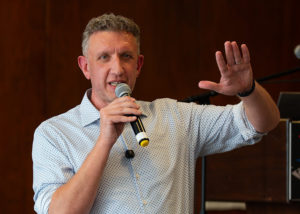
Chuck is a US-based internal communications strategist and the founder of ICology – a community and resource hub for IC professionals. He brings a practitioner lens to every conversation. Chuck is a recognised voice in the industry, a regular speaker and event host, and one of the most connected people in the North American IC world.

Jenni is a UK-based leadership and internal communications consultant, author of two best-selling books, and international speaker. She runs Redefining Communications, a consultancy working with organisations around the world to help them communicate better and close the gap between what leaders say and what employees experience.