
Chuck Gose and Jenni Field explore “microshifting” as the next stage in flexible work, dig into fresh data on how people actually use ChatGPT and where GenAI is already reshaping the comms function, and close with a simple two-word phrase for setting real boundaries at work.
Discussing a Forbes piece on “microshifting” — flexible work blocks organized around energy and life rather than a fixed schedule — Chuck and Jenni examine data showing “hybrid creep” is real (34% of hybrid workers now go into the office four days a week, up from 23% in 2023) even as employees push back by refusing to let a rigid clock dictate their productivity. Owl Labs data cited in the discussion shows employees would sacrifice real percentages of salary for flexible hours or a four-day week, underscoring how valuable flexibility has become relative to pay itself.
Reviewing OpenAI’s new usage-and-adoption report, Chuck and Jenni note that four tasks dominate real-world ChatGPT use at work — writing, research, programming, and analysis — supporting the idea that today’s AI adoption pattern looks like augmentation rather than wholesale automation. The two compare their own daily habits directly, sharing where they’ve each embraced AI in their work and where they still hold back.
A BCG report finds comms sits near the top of the AI-readiness list: roughly a third of time can be reclaimed today by wiring GenAI into task-level work, climbing toward 47% as teams reshape processes further, with cost impact tracking a similar curve. More than 80% of a typical comms role sits in the “augmentation or supervised autonomy” zone, with only about 8% purely human-dominant. Chuck and Jenni discuss what it means to use that freed-up capacity to raise quality and personalization rather than simply cutting headcount.
Closing the episode, the hosts discuss a BBC piece on the phrase “I don’t” as a more effective boundary-setting tool than “I can’t” — reframing a boundary as a personal standard rather than an excuse that invites negotiation. Both hosts share their own examples, from not taking meetings after five to not doing overnight flights for work.
What is “microshifting,” and is it really replacing the traditional 9-to-5? “Microshifting” describes flexible work blocks organized around energy and life rather than a fixed schedule, per a Forbes piece — though “hybrid creep” is real too (34% of hybrid workers now go into the office four days a week, up from 23% in 2023), and Owl Labs data shows employees would sacrifice real percentages of salary for flexible hours or a four-day week.
How do people actually use ChatGPT at work, according to OpenAI’s own data? Four tasks dominate — writing, research, programming, and analysis — supporting the idea that today’s AI adoption pattern looks like augmentation rather than wholesale automation, per OpenAI’s new usage-and-adoption report.
How much of a typical internal comms role can realistically be handled by AI? More than 80% of a typical comms role sits in the “augmentation or supervised autonomy” zone, with only about 8% purely human-dominant, according to a BCG report — roughly a third of time can be reclaimed today by wiring GenAI into task-level work, climbing toward 47% as teams reshape processes further.
Why is saying “I don’t” more effective than “I can’t” for setting workplace boundaries? A BBC piece argues “I don’t” reframes a boundary as a personal standard rather than an excuse that invites negotiation, unlike “I can’t” — both hosts share their own examples, from not taking meetings after five to not doing overnight flights for work.
Chuck: Welcome to Frequency, I’m Chuck Gose.
Jenni: And I’m Jenni Field. Frequency is your go-to for real talk about comms, culture, and employee experience — beyond the buzzwords and straight to what matters. This week I want to start with meetings — I feel like so many of them lack any real purpose, to the point where I’ve started thinking we should just rebrand the pointless ones as “parties” instead, since at least then people would know not to expect an outcome.
Chuck: I love that reframe. It also connects to something I’ve been thinking about since Leaders Reboot and our own recent in-person events — how much richer leadership conversations and team dynamics are face to face compared to over video, even when the video version is perfectly functional on paper.
Jenni: Completely agree — there’s a texture to in-person connection that a video call just can’t replicate, no matter how good the technology gets. Speaking of new ways of working — let’s get into “microshifting.” Forbes frames it as short, flexible work blocks fit around your life and energy rather than one fixed eight-hour slab. It’s less about location and more about control — trust plus clear outcomes beating presence tracking. The risk is fragmentation if teams don’t set shared windows for availability. Where do you see this breaking down first — goals, availability, manager trust, or something else?
Chuck: I think manager trust is where it breaks down first, honestly — microshifting only works if a manager genuinely trusts outcomes over visible activity, and a lot of managers still haven’t gotten there, even with hybrid work now several years old. Without that trust, microshifting just becomes another thing for a suspicious manager to monitor rather than the flexibility it’s meant to offer.
Jenni: That tracks with the “hybrid creep” data too — 34% of hybrid workers now go in four days a week, up from 23% in 2023, even as employees keep pushing back against letting a fixed clock dictate their day. Owl Labs data shows employees would sacrifice real percentages of salary for flexible hours or a four-day week — flexibility has genuinely become as valuable as compensation itself, which is a striking thing for organizations to reckon with.
Chuck: And knowledge workers with full schedule flexibility report meaningfully higher productivity and focus, while a lack of flexibility triples someone’s intention to job-hunt — that’s not a soft, feel-good statistic, that’s a retention risk hiding in plain sight.
Jenni: Ensuring fairness across roles is the hard part though — not every job can microshift the same way a desk-based knowledge role can, and that’s where I think this concept needs the most careful thinking before it’s rolled out broadly.
Chuck: Let’s move to AI — OpenAI’s new usage report is refreshingly concrete about what people actually do with ChatGPT in their first 90 days: four tasks dominate — writing, research, programming, and analysis. It’s augmentation, not wholesale automation, at least so far. Where have you personally embraced AI in your work, and where have you resisted?
Jenni: I lean on it heavily for first drafts and structuring my thinking, but I still resist it for anything that requires genuine judgment calls about a client’s specific culture or politics — that’s exactly the kind of context AI doesn’t have and I don’t think it should be trusted with yet. What about you?
Chuck: Similar — research and drafting, yes; anything requiring real relationship context or sensitive judgment, no. It’s a good sanity check against the more apocalyptic “AI is coming for everyone’s job” framing that gets so much attention.
Jenni: Speaking of which — BCG’s latest report puts comms near the top of the AI-readiness list: roughly a third of time reclaimable today by wiring GenAI into task-level work, climbing toward 47% as processes get reshaped further. More than 80% of a typical comms role sits in the augmentation or supervised-autonomy zone, with only about 8% purely human-dominant. How do you feel about that 80% figure?
Chuck: My honest reaction is that it’s less alarming than it sounds once you actually read what’s inside that 80% — it’s largely repetitive, data-driven, or content-intensive work, which is exactly the stuff nobody particularly enjoys doing manually anyway. The real opportunity, like BCG frames it, is using that freed-up capacity to raise quality and personalization rather than just cutting headcount.
Jenni: That’s the crucial distinction — this data is a blueprint for elevating the work that’s left, not an argument for shrinking teams. I’d want any leader reading this report to commit publicly to that framing before rolling out AI tools, so employees don’t reasonably assume the endgame is job cuts.
Chuck: Let’s close with something practical — a BBC piece on the phrase “I don’t” instead of “I can’t” for pushing back at work. “I can’t” invites negotiation and sounds like an excuse; “I don’t” is a stated personal standard that’s harder to argue with. What’s yours?
Jenni: “I don’t take meetings after five” — full stop, no negotiation implied.
Chuck: Mine’s “I don’t do red-eye flights for work” — I learned that one the hard way after a few brutal trips early in my career. It’s such a small linguistic shift, but it changes the whole conversation.
Jenni: It really does — worth trying for anyone who’s been struggling to hold a boundary that keeps getting negotiated away.
Chuck: That wraps this week’s stories. What’s your freak-out?
Jenni: Genuinely just excitement about Leaders Reboot coming up in London — looking forward to a room full of people working on their own credibility and leadership presence.
Chuck: Mine’s much smaller — I hit Diamond Medallion status again on my airline loyalty program, which shouldn’t feel as good as it does, but here we are.
Jenni: A little status boost is allowed. Thank you all for joining us this week. All the articles that inspired this conversation are in the show notes — rate and review after you’ve listened, subscribe so you don’t miss an episode, and pass this along to someone who’d enjoy it; find us on YouTube too. Thank you to Poet Ali for contributing the music to the show, and we’ll be back next week with more news, insights and opinions about comms and leadership in workplaces today. Keep tuning in and turning up.
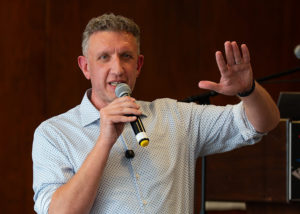
Chuck is a US-based internal communications strategist and the founder of ICology – a community and resource hub for IC professionals. He brings a practitioner lens to every conversation. Chuck is a recognised voice in the industry, a regular speaker and event host, and one of the most connected people in the North American IC world.

Jenni is a UK-based leadership and internal communications consultant, author of two best-selling books, and international speaker. She runs Redefining Communications, a consultancy working with organisations around the world to help them communicate better and close the gap between what leaders say and what employees experience.