
Jenni brings four stories built around one question: whose job is it to fix the things that are broken about how we work? A Times piece on return-to-office tracking gets Chuck talking trust, not compliance. New HBR research says generative AI makes people more productive but less motivated — and Chuck isn’t buying that the AI is the problem. A viral Diary of a CEO clip about “owning your own” work-life balance gets pushed back on hard. And Amazon’s Andy Jassy explains away a flattened management structure in a way Chuck finds a little too convenient. Along the way: time zones, hustle culture, and why Jenni’s new drum lessons are exactly the kind of play that has no ambition attached to it.
Jenni brings a piece from The Times on return-to-office mandates, flagging a quote from Daniel Harris, director at recruiter Robert Walters: “tactics of potential bonus cuts or tracked attendance ensure compliance.” She finds the language dehumanizing — treating employees like a monitored commodity — and cites a Michael Page survey referenced in the article (unavailable directly) finding 43% of managers believe productivity improves in person, against 46% of employees who say they’re more productive at home. The article also points to generational data from property group JLL and jobs platform Flexa, noting Gen Z workers (born 1997–2012) are actually the least likely to want remote-only roles. Chuck calls the tracking impulse “big brotherish” — a sign of a lack of trust rather than a real productivity strategy — and notes that if 43% of managers believe in-person work is more productive, that means 57% don’t. On the generational split, his read is that younger employees may be craving the in-person social development COVID took from them, not necessarily endorsing a five-day mandate.
Jenni raises new HBR research — a study of over 3,500 people finding generative AI use drives real performance gains, but also leaves employees less motivated and more bored when working on tasks without AI. Chuck’s reaction flips the framing: if people are bored and unmotivated the moment AI is taken away, they were probably already bored and unmotivated before it arrived — so the fix isn’t limiting AI, it’s letting people use it, since it’s clearly unlocking something. He points to his own use of AI as a “formula assistant” in spreadsheet work as proof it removes tedium rather than replacing judgment. Jenni raises a separate data point she’s still tracking down for the show notes — that AI reportedly improves high performers’ output by around 7%, but boosts perceived expertise for average performers by something closer to 20% — and connects it back to an earlier conversation about organizations preferring to hire AI over people for certain tasks.
Jenni brings up a clip from Diary of a CEO with Steven Bartlett, featuring Emma Grede — founding partner of Skims, Good American, and Safely, chairwoman of the Fifteen Percent Pledge, and a board member at Baby2Baby — arguing that work-life balance is something individuals are responsible for building themselves, and that an extraordinary life or career takes more than a nine-to-five. Chuck calls the framing “convenient” — close to corporate gaslighting, putting a systemic issue back on the individual — but draws a line between people who’ve knowingly chosen an ambitious, all-in path (not the ones he sees struggling with burnout) and the far larger group being told their exhaustion is a personal failure to manage. He reframes balance as an elastic relationship between work and life, where each gives ground to the other at different times, rather than a fixed split. Jenni agrees the responsibility for setting personal boundaries is real and individual, citing her own past decision to leave a demanding office job at 4pm rather than 6pm once she recognized the organization wasn’t actually in crisis — but she also acknowledges plenty of listeners will feel that culture, not willpower, is what’s actually stopping them.
Jenni brings Amazon CEO Andy Jassy’s comments on the HBR IdeaCast, describing a company that’s grown so many layers of management it now has “a pre-meeting for the pre-meeting for the pre-meeting for the decision meeting” — and an effort to increase the ratio of individual contributors to managers by at least 15%, a target Amazon has already beaten. Chuck is skeptical, calling it a clever way to dress up stripping earned manager titles from people who worked hard to get them, and argues the real issue sounds more like a trust and communication problem dressed up as a headcount problem. Jenni pushes back on judging the change too quickly without knowing how it was implemented — whether roles were eliminated outright or decision-making authority was simply redistributed — while agreeing that organizations rarely examine what they could remove, not just add, when untangling slow decision-making.
Is “tracked attendance” at the office a productivity strategy or a trust problem? Both hosts read tracking and compliance language as a symptom of eroded trust, not a genuine output strategy — especially since the data shows most managers (57%) don’t even believe in-person work is more productive.
Are younger employees really the generation that wants to work from home the most? No — data from JLL and Flexa cited in the Times piece finds Gen Z workers are the least likely of any generation to apply for remote-only roles, which runs against the common narrative.
Does using AI at work actually make you less motivated? New HBR research says yes, on tasks done without AI afterward — but Chuck argues that’s a sign those tasks were already unmotivating, not evidence that AI itself causes the drop.
Is work-life balance really down to the individual, as Emma Grede argued on Diary of a CEO? Partly, say the hosts — personal boundary-setting is real and valuable, but treating it as entirely a personal responsibility lets organizational culture off the hook.
Why is Amazon cutting management layers? CEO Andy Jassy says growth created too many approval layers and “pre-meetings,” so the company is deliberately increasing the ratio of individual contributors to managers by at least 15% to speed up decision-making.
Chuck: Welcome to Frequency, I’m Chuck Gose.
Jenni: And I’m Jenni Field.
Chuck: Frequency is your go-to for real talk about comms, culture, and employee experience — beyond the buzzwords and straight to what matters. Jenni, to kick things off today, I wanted to begin with a celebration I saw you share on Instagram. A little offended I saw it there first — thought we were better friends than that. But congratulations on passing 4,000 copies of your latest book.
Jenni: Thank you — we actually got to 4,001 right at the six-month mark for Nobody Believes You. I’m really pleased. Sometimes it’s hard to celebrate those milestones because you’re already onto the next thing, but I’m really, really pleased. Very good number.
Chuck: I want to sit with that for a second — genuinely impressive. As someone who’s never written a real book, I recognize that achievement. But I wanted to open with a positive one so I could come back with a slightly less positive one — can we talk about your abuse of time zones? We use WhatsApp to plan the show, and the other morning I woke up to an absolute barrage of comments and questions from you. I’m an early riser, up around 5:30–6am Eastern, which I recognize is midday for you. I’m now feeling the pain I used to inflict on West Coast colleagues by messaging them at 8am my time. And then the flip side — I’m probably sending you things at 8, 9, 10pm my time, which doesn’t feel late to me at all. Do you not recognize the danger of time zones?
Jenni: No, because I work asynchronously — when I message you, it’s on the basis that you’ll deal with it whenever you’re awake, not immediately. It’s more “here’s everything we need for today” than an urgent ping. Occasionally I’ll flag that I actually need something now.
Chuck: There was a bit more aggression in this last round, I felt.
Jenni: There was — I’d had a very busy week of travel, so my time to get things done was really compressed. Normally at home I’ve got time to think it through; that week it was “I’ve got an hour for this or it’s not happening.” But equally, when you send me things late at night, I just assume it’s for me to pick up whenever I’m ready — so I figure you extend me the same courtesy.
Chuck: Fair enough. Let’s get into this week’s discussion — what have you got queued up?
Jenni: A few different things — about four articles. We’re covering the impact of AI at work and a bit on work-life balance: an HBR research piece on generative AI and its effect on productivity and motivation, something on work-life balance and the importance of context in podcast soundbites, and the future of the line manager role. But I want to start with a piece from The Times about our “time in the sun” coming to an end and a return to office. Return-to-office has been a running topic for us, but there were a few quotes in this one worth talking through — some of which are what I sent you on WhatsApp the other day. The article quotes Daniel Harris, director at recruiter Robert Walters: “tactics of potential bonus cuts or tracked attendance ensure compliance,” adding that “increasing productivity is a key focus for many employers who aim to maximise workforce output through tighter monitoring.” I really struggled with that “tracked attendance ensures compliance” framing — it feels like we’re going backward, talking about employees like a commodity, which dehumanizes work even more. The article goes on to reference a Michael Page survey of 50,000 professionals — I couldn’t find the original survey, but per The Times it found 43% of managers believe productivity improves in person, while 46% of employees said they’re more productive at home thanks to fewer distractions, better time management, and more autonomy. It also cites property group JLL and jobs platform Flexa (whose clients include Microsoft, TUI, and Virgin O2) finding that Gen Z employees — born 1997 to 2012 — are actually the least likely to want remote-only roles. There’s more RTO data every week, but this generational split feels like it might cut against the assumption that young people only want to work from home. My first question, Chuck — what do you make of the tracking and compliance piece? Is that more common practice on your side of the pond, or are you as outraged as I am?
Chuck: It is concerning. There’s a word in that quote worth noting — a lot of this conversation is about knowledge workers, and requiring people to be at work while focusing on outputs. How do you actually measure outputs for someone in accounting, or in HR? In comms we’ve been trying to shift the narrative from outputs to outcomes — what are you actually changing or improving in the business, not how many things you sent or how many widgets you made. The tracking piece feels very “big brother,” which speaks to a lack of trust. And some of the data itself is interesting — when 43% of managers believe productivity improves in person, that means 57% don’t. Managers skew toward an older generation, so the more interesting part to me is that younger employees actually want to come into the office. There’s a balance between productivity belief and generational desire — it’s encouraging that new employees want office time, though it doesn’t mean five days a week. Give them the choice. But the monitoring, the measuring outputs, the “how many widgets did you make” — that’s a massive lack of trust, focused purely on control.
Jenni: Totally agree. What’s your take on the generational piece specifically?
Chuck: I wonder how much of it traces back to COVID — younger generations missing out on pivotal social development during high school or college. As humans we crave that, so it makes sense they’re seeking it out now. I just don’t think everyone needs it five days a week, 40 hours a week.
Jenni: Fair. I find it really interesting data, because there’s a narrative that young people categorically don’t want the office, and this suggests otherwise — which I think is a good thing, given the learning and opportunity that comes with it. Glad we’re aligned on tracking and control not being the answer.
Chuck: Just to reiterate — RTO doesn’t have to mean office-only, and it doesn’t have to mean five days a week. It can still mean flex or hybrid work, whatever language you want to use. Giving people that choice is what helps.
Jenni: Agreed — it always comes back to choice. Next: a piece from Harvard Business Review, “Gen AI Makes People More Productive—and Less Motivated.” AI has been the year’s biggest topic, so I’m always keen to see research that backs up the opinions and headlines, because it’s easy to either frighten people or oversell it. This piece argues there’s a real opportunity from integrating generative AI into the workplace — around productivity, creativity, and innovation — but also a downside. A study of over 3,500 people found using AI tools led to performance gains, but also left employees less motivated and more bored when working on other tasks without AI. If that’s the case, leaders need to think harder about workflows and the broader employee experience that drives intrinsic motivation. I was actually talking to someone just before we recorded about research — not yet public — looking at AI’s effect on critical thinking over longer time horizons: low, medium, and heavy usage, then what happens six months on. But my question here: motivation and productivity seem tightly linked for employees — so if AI is the thing everyone wants brought in, but research says it leaves people less motivated, how do we get that balance right?
Chuck: I read this differently. It uses “performance gains” — not sure that’s a direct synonym for productivity — but then says people were less motivated and more bored working without AI, which to me suggests they were already less motivated and bored before AI, full stop. So: let them use it. If it improves performance, creativity, and how good they feel about their work, then let them use it — because without it, they’re telling you they’re bored anyway. Maybe that’s oversimplified, but that was my gut reaction.
Jenni: I love that. I read something else I still need to track down for the show notes — about AI’s impact varying by seniority or expertise level. If you’re a very high performer, AI apparently only improves your performance by something like 7%. If you’re more middle-of-the-road, it lifts your perceived expertise by something closer to 20%. Quite different depending on where you sit — which connects to an earlier conversation we had about organizations preferring to hire AI over people for certain jobs. But I love your take that they were already bored — give people tools to play with, get them curious, and maybe that’s what actually helps.
Chuck: That’s some of what I’ve talked about before — AI gives you room to build and create in ways you couldn’t before. Personally, it’s reshaped how I use spreadsheets: if you’re not an Excel guru, formulas and endless Google searches are tedious, and now AI is essentially my formula assistant. That’s made me feel not just more productive, but like the actual work is better — I’m not stuck in the grind, which frees up time for other things, including more creative work like images or video. It unlocks more than just time; it gives people freedom to create differently. So yes — I think a lot of people were bored before this, and it’s lit a spark, giving them a counterbalance.
Jenni: I love that take — it’s such a positive framing. But it also makes me think about the danger of just looking at the numbers, because there’s going to be so much more context behind that data than the headline figures suggest.
Chuck: Few people love digging into context more than me, Jenni.
Jenni: You really do. So — onto your favorite topic, work-life balance. There was an interview on Diary of a CEO with Emma Grede a week or two back, and a clip did the rounds everywhere about “lying about work-life balance.” Emma is founding partner of Skims, Good American, and Safely, all launched with the Kardashian family — she’s also chairwoman of the Fifteen Percent Pledge, a board member at Baby2Baby, and was named one of Forbes’ Richest Self-Made Women in America. I had the pleasure of hearing her speak at a Unily conference in October ’24, and she was fantastic. In the interview with Steven Bartlett, nearly every article I read this week in prep for this kept coming back to this clip. When you only get a snippet of a longer conversation, you lose context — something we’ve talked about before — but what she says is that you’re responsible for your own work-life balance, that it’s yours to figure out. She points out that work is now far more flexible than it used to be, speaking to her own organization, but also argues that if you want an extraordinary life, or to be at the top of your game, it’s going to take more than a nine-to-five — if you’ve got that ambition, you can’t expect to get there in a normal nine-to-five setup. Around the same time, I saw a post from professor Adam Grant on Instagram, essentially arguing that burnout and work-life balance are tightly bound together. I know you’re not a fan of work-life balance as a concept, but there’s something in what Emma’s saying about individuals taking ownership — though I also know listeners will say they’d love to take ownership, but their organization’s culture, per Adam Grant’s point, just doesn’t let them. What did you make of the interview?
Chuck: You’re right, not one of my favorite topics, but let’s get into it. It’s very convenient to say “this is your problem to solve” — putting it back on the individual feels remarkably like corporate gaslighting, like you’re supposedly in charge but aren’t really given the conditions to be. This might be the audience of Diary of a CEO specifically — plenty of people might want an extraordinary life, but that’s a long reach for most of them. I do like the point about ambition — there will always be people who push harder, who want to fill their cup more, and that’s on them. But those aren’t the people I see struggling with burnout. Those aren’t the people I see challenged by work-life balance, because they’ve already accepted there won’t be a balance for them — that’s not in the cards, by choice. We’ve had some really valuable conversations inside ICology about burnout, and the key thing I’ve learned is that work is only part of burnout — there’s so much on the personal side that contributes too. Problems at home, caring for an aging parent — all sorts of things that lead to burnout that have nothing to do with work. Work just piles on and says “this is your problem to solve, go figure it out.” Boundaries sound great — that’s something we’ve discussed in ICology, and I’ll admit I’m genuinely bad at setting them. But that’s on me to fix. The ambition angle is fine — those aren’t the people I see struggling with burnout. It’s the people being told “this is your problem, companies are out” that concern me.
Jenni: Interesting what you said about boundaries being yours to set — for me, work-life balance is really just another word for boundaries. I decide my non-negotiables, what I will and won’t do. I’ve talked before about working at an organization where I was starting work on the train at 6:15am, in the office by 7:30, leaving at six, home by 7:30, then the gym, then bed, on repeat daily. I loved it, honestly — I did have a day at home in there too — but eventually I realized the organization wasn’t actually in crisis, so I didn’t need to be there that long, even accounting for the time zones I was managing. So I chose to leave at four to get home at a reasonable hour — that, to me, is what we now call work-life balance, but it was really just setting a boundary around where I was comfortable. I wonder if “balance” has just become an overused buzzword. Emma is talking about her own organization and the culture she’s built — she says in the interview that when someone asks “what’s the work-life balance here?” in an interview, she doesn’t want to hear that question, because building a business means wanting people who bring that ambition with them. If someone instead asked “what’s the culture like here?” — which is arguably the same question asked differently — I think that’s a completely fair thing to ask. I wonder if we’ve just become uncomfortable with “balance” as a word, since it’s come to mean something that doesn’t really mean anything specific anymore.
Chuck: I see work and life more as an elastic relationship. There will be times work needs more, so life gives a little; times life needs more, so work gives a little. As long as people feel that give-and-take exists in their life, that’s what actually works. I think about it like gymnasts on a balance beam — some people are thrilled just to walk across without falling, and some can do incredible things on it. Balance is deeply personal. Organizations that get it right recognize that elasticity — that there’ll be stretches and pulls. You and I both travel a lot, and there are times you need to pull in that direction, and times you’re home and need to pull back the other way. We both work for ourselves, so we get to make those calls — not everyone does. But I think that give-and-take, the ability to lean one way or the other when one side needs more, is actually what people mean by work-life balance.
Jenni: I love that. A few people come to mind — your friend Jon Acuff and his book All It Takes Is a Goal, where he writes about being in the season you’re in. I say this to people constantly — sometimes you’re in a tough season and the elastic is stretched, and other times you’ve got more space. That connects to the work of my coach Chris Ducker, whose upcoming book Long-Haul Leader — he interviewed me for it — is about being a leader for the long haul without burning out. He always says “hustle is a season, not a lifestyle.” I think we’re sometimes made to feel we have to keep going, doing everything all the time, and that’s exactly when the elastic gets overstretched. It’s not just work — plenty of other things compound it too, and it’s about finding a way to navigate that give-and-take. That’s why I think this is genuinely yours to set — your boundaries, what’s right for you, how far you can stretch the elastic at any given time. That’s not something a boss or organization can hand you. I get your frustration with companies washing their hands of it, but I do think what’s right for me, for you, for our friends, will all differ based on what we’re each able to take on and manage at any one time.
Chuck: I blame the Gary Vees of the world for this hustle culture — this sense that everything you do has to be the best, at the top of the game, or monetized. People can’t just have a hobby anymore; it has to somehow make money. There’s a pressure I don’t think gets factored in enough — the pressure to be successful, influential, whatever the marker is.
Jenni: I’m with you. I’m all for making time to play. Last one on my list — this is on the back of a clip you sent me, actually. Amazon CEO Andy Jassy talking about agility, AI strategy, and the changing role of managers, on the HBR IdeaCast, IdeaCast. He talked about the growth of the organization and its impact on the ratio of managers to other employees. He said: as you get larger — and Amazon has grown enormously over the last ten years — you end up with a lot of managers, and layers of managers, which leads to things like “a pre-meeting for the pre-meeting for the pre-meeting for the decision meeting,” so that no one actually feels like they own the decision, because it’s being made three levels up as a recommendation rather than a call. I loved that “pre-meet, pre-meet, pre-meet” line, because I talk about something similar in my first book, Influential Internal Communication — I worked somewhere that insisted “we work at a fast pace here,” and it became obvious there was just a lot of pre-meet, pre-meet, pre-meet — not fast at all. Jassy said this is what they’re trying to limit: they want owners doing the real work, moving quickly and autonomously, and as part of that effort they’re increasing the ratio of individual contributors to managers by at least 15% across the company — a target they’ve already beaten in their first quarter. So they’re flattening the organization to move faster and drive more ownership. What I think matters here is the ownership piece — in everything I’ve read on leadership and organizational success, the further you get from ownership, the further you get from accountability, and that makes it harder to be someone people trust and want to follow. I wanted your take, since you sent this to me originally.
Chuck: My first reaction was that this feels like a clever way to dress up stripping a lot of people’s manager titles — titles they probably worked hard to earn. I’ve had the privilege of working with the Amazon team in the past, and there’s a lot of pride tied to tenure there — I believe even your badge color reflects how long you’ve been there. So there’s a lot of people who’ve worked hard to earn a manager title, and now the message is essentially “we’re having too many meetings, so we’re taking that title away.” I don’t see the direct link between “too many meetings” and “too many managers” — but he’s connecting those dots. The pre-meet, pre-meet, pre-meet problem sounds like a trust issue, a communication issue — it doesn’t sound like a “too many managers” issue. Jassy’s been there a long time, worked his way up through plenty of manager titles himself, and now it’s “that worked for me, but we’re changing it, and 15% of you are losing the title you earned one way or another.” Feels convenient to frame it that way. I just feel for the employees who worked hard for that title and are now hearing “thanks, but no thanks.”
Jenni: I wonder how it’s actually being implemented — whether people have simply lost that specific responsibility, or whether the roles themselves are gone, or whether the roles stayed but the decision-making and ways of working changed. That’s not clear from what’s been said — they’ve stated the ratio changed, but not exactly how. You can’t take a blowtorch to an entire layer of the organization without addressing the underlying trust issues — no one should do that. But I do think there’s something in the idea of “less is more” — comms conversations are usually about adding channels and doing more, and we don’t spend enough time asking what we can take away. I know that’s uncomfortable to discuss when it’s about people, but when an organization is examining what’s actually slowing it down, trying something and seeing what happens has value — it’s too early to know the outcome, and I hope they’ve built in a genuine review point, maybe the standard 90 days, to check whether it’s working. I hope it hasn’t meant mass redundancies. But removing some of that decision-versus-recommendation complexity — I’ve experienced this in my own consultancy, where an inquiry comes in, we go back and forth, and then I’m told “we just need sign-off,” only to later hear they’ve gone another direction, because the person I was speaking to was never actually the decision-maker. That’s a waste of everyone’s time, and the less of that, the better, in my view.
Chuck: I rarely see organizational structure itself as the real problem. I’ve worked with very flat organizations where that didn’t work, and very hierarchical ones where that didn’t work either. Structure is just an easy thing to point to and rebuild as a “fix.” In my experience, I’ve actually found Amazon’s meeting culture to be one of the more disciplined ones — there are no decks or slide presentations in meetings; as the meeting owner, you write a pre-read so everyone can digest the information beforehand and arrive prepared. So I’d actually call them fairly responsible on this front — maybe that’s changed over the years, I don’t know — but that’s why I was surprised they framed this around “too many meetings,” since my experience was that they were genuinely focused on making meetings worth having.
Jenni: It’ll be interesting to see what happens longer-term, and whether they see results from the change.
Chuck: I also wonder — Andy Jassy, if you’re listening — how many meetings are you in every day? Is this something leaders hear about but don’t actually experience themselves? Every employee will tell you they have too many meetings, the same way every employee says they have too many emails — anything more than one can feel like too many. But is it real? Or is this really about flattening costs and reducing headcount, dressed up as a meetings problem? I don’t know all the reasoning, but I don’t love the logic.
Jenni: You could write a comedy sketch about that one. Right — that’s all our articles for the week. Now, what’s freq-ing you out this week, Chuck?
Chuck: Mine’s a bit mild this week — it’s about context and semantics, which you know I love. One thing that drives me up the wall is people dressing up boring things instead of just calling them what they are. A “campfire” or “fireside chat” between leaders — I have yet to see one of these actually happen next to an actual fire. It’s just a conversation, but we dress it up like it’s Between Two Ferns — two chairs facing each other on a black stage with some ferns thrown in. My other one — and I’ll tread carefully here, Jenni, because I know you’ve done this — is people hosting AMAs, “ask me anything,” but then setting rules about what can and can’t be asked. If you’re going to host an AMA, everything should genuinely be on the table. You can choose not to answer something, but don’t publish rules in advance limiting what people can ask. Do a fireside chat or don’t. Do an AMA or don’t. Don’t limit people’s creativity — maybe someone wants to know your favorite movie, or the best concert you’ve been to. That’s context, that’s how people actually get to know you. Don’t restrict it.
Jenni: That’s fair — though I’ll say my AMAs genuinely are ask-me-anything. I do frame them around certain topics, but people really can ask me anything within that. I’ll actually link this back to something we touched on earlier — how everything’s become a competition, or something to sell, and not enough pure play. I’m genuinely excited that next week is my third drum lesson — I can only fit them in sparingly, since my diary’s booked solid until early July, but making time for something that’s pure play, with zero ambition attached, feels really important. I’m not learning drums because I want to be on a stage — it’s just always been something I wanted to do, and I’m looking forward to another hour with Ryan, my brilliant teacher, trying to hit some drums in time with a tune.
Chuck: I saw the video you posted a month or two back of you doing that, and I loved it — because there’s no angle to it. You’re not trying to join a band or make money off it. There’s real play in it, and it’s probably genuinely therapeutic to just hit things sometimes. Quick plug, slightly off script: if anyone’s interested in the value of play — personally and at work — check out Gary Ware’s book, Playful Rebellion. I’ve had the privilege of meeting Gary at a few events, he’s spoken at one of mine, and he makes a strong case for what businesses actually get out of letting employees play, alongside the personal-life version of the same idea. Love that you’re doing that.
Jenni: Yeah, I love it too.
Chuck: One thing I wanted to close on, which I forgot to mention on our very first article — because it wasn’t important to the conversation itself — but the headline of that first Times piece was “working from beach had its time in the sun, now it’s back to offices.” Come on, people — that’s not the reality for most people. That’s the problem with a lot of these return-to-office mandates: leaders assumed that because they couldn’t see their employees, everyone was working from the beach — the polar opposite extreme. It’s more like “from your kitchen table, back to the office” — using an ironing board as a desk, sure, that’s probably closer to reality. The beach? That’s a stretch.
Jenni: Fair — and it’s basically impossible to see your laptop screen on the beach anyway because of the sun glare. We could go around on that one again, but — thank you all for joining us this week. All the articles that inspired this conversation will go in the show notes, along with links to the books we referenced. Please don’t forget to rate and review after listening, and subscribe so you don’t miss an episode — pass it along to anyone you think would enjoy listening or watching, since you can find us on YouTube too. Thank you to Poet Ali for contributing the music to the show. We’ll be back next week with more news, insights, and opinions about comms and leadership in the workplace today. Keep tuning in and turning up.
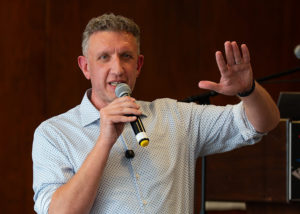
Chuck is a US-based internal communications strategist and the founder of ICology – a community and resource hub for IC professionals. He brings a practitioner lens to every conversation. Chuck is a recognised voice in the industry, a regular speaker and event host, and one of the most connected people in the North American IC world.

Jenni is a UK-based leadership and internal communications consultant, author of two best-selling books, and international speaker. She runs Redefining Communications, a consultancy working with organisations around the world to help them communicate better and close the gap between what leaders say and what employees experience.