
Chuck calls this week’s lineup a “cornucopia,” and it earns the word: a report that frames HR’s challenges as a mountaineering expedition, an essay naming the quiet anxiety everyone’s carrying about work right now, a brand-new leadership buzzword (AQ, adaptability quotient — Chuck immediately invents his own, GQ, “gut quotient”), Nick Bloom’s data showing hybrid work never actually declined, and a LinkedIn post arguing Marketo killed marketing. The through-line is one Jenni keeps circling back to all episode: is any of this actually new, or are we just relabeling challenges that have always been there?
Chuck brings a report called Peak HR, from Inspiring Workplaces and the TSC, which frames HR’s current challenges as a mountaineering expedition — scaling peaks like people strategy, technology, and culture. Jenni likes the metaphor but pushes on the premise: these aren’t new challenges, she argues, just the same alignment problems HR and comms have wrestled with for the last ten or fifteen years, repackaged. She flags a line in the report suggesting “data” is the answer to alignment problems, and pushes back hard — more measurement isn’t automatically better measurement, especially when you’re trying to quantify something as human and behavioral as culture. Her fix: anchor to one clear organizational outcome (she uses “reduce workplace accidents by 60%” as an example) rather than comms-specific vanity metrics, and accept that comms is a contributor to that outcome, not its sole owner. Chuck connects it back to the “strategy fatigue” conversation from an earlier episode — if business strategy keeps shifting, the alignment target is always moving, so the peak is never really summited, only continuously climbed.
A Substack essay by Rojo Spinks, titled “Everyone I Know Is Worried About Work,” names a low-grade, mostly unspoken anxiety Chuck says he recognizes immediately — everyone looks fine on LinkedIn while quietly panicking about layoffs, AI, or job security underneath. Jenni doesn’t think the disconnect is only between leaders and employees — she thinks it cuts across teams, functions, and geographies — and points to the media environment itself as part of the cause, citing The Science of Fear on how coverage of one story generates more coverage of the same story, inflating how bad things feel. Her example of doing this well is Marks & Spencer’s handling of a recent cyber attack in the UK: simple, consistent, factual communication throughout, calm without minimizing what happened. Her advice to leaders wanting to surface employee worry: always communicate with the audience’s needs in mind, not to relieve your own urge to be seen as transparent, and be ready to act on what you surface rather than asking the question and going quiet.
A LinkedIn post by Mariya Koteva introduces Chuck to AQ — adaptability quotient — a term he initially rolls his eyes at before deciding the underlying idea holds up: leaders with high IQ but no people connection, or high EQ who grind through change without adapting, are both incomplete. Jenni agrees it’s a little buzzwordy but ties it to research on DISC behavioral styles and to pandemic-era resilience training — humans are naturally adaptable, she argues, we just don’t always want to be, and that reluctance varies by personality type. Chuck, only half joking, proposes a new one of his own: GQ, “gut quotient,” for people who lead on instinct — his point being that naming a strength gives leaders a way to see themselves in the conversation, which he thinks is a net positive even if the acronym itself is throwaway.
Returning to a frequent guest-by-proxy, Chuck cites Nick Bloom’s LinkedIn post pushing back on the narrative that remote work is over: roughly 28% of full workdays in the US are still remote, a figure that’s been essentially flat for two years, despite headline-grabbing return-to-office mandates. Bloom’s own line — “stories and anecdotes tend to circulate when they’re interesting, shocking, or funny; real data is typically boring, but true” — becomes the episode’s thesis statement. Jenni connects it to her own pre-pandemic experience working a hybrid pattern before the word existed, and wonders whether leaders overcorrect toward RTO mandates less because of real data and more because one high-profile company announcing a return triggers a cascade of others following, each afraid of standing out.
Chuck closes with a LinkedIn post by Shannon Pham arguing that automation platforms like Marketo, HubSpot, and Pardot have pushed marketing toward volume and vanity metrics at the expense of storytelling and relationship-building. Jenni draws on her own marketing degree — heavy on consumer psychology, light on the metrics-first approach she sees in marketing education today — to argue internal comms risks the same drift if efficiency tools replace, rather than support, human connection. She’s currently exploring this with Dr. Kevin Ruck: reframing the conversation away from ROI (which reflexively pulls toward numbers) and toward “value,” which she compares to trying on clothes without looking at the price tag first — value is what you’d pay based on what something’s actually worth to you, not a number someone else assigns. She’s also been reading Simplify the Funnel by Ant Hodges, on blending automation with genuine human connection rather than choosing one or the other.
Are HR and comms facing genuinely new challenges, or old ones repackaged? Jenni argues the underlying challenges — aligning people strategy with business strategy — aren’t new; what’s changed is the language and framing used to describe them, not the substance.
Why does chasing more data often fail to fix alignment problems? Because alignment and culture are human, behavioral problems that resist clean measurement — the fix is anchoring to one clear organizational outcome, not accumulating comms-specific metrics that don’t connect to it.
How should leaders talk about a crisis without causing more anxiety? Jenni points to Marks & Spencer’s cyber attack response as a model: simple, consistent, factual, and calm, communicated with the audience’s needs in mind rather than the leader’s own urge to appear transparent.
What is AQ, and does it matter more than IQ or EQ? Adaptability quotient — a newer, buzzwordier term the hosts land on as genuinely useful: leaders can be highly intelligent or empathetic and still fail to adapt to a constantly shifting environment.
Is remote work actually declining? No — Stanford economist Nick Bloom’s data shows roughly 28% of US workdays are still remote, essentially unchanged for two years, despite headline-grabbing return-to-office mandates suggesting otherwise.
Is internal comms at risk of losing its human element to automation, the way marketing has? Jenni thinks the risk is real, and argues the fix is reframing measurement around “value” — what communication is actually worth to people — rather than ROI, which pulls the conversation toward numbers by default.
Jenni: Welcome to Frequency, I’m Jenni Field.
Chuck: And I’m Chuck Gose.
Jenni: Frequency is your go-to for real talk about comms, culture, and employee experience, beyond the buzzwords and straight to what matters. So this week, Chuck, I want to follow up on the conversation from last week where you asked whether there’s a UK equivalent of the DMV or BMV. Yesterday I spent the day working in a coffee shop because my car had its MOT — and I wondered, is this universal? Do you have to have an annual test on your car over there?
Chuck: I have no idea what you’re talking about, Jenni. I thought “method of transportation,” but that’s just the car — I genuinely don’t know what an MOT is.
Jenni: I couldn’t even tell you what it stands for beyond “test.” Every year we have to have an MOT on our cars so they can be taxed and confirmed as safe — if you don’t have one, that’s against the law. You don’t have anything like that?
Chuck: Is it like an emissions test?
Jenni: Yeah, that’s part of it, I think.
Chuck: So getting your MOT is like us going to the BMV — a necessary evil of owning a vehicle.
Jenni: Yeah, it’s strange you don’t have it, I assumed it was universal. Okay, the second thing I wanted to cover before the serious stuff — what we got up to over the weekend. It was my brother-in-law’s 30th birthday, a big party with a Great Gatsby theme, so everyone had to do fancy dress. I love a bit of fancy dress — I’ve got photos of myself as the Stay Puft Marshmallow Man, as a panther, as a cow. Is that something you or your family do, or is fancy dress more of a thing over here because of the shows I watch?
Chuck: For us, “fancy” shows up when we go to Vegas as a couple — we love getting dressed up, going out, cocktails. I’m being fancy.
Jenni: But you’re not in a costume.
Chuck: No, that’s not a thing for us. Some people do costume parties or theme parties — I’ve seen a really clever Instagram video of a “mismatched theme party” where everyone showed up dressed for whatever party they thought it was — pajamas, togas — but that’s not really a thing in my family.
Jenni: So you’ve never gone in a costume to something, outside Halloween?
Chuck: Probably not.
Jenni: I definitely do it a lot — for a reason, not just on a random Saturday night. Fair enough. So what else is on your list this week?
Chuck: A couple of weeks ago I said we had a bevy of stories — this week, Jenni, it’s an absolute cornucopia. We’ll get into why it seems like everyone is quietly worried about work and what that means for leaders and comms, then we’ll talk about AQ, a brand-new term for me, move along to our weekly unofficial guest Nick Bloom — who doesn’t know we talk about him this much — on why remote work isn’t actually declining, and close with a spicy take that Marketo has killed marketing. But first — a report called Peak HR, from Inspiring Workplaces and the TSC. It frames the evolution of HR as a mountaineering expedition — climbing big peaks like people strategy, technology, and culture. I thought it was a smart way to capture the ambition and struggle HR teams are facing, and it felt relevant to comms too — steep climbs, navigating risk, needing a clear path forward. Do you think that metaphor fits the challenges teams are facing today, or is it a bit too heroic compared to the day-to-day grind?
Jenni: I don’t think it’s too heroic — I like the idea of peaks to climb, and there are plenty of extreme-sports metaphors that could work here; a friend of mine just climbed Everest, which is incredible. But what I keep coming back to is whether these are actually new challenges, versus what things have looked like for the last ten or fifteen years. The peaks — people strategy, technology, culture — don’t feel specifically different from what we’ve been dealing with for a while. So it’s a good read, and it’s nice to see roundtable conversations distilled into a report from different experts, but it does feel like fairly familiar territory.
Chuck: I don’t know that they were trying to break new ground. And your Everest point is apt — it’s been there forever and people still try to climb it, though apparently there’s now an effort to tell people to stop trying, because it’s become a mess. One of the key peaks was aligning people strategy with business strategy — nothing new, but it’s the climb so many people are on, and it’s something comms wrestles with too. Where do you think organizations get this right, and where do they miss the mark?
Jenni: It’s still such a live conversation — I’ve had it maybe five times in the last week, this idea that being seen as strategic means aligning your work to organizational strategy. There’s a quote in the report, paraphrasing, along the lines of “go with data, that always works” — and I hear that a lot, and I’ve done it myself, and it hasn’t always worked. I think that’s where we get it wrong: assuming the answer is more measurement, more metrics, more data, when we’re actually working with something as human as HR is — behavior, which is genuinely hard to measure — and we want to make it simple when it isn’t. So we start chasing data to prove our point instead of anchoring to an actual outcome. If the goal is reducing accidents in an organization by 60%, that’s the measure — comms is one of several contributors, alongside training and shop-floor design changes, but the outcome is the 60% reduction. We shy away from being included in outcomes like that because we think it’s not solely our responsibility — but it’s okay to share ownership of an outcome rather than needing to own all of it. That’s where I think we get it a bit wrong.
Chuck: As we’ve said before, you can get the data to say pretty much whatever you want — we’ve done it to each other on the show. More data isn’t necessarily better data; it can add confusion. Going back to strategy spice versus change spice — because business strategy keeps shifting, the aim is always moving, so with the mountaineering metaphor, a storm rolls in, the strategy changes, and alignment has to shift with it. You can work toward alignment, but you have to be ready to realign constantly.
Jenni: Yeah — and I liked your Everest point, that these peaks have always been there and people keep trying to climb them regardless. Maybe it’s less about reaching a summit and more about the ongoing adaptability and flexibility to navigate it no matter what happens. But the concept of a “peak” implies you do eventually reach the top — are we ever going to get there, or are we always just climbing?
Chuck: Always, always. Let’s move to our second piece — an essay from a Substack called Everyone I Know Is Worried About Work. I thought it hit a nerve, capturing something so many people are quietly dealing with — this persistent hum of anxiety, whether it’s layoffs, AI, burnout, or just existential dread. It’s like the first night in a new hotel room when you notice a strange ambient sound and can’t stop hearing it — then eventually you stop noticing it, even though it’s still there. Maybe work anxiety has always been there and we’re just noticing it now. The article paints a picture of everyone looking fine on the surface — LinkedIn posts of people “killing it” — while quietly panicking underneath. In your work with organizations, how often do you see that disconnect between what leaders think employees are feeling and what’s actually going on?
Jenni: That disconnect is there to some degree, but I don’t think it’s only between leaders and employees — it happens across different teams, functions, industries, and parts of the world too. What struck me in the article — and I went down a bit of a rabbit hole reading the linked pieces — is that there are genuinely big challenges in the job market for a lot of people, but there’s also a media environment that isn’t helping us as human beings. I read a book called The Science of Fear right as the pandemic was starting, and there’s a whole chapter on how media finds a story and then keeps reporting on it, generating more coverage simply because it’s already been highlighted. It feels like that’s happening here — I see as many posts from people looking for work as I do people getting promoted or landing new jobs, but there’s this general uncertainty across the board about financial situations and job security. I don’t think it’s leaders having a lovely time while employees are terrified — I think there are just different worries in different groups, but worry nonetheless, everywhere.
Chuck: There’s a tension there too — a desire to see vulnerability and honesty from leaders, but also a desire for confidence. Do you want a leader to say “I’m worried too,” which probably doesn’t help, or do you want them to hold it together? So leaders are quiet about it too, in a way. My next question — for people in comms or HR, how do we do a better job surfacing these worries without accidentally making things worse?
Jenni: The big thing is being really clear about direction and having strong communication skills, because if you want to surface how people are feeling, you need the skill to actually do that as a leader — and you have to be ready to act on what you surface, not just ask the question. Every communication should be built with the audience in mind, not your own need to feel transparent — there’s a difference between “I need to share this because I should be open” and “is this what people actually need to hear.” If something’s genuinely affecting the organization — tariffs, for example — you have to talk about it, even without all the answers. A great UK example this past week: Marks & Spencer, a big retail brand, had a major cyber attack, and their communication throughout has been simple, consistent, and factual. It’s been calm the whole way through — they haven’t avoided the subject, but they’ve handled it in a way that makes people feel like they’ve got it under control. We’ll share a link to some of their posts in the show notes.
Chuck: Great example — I’ll look into that too, the way they’re leading the conversation rather than trailing behind it. Next — I’ll admit before this came across my feed, I had no idea what this term was: AQ. I knew IQ, I knew EQ, but adaptability quotient was new to me. Is this something people are genuinely discussing in leadership circles, or another eye-roll-worthy buzzword? Either way, does adaptability matter more than intelligence or emotional intelligence, given how constantly things are shifting?
Jenni: It’s a little buzzwordy, I won’t pretend otherwise — it feels like an opportunity to create a new framework, but we all do that. What I find interesting is there are lots of “quotients” out there — innovation quotients and so on — but adaptability is the one this article focuses on, and it got me wondering whether humans are naturally adaptable. We are, evolutionarily — we adapt to different climates and environments — but whether we want to be adaptable is a different question, and that varies by personality type; I do a lot of work with DISC, which looks at different behavioral styles, and some people are just more comfortable with adaptability than others. I’m with you on the buzzword skepticism, but it is a conversation worth having given change fatigue and everything else going on — adaptability feels bundled with resilience for me, the mental resilience training from the pandemic, moving like water through rocks. Given everything we said earlier about peaks and climbing, you have to be adaptable to actually climb the thing, depending on what’s happening.
Chuck: I’m glad I held back the eye roll, because the more I looked into it, the more I liked it — we’ve all worked for leaders with very high IQ and zero connection to people, and others with very high EQ who just grind through without adapting. I like that there’s this additional dimension. In fact, I’m inventing a new one today: GQ, gut quotient — for people who just have a feeling in their gut. Are you high GQ, high AQ, high EQ? I like it because it gives leaders another lens to see their own strength in, which I think is a good nudge and bit of encouragement.
Jenni: I like GQ — makes me think of the magazine, which I assume you have over there too, good, just checking that’s a global reference given how much we’ve covered today that isn’t. I had a thought about leaders and then lost it — ah, I know: I’ve just written a book about being a more credible leader, partly because there are so many buzzwords out there already and so much pressure on leaders to add more and more to their plate. Part of why I wrote it was to ask whether we’re naturally adaptable anyway, but just don’t like to be — I don’t want to layer even more onto leaders who are already trying to do so much.
Chuck: Absolutely. Moving on to hybrid work — apparently hybrid has won. We’ve talked about Stanford professor Nick Bloom before, and I don’t want to bring him back into the mix too often, but he posted something that caught my eye — pushing back on the idea that work from home is over. As a society we love declaring things dead, and he’s got the data: in the US, about 28% of full workdays are still remote, and that number has been basically flat for two years. Not everybody has a job that allows remote work, but for those who do, it’s held steady. He points out that return-to-office mandates grab headlines, but in reality, remote and hybrid work are now a stable part of how we work, not a pandemic-era blip. It’s a reminder that the loudest narratives out there aren’t always the most accurate, and leaders and communicators need to stay anchored in what’s actually happening. Do you think there’s a tendency for comms or HR leaders to overcorrect based on what they see other companies doing, rushing to declare remote work over just because it’s trendy?
Jenni: I think people can go one way or the other — overcorrect because everyone else seems to be doing it, or wait and do nothing — and I don’t know there’s much of a middle ground, or that middle ground is just noisy. Nick’s data is brilliant because it grounds the conversation in reality rather than what people are talking about. There’s a great line in his post: “stories and anecdotes tend to circulate when they’re interesting, shocking, or funny — real data is typically boring, but true,” which made me laugh because it’s exactly right. I don’t know that people are overcorrecting so much as they’re worried about the impact of putting a stake in the ground. What I find fascinating is that I worked in a hybrid pattern for years before the word existed — I was in the office three days a week, at home one or two, or elsewhere — and there wasn’t infrastructure to support it, colleagues would do laps of the office and realize someone wasn’t there. That was eight years ago, and I’d been doing it for five or six years before that. As soon as I started commuting to London — about an hour and a half each way — I was working from home maybe one day a week. Maybe I got lucky with culture and management, but I think a lot of this over-inflation is just noise around something plenty of people have been doing quietly for decades.
Chuck: I’d describe it as more of an overcorrection higher up the organization — one big company announces a return to office, the next day another does, then a CEO makes a statement, then another CEO follows a day later. There’s a fear of standing out or looking weak by not following suit. Going back to the data — “we’re just continuing what we’re doing” doesn’t make headlines, it’s not scandalous.
Jenni: No, you’re right — someone has to go first to give everyone else permission to follow. I wonder how much CEOs in the same industry are actually talking to each other about this versus not at all. There’s clearly a learning-from-each-other happening, and everyone’s still figuring out what work looks like today. We had a bit of back-and-forth about this in our own chat, and I said I needed to sit with it, because I feel like there’s something else underneath all the RTO-mandate conversation that I haven’t fully worked through yet — it feels messy and complicated in a way it maybe shouldn’t be, and I’m trying to figure out why.
Chuck: Maybe it points to people feeling uneasy because they don’t know which way the wind’s going to blow that day. All right, let’s wrap with — since we’re on a theme of things dying — apparently Marketo has killed marketing. It’s dead, over, murdered, according to a LinkedIn post from Shannon Pham, and the headline alone grabbed me. She’s being tongue-in-cheek, but her point is serious: automation platforms like Marketo, HubSpot, and Pardot have pushed marketing toward volume and vanity metrics and away from human connection — automating emails, scoring leads, tracking clicks, while losing the art of storytelling and relationship-building. Reading it, I wondered whether internal comms is falling into the same trap, chasing what can be automated and measured without asking what we’re actually here to do. Do you think internal comms is at risk of relying too much on efficiency and data and losing that human touch?
Jenni: Yes, I think there’s a real risk. It’s a great post about taking something human and trying to make it very data-driven — it has genuinely shifted. I did my degree in marketing, with a dissertation on consumer behavior, and I can barely remember doing statistics classes; it was mostly human behavior, psychology, the seven Ps. Marketing degrees today feel much more metrics-focused. I think internal comms risks the same thing as digital tools promise efficiency — we lose the human element chasing it. That’s true of any function built on relationships — marketing, HR, comms — we have to make sure metrics are used the right way, if they need to be there at all. I do a lot of measurement workshops with clients, and it’s never about clicks and shares, it’s much bigger, like the accident-reduction example earlier. I’ve been reading Simplify the Funnel by Ant Hodges, which is excellent on blending automation with genuine human connection rather than treating them as opposites. Internal comms can’t automate everything, because the relationship an employee has with their organization is nothing like the relationship a customer has with a brand — someone once compared rating your workplace to rating a restaurant, and I thought, that’s such a different relationship — you visit a restaurant once every few months, whereas you’re inside your organization constantly. I’d hate to see us drift too far toward automation, but maybe this conversation is the start of a pushback against that.
Chuck: It reminds me of when comms went all-in on “data, data, data” a decade ago, chasing it without always understanding what it meant, partly driven by the ROI conversation, which I’ve always hated because it forces everything back to a number. I’m actually giving a new talk on this soon at the ScreenCloud Summit — “The Haunting of ROI: A True Workplace Crime Story” — about how we’ve been chased by this ROI obsession and lost track of what we did well. Inside ICology, a member recently asked about a team resisting AI because they felt it eroded the human element of their work — which is a fascinating contradiction, because we recognize the need for human connection there, but abandon it entirely when it comes to data, treating people as numbers and percentages instead.
Jenni: You’re spot on about ROI — I’ve got a lot of thoughts on that talk I’m saving up for after we finish recording. For me, the conversation is shifting from ROI toward value — which is what I’m exploring with Dr. Kevin Ruck: what value does internal communication actually bring, and how do we look at that without reducing it to a number or an equation, because value is deeply individual. It’s like trying on new clothes and not looking at the price tag first — you decide what you’d pay based on what it’s actually worth to you, rather than what a price tag tells you. That’s a much richer conversation than ROI, which pulls you straight to numbers.
Chuck: Continuing your clothing analogy — I’m a larger person than most, and an XL at one company is not the same as an XL at another; the same word means different things in different contexts. So the number matters less than the fit, and that’s what people should really be looking at.
Jenni: Exactly — what an analogy-filled episode this has been. Right, what are you freaking out about this week?
Chuck: What are you freaking out about?
Jenni: I’m reading a book — I know, another book — called Build the Life You Want by Arthur Brooks and Oprah Winfrey, about the art and science of getting happier. I’m generally a very happy, positive person, but it talks about the “macronutrients” of happiness — enjoyment, and purpose among them — and breaks down how happiness and unhappiness actually coexist. Given everything we said earlier about everyone quietly worried about work, I think we’re sometimes conditioned to feel we should be happy and joyful all the time, when we’re more complex than that. So I’m freaking out about it in the sense that I’m loving it.
Chuck: How are you measuring happiness, Jenni? I want the data behind it. For me — my freak-out is spending time with the Lucid Hub team in Las Vegas, which I love, no arm-twisting required. But my freak-out is that Vegas was quieter than normal — Canadian visitors down 30%, Mia visitors down over 20%, Asia visitors down too, all tied to the current administration and people just not wanting to travel. It made me wonder why this is bothering me so much — maybe it’s less a single tipping point and more that Vegas had been built up so much without acknowledging its weaknesses, and now one thing has people saying it’s not worth coming. And I don’t like a quiet Vegas. For anyone who says they don’t like Vegas — nobody hates Vegas, they just hate themselves. My plea is that we still have to live a life out here, we still have to travel, and I hope this is a blip, because I do worry about the impact on the businesses there.
Jenni: I’m holding on to the Marriott CEO’s comment from last episode — political winds come and go, you’ve been around a long time and you’ll be around a long time, things shift and change, it’s just a question of how long you have to weather it. Fingers crossed it’s a blip, and there’ll be plenty of visitors next time you’re there — which is inevitably soon, given how often you seem to go. Have you got your next trip booked?
Chuck: Of course — first weekend in June, for Coldplay. That’ll be a busier weekend, given the size of that show.
Jenni: You’ll have to let us know if it’s busier. We’re going to wrap this up — thank you for joining us this week. All the articles that inspired this conversation are in the show notes, so don’t forget to check those out, and please rate and review after you’ve listened. Subscribe so you don’t miss another episode, and pass this along to someone you think would enjoy listening or watching, because you can now find Frequency on YouTube, Apple Podcasts, Spotify, wherever you get your content. Thank you to Poet Ali for contributing the music to the show. We’ll be back next week with more news, insights, and opinions about everything comms and leadership in the workplace today. Keep tuning in and turning up.
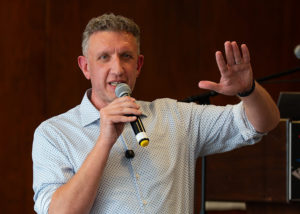
Chuck is a US-based internal communications strategist and the founder of ICology – a community and resource hub for IC professionals. He brings a practitioner lens to every conversation. Chuck is a recognised voice in the industry, a regular speaker and event host, and one of the most connected people in the North American IC world.

Jenni is a UK-based leadership and internal communications consultant, author of two best-selling books, and international speaker. She runs Redefining Communications, a consultancy working with organisations around the world to help them communicate better and close the gap between what leaders say and what employees experience.