
Only half a hand went up when Chuck asked a live London audience who has an AI “employee” on their team. Plenty of people talk about AI as the newest team member. Almost nobody is counting it as one.
Recorded live at Unily’s Unite 26 conference in London, Chuck and Jenni swap news articles for stories straight from two days of sessions. Charlene Li’s call to stop doing pilots. The risk of calling AI a teammate when you need real headcount. Why Jenni can’t get on board with “taste-making.” And whether “do less but better” holds up against a songwriter who says 70% of his work is garbage. Running underneath all of it is Jenni’s question: small teams, no budget, poor HR data, blaming IT. Is any of this new, or has internal comms been making the same excuses for 20 years?
Jenni opens with the strategy themes that kept surfacing at Unite 26: the only strategy is the organizational strategy, roadmaps exist to deliver it, and technology isn’t the problem, leaders who won’t step into uncertainty are. The line both hosts picked up on came from Charlene Li’s keynote: stop doing pilots.
Chuck thinks that caught a lot of communicators off guard, because a pilot has long felt like a win. Without real commitment from the organization, though, a pilot just entertains everyone. Plenty of careers include time wasted on pilots that were never going to happen, and Chuck’s advice is that you don’t have to say yes when one is offered. Jenni points out that Li’s alternative was a “test,” which is partly a change of language. Chuck accepts that, with a condition: the test needs to define how it’s measured and what happens if it works. “We’ll see” isn’t a commitment.
Several sessions described AI as the new member of a small comms team. Jenni keeps coming back to the problem with that. If AI is your extra headcount, how do you ever build the business case for real people or more budget? She adds two more worries: communicators say they don’t want to be seen as tactical, then spend two days talking about content and tactics, and someone told her the profession blames everyone else for its situation, whether that’s IT, HR or “I can’t control that.” It feels like the short game.
Her advice: if AI is part of the team, be very clear about what’s in and out of scope, and still have the conversation about budget and growth. She admits she’s been guilty of blaming others herself, and credits Ryan Holiday’s keynote for the reminder that you control your response to the situation.
Chuck polls the room on who actually has AI as a team member. No hands, then half a hand. He wonders whether the idea is theory running well ahead of practice. Jenni agrees it’s true of AI generally: a director of corporate affairs recently told her they only use AI to plan vacations, and the podcast world can be an echo chamber. Chuck adds a distinction the show has made before. Not using AI and not benefiting from it are different things, because people who never open Copilot or Claude still benefit from AI built into the tools they use.
Judgment and curiosity came up across sessions as core skills for internal communicators, and so did a phrase Jenni had never heard: “taste-making.” She assumed it was a slip for sense-making, so she asked the speaker afterward. The explanation was an interior designer who has all the training but no taste, so the room still looks bad. Jenni buys the premise and not the word. Comms work has to land and have impact, and communicators often just know when AI-generated content won’t work, even if they can’t say why.
Chuck says judgment and curiosity are exactly what make communicators successful with AI: curiosity about whether it can help, and judgment about what it produces. He also defends the “Make It Pretty Committee” that US communicators like to complain about. Wanting things to look good isn’t a bad thing if it helps them work. On gut instinct, he tells the story of a London Underground comms lead whose train drivers said no to new mobile technology. The communicator rolled it out anyway, and it worked, because the drivers were saying no to more, not to something better.
He also offers his read on the transatlantic difference. UK communicators pride themselves on strategy and push tactics down the chain. Americans love the tactics and sometimes get to strategy later, if at all. You need both. Strategy that never turns into action has little value, and tactics without strategy waste effort.
When Jenni presses for the skills of the future, Chuck reframes the question around attitudes. He tells the story behind The Very Hungry Communicator, the book he made with Alan Oram of Alive With Ideas: asked what kind of communicator he likes working with, Chuck said hungry ones, and Alan started sketching a hungry caterpillar.
His list: listen to the right people, not the loudest. Stop making excuses and do the work, including work you don’t want to do. Remember communicators are employees too, with privileged access to leaders and information most employees don’t have. And keep learning, a point he takes from Ryan Holiday: if you think you know everything, you won’t learn anything. Jenni agrees the profession spends a lot of time on how to do change or leadership comms better and much less on communicators themselves, pointing to Advita Patel’s session on confidence as the kind of self-knowledge that shapes how people show up.
Chuck reopens an old argument: Jenni once told him AI was like any other change project. She still stands by it. Hattie Roach’s AI playbook session, an end-to-end look at building, scaling and embedding AI, was the one Jenni most wanted the slides from, and to her it was a well-run change program, just a massive one.
Chuck’s analogy: normal change is the tide coming and going, and AI is a tidal wave. The last shift this big was the internet, back when you needed a business case to get an email address. Now imagine making a business case not to have one. Neither host moves.
Jenni’s closing story is the one that frames the episode. “Do less but better” has been good advice for years. So has the list of complaints: small teams, no budget, too much to do, difficult stakeholders, IT systems that don’t talk to each other, poor HR data. It’s been that way for her whole career, about 20 years. So do communicators accept it, or find the courage to change?
Chuck says some things you accept, since comms can’t fix bad HR data. But he challenges “do less but better,” which Jenni took from Sharon O’Dea’s session on cutting through the noise: three or four targeted pieces in the right format instead of ten that miss. Chuck’s counter is Jonathan Mann, who holds the Guinness World Record for most consecutive days writing a song and wrote “The iPhone Antenna Song” that Steve Jobs played at Apple’s iPhone 4 press conference. By Mann’s own estimate, as Chuck remembers it, about 10% of his songs are excellent, 20% pretty good and 70% garbage. You only find great by making more.
Jenni says writing songs and reaching Tom, who drives a van, are different jobs. They land on the same process: produce, stop every few months to ask what you’ve learned, then do less but better. Chuck gets the last word on Tom. If you’re not thinking creatively about him, you’re missing out.
Asked for the one skill every communicator needs, Chuck says being a connector: connecting people, knowledge and values, and connecting yourself to the business. Jenni says belief in yourself, built by doing the work and investing in yourself, because “no one’s coming.” Chuck adds collaboration.
On attitude, Jenni struggles to name a phrase and reaches for a story from Ross Edgley’s The Art of Resilience about prisoners of war who pinned their hopes on a release date and didn’t survive. Optimism with realism lasts. Toxic positivity doesn’t. Chuck calls it bringing the “and” to the conversation.
The last question is about face-to-face work and the office. Jenni sees real value in being in the room for relationships. If your relationship with a London-based chief of staff is difficult and you won’t go to London, it will probably stay difficult. But she doesn’t think presence should be forced. Chuck quotes a line the hosts have used before, that inconvenience is the price you pay for friends and community, and points out that the people at Unite in person got more than those watching online. His challenge to companies: design a workplace people want to come to, rather than mandating attendance out of command-and-control thinking or using it to force attrition.
Chuck is freq-ing out about three things. A Charlene Li slide put purpose at the center of values, mission and vision, which made him wonder whether purpose works better as the thing that protects them. A slide claiming 94% of us aren’t AI high performers struck him as the most McKinsey thing he’s ever heard. Of course we aren’t, and how is high performance defined? (For context, McKinsey’s State of AI research defines AI high performers as organizations attributing at least 5% of EBIT to AI, roughly 6% of respondents, so the figure describes companies rather than individual people.) And he’s hoping to bump into Jacob Ward, whose London running and cycling clubs he follows on TikTok. Ward walks over to anyone standing alone, and Chuck has been doing the same at Unite.
Jenni rejects a line she heard at the conference: if you’re not changing things, you’re not leading, you’re just managing the status quo. Telling leaders they always have to be changing leads to chaos. And a digital workplace is not an intranet, however much the two have been blurred over the past few days.
Should internal comms teams stop running AI pilots? Charlene Li argued at Unite 26 that pilots without commitment are close to worthless. Chuck agrees and says you can turn one down. If you run a test instead, agree in advance how it’s measured and what commitment follows if it works.
Is AI really a member of internal comms teams? Not yet, judging by a live room of communicators, where only half a hand went up. Jenni warns that treating AI as headcount can weaken the case for hiring real people.
What does “taste-making” mean in internal communications? It’s the idea that skills aren’t enough without taste, like an interior designer with training but no eye. Jenni accepts the idea but not the buzzword, and links it to the gut sense that tells communicators when content won’t work.
What’s the most important skill for an internal communicator? Chuck says being a connector of people, knowledge and values. Jenni says belief in yourself. Chuck also argues attitudes, like curiosity and a hunger to learn, matter more than any specific skill.
Is “do less but better” still good advice? Partly. Chuck argues you only learn what great looks like by producing more, citing songwriter Jonathan Mann. Jenni and Chuck settle on producing, learning from what works, then cutting back.
Should employers mandate a return to the office? Both hosts see value in being together for relationships. Neither thinks it should be forced. Chuck’s challenge is to design a workplace people want to come to.
Chuck: Welcome to Frequency. I’m Chuck Gose.
Jenni: And I’m Jenni Field. Frequency is your go-to for real talk about comms, culture and employee experience. Beyond the buzzwords and straight to what matters. And this week we are live at Unily’s Unite 26 conference in London. So this episode will be a little different. I’ve got some stories for us to discuss, but all from the last two days of the conference. And thank you to Unily for inviting us back. For those listening to this as your normal Frequency take, there is a live audience with us. So if everyone wants to say hello, give us a cheer.
Chuck: Mm-hmm.
Jenni: So we’re gonna talk about leadership, the internal comms playbook, AI, cutting through the noise and all sorts of things. We do also have time for audience Q&A, so it’s our favourite part of doing a live episode. You can submit through the app, but even better if you grab the mic when the time comes. We also have some exciting news to share. For those in the room with us, you’ll notice that we have a QR code on the screen.
And for those listening, it’s time to introduce you to the brand new Frequency website, where you’ll find every single episode with key links, key takeaways, full transcripts, everything you could ever wish to have from Frequency. And you can grab the Spotify, Apple or YouTube links on there as well, and all the details you need. But the reason for the QR code is because we don’t want you to miss another episode, and we want to be able to email you about it, other events we’re doing, things that we’re reading that might not make the podcast. So sign up, it’s new. We don’t have anything live yet in terms of sending you anything, but bear with us as we kind of get things started.
Chuck: But let’s talk about me first. Actually, us. Let’s talk about us first. Okay. We realized right before recording this that Jenni and I have been connected now for ten years, just now having done the podcast for the last year and a half, which is pretty remarkable for all that. But let’s now go back to me. Okay. It’s now been a couple of years since I’ve been over here in London, and I absolutely missed being over here. So for those that may not know, I used to work for Rolls-Royce way back in the day.
I got to spend a lot of time over here and fell in love with the city. And now it’s been, again, a solid two-plus years since I’ve been over. So it’s great to be back.
Jenni: It’s lovely to have you back.
Chuck: And you asked me if there’s anything that I need to do, ’cause I’m gonna be spending some time here. And you mentioned, like, when you come across you like to go to Wendy’s. And I’m like, that’s a thing for you all?
Jenni: I do. I mean, it’s a thing for me and my husband. It might not be a thing for anyone else.
Chuck: So then I was thinking about it, like, what would be my thing? And it’s probably Nando’s. We just don’t have that over there. So at some point on this trip we will actually have to hit up Nando’s. Yeah.
Jenni: We’re going to go and have some. Okay, let’s kick off with the first theme from the conference. So it’s the AI strategy challenge. We’ve heard a lot about AI over the course of the conference. Some folks have said it’s been a bit too much on the AI, but there have been a few things about strategy and leadership that I thought were worth mentioning. A couple of points. So the only strategy is the organisational strategy. Then there are roadmaps to deliver that. We also talked about the problem with pilots.
And that technology isn’t the problem, it’s leaders not stepping into the uncertainty. So I’m a big fan of focusing on organisational strategy as the anchor to everything else inside the organisation. And I also agree with the leadership angle there. But my question for you, Chuck, is that we both picked up on the “pilots are dead” message. So what was it about the “we should all stop doing pilots” that got you thinking?
Chuck: Yeah, it was during Charlene Li’s keynote that she mentioned that. And I think that probably caught a lot of people by surprise, because I think as communicators, we’ve often thought of pilots as a sign of success. Like, they might do this. We might end up working on this. And her philosophy around them being sort of worthless, I want us to buy into more. ‘Cause without that commitment, are they just sort of entertaining us, without any real commitment or buy-in for the long term? So I think we have probably, a lot of our career, when we look and reflect back, spent some time wasted on pilots that were probably never really going to happen, because we didn’t have the commitment from the organization. And so I think it’s a good chance: if the organization offers you that, you don’t have to say yes. You can still dig in and get the longer commitment to something.
Jenni: She did say, though, that you shouldn’t do pilots, but you should do, like, tests. So it was more about the language of the pilot, because no one’s really bought into it. So it’s like, if someone says you want to do a pilot: no, I’ll have a test or something like that, because you need the budget and stuff to.
Chuck: I think so, but I think we still need to show, okay, if we prove this, then we get that. It’s not just a “well, we’ll see.” So how are you testing? How are you measuring the test? How do we know if it’s worked or not? And if it’s worked, then you should get the commitment. If it didn’t work, then yes, maybe not. But I think you should have those guidelines put in place.
Jenni: So, nice. The second thing I want to talk about is whether or not we’re shooting ourselves in the foot.
Chuck: Very American of you. Nice.
Jenni: I know. I know. Well, I thought it would, you know, make you feel a bit more comfortable.
Chuck: I got it. Thank you. To bring in guns and a thing.
Jenni: So I keep coming back to this, and this is why. So there was some talk about AI being the new team member in your team, if you have got a very small team. And it got me thinking about: are we shooting ourselves in the foot to then grow the team? Because if you’re saying, I’ve got this AI team member, it’s going to do all this stuff, how do you then build the business case for more team members or more budget, if you’re accepting that that is kind of where you are? We also keep saying that we don’t want to be the tactical people, but I feel like we spent quite a lot of these two days talking about content and tactics. And someone said to me earlier today, we seem to blame everyone else for our situation. It’s IT’s fault, or it’s an HR issue, or I can’t control that. There’s always a reason why we can’t do it.
So I know there’s always going to be challenges around how we set up our functions and how we operate a comms team, but it feels like we’re playing the short game here, and I’m a big fan of the long game. So my question is, do you agree, and what is your advice?
Chuck: I would like to hear your advice first. Since you’re the big organizational strategy person, what’s your advice?
Jenni: So my advice would be that if you’re going to use AI as a team member, you’re very clear about what’s in scope, what’s out of scope. And I think that brings in some of the conversations about judgement and other things that we need in the team. And I think there needs to be a conversation about what the budget and growth would need to be. I think that “we blame everyone else for our situation” is something that I definitely have done in my career. But listening to Ryan Holiday this morning, I sort of left that talk feeling like I was ready to change the world. And I think there is a real emphasis on: you can control the situation, your response to the situation. And I think we have to remember that.
Chuck: I’m curious, looking out into the audience here, does anybody actually have, in your organization, AI as a team member? ‘Cause I’ve seen this talked about amongst some HR circles who are like, we’ve got these new AI employees and we’re going to treat them like people. Is that anyone’s experience yet?
Jenni: There are no…
Chuck: There are no hands up. And so I just really wonder, is this one of those theoretical things that we’re talking about, where we’re somewhat thinking about it mentally as sort of this teammate, but we’re not counting them as one? So I wonder, is it ever gonna really impact the growth? I see a little half a hand go up. So we have half a team member out there. If that’s really something that’s going to happen, or is that part of that theoretical way of AI, us thinking ahead way too far before the practice catches up with the application?
Jenni: Yeah, but I think that’s probably true about AI in general. I feel like, you know, as a consultant, I talk about it a lot. We talk about AI a lot on the podcast, but I think the reality, certainly for my clients… I was talking to a director of corporate affairs the other day, and they were saying, I don’t use AI at all, but to plan my holidays. Like, it’s not anywhere near work. And I think sometimes there may be the echo chamber that we can be in, where the reality is just very, very different.
Chuck: We’ve talked on past episodes about this, the use of the word “use” of AI. And people that say they aren’t using it are likely still benefiting from it. So then are they actually using it without going to an AI site? Yeah. They’re not going to Copilot, not going to Claude, but they’re still benefiting from AI that’s embedded in the technology. So I think the use and benefit is something we should be very clear about.
Jenni: I want to talk next about the skills of the internal communicator. ‘Cause a few sessions talked about this, both from a content and a noise perspective and the sort of playbook. There was talk about skills like judgement; curiosity came through as a big thing for internal comms. And that’s one of the sessions where I heard the phrase “taste-making” for the first time. “We need to be taste-makers.” And I thought, do they mean sense-making? ‘Cause I don’t know what this means.
Chuck: S-E-N-S-E.
Jenni: So yes, yeah, but that isn’t it. So I went over to the person afterwards and said, what does this mean? Because I’ve never heard the phrase taste-making and I can’t make it make sense. So we had a good chat and they explained to me that it was about having taste. Stay with me. So they said, imagine you’re an interior designer and you’ve got the skills and you’ve learned how to be an interior designer, but you don’t have any taste. So it still looks rubbish.
That’s what they were bringing into the world of comms, in that things still have to work, they have to land well, they have to have the impact, they have to have the taste. I’m still not sure that taste-making is the word. I’m not buying into the word. And we often talk about the buzzwords that are doing the rounds in the industry, but I am buying into the sort of premise. Is it judgement? I’m not quite sure. There’s context and culture to consider in that, but I like the idea of it. I’m just not sure how to articulate it in a way that isn’t taste-making, because I can’t quite get on board with that. But I also thought that the pieces around judgement and curiosity being the core skills for internal comms were really important. But there’s also been this talk about content, how to create it with impact, do less but better. There’s just been a lot of those themes. So my question for you is about the skills for the internal communicator of the future. What’s going to help us navigate all of this challenge, with all of this content that’s now going on?
Chuck: Yep. I’m gonna answer your question, but just not right away.
Jenni: Okay, sure.
Chuck: Because when you mentioned judgment and curiosity, to me, those are the two ingredients for success with communicators using AI. That’s what you need to be successful with AI: will it help me grow? Will it help me do this? Can it help me do this? And then the judgment on what it’s producing. So I think we should bring that back into the AI conversation. But thinking about interior designers, I don’t know, in the US, when you’re at conferences, at some point in the event, someone will bemoan being a part of the Make It Pretty Committee. Has anybody heard that before over here? Like, when you talk about interior designers, that made me think of it. And then people are like, no, I’m not part of the Make It Pretty Committee. I’m a proud co-founder of the Make It Pretty Committee. Like, I don’t know, then are you part of the Make It Ugly Committee? I think we want things to look nice. So maybe this is taste-making, maybe this is sense-making, maybe this is design, but it is about: does it work?
Jenni: Yeah.
Chuck: For the organization. And if it means something looks good and that helps draw the attention, that’s not a bad thing. I don’t know why… I’ve never been told, hey, go make this pretty. I think we’re internalizing some of that from time to time. Maybe some people have been told that. But that’s what we think about with that.
Jenni: But in terms of that taste-making as a concept, I’m not going to stay on this for too long, because I could be here all day. I agree with the premise of: you’ve got to have this skill as a communicator to know that that’s going to work. And I’ve been chatting to a few folks about it before we were recording this, and we all agree that it’s a thing, but it’s not judgement. It’s not that. But there is a thing about the profession where we understand that when somebody does an AI-generated piece of content and brings it to us as a comms function, and we go, that might look like it looks great, but it’s not going to work. And I can’t really tell you why it’s not going to work. I just know that I’ve got to rewrite this because it’s dreadful. Is that just professional skill? Judgement?
Chuck: I think it’s something in your gut, that you just have this feeling and you know. And I call back to this: a communicator from years ago that I heard talk. They were leading comms for the London Underground, and this was the time when they were running the rollout of mobile technology for the train drivers. And they asked the employees, would you use this? Would you want this? What do you think the employees said? No. Resounding no.
But the communicator was like, I just think they would use it. I really do. I think if we gave them a shot… they don’t really know what they’re saying no to. So I really think it will work. And they rolled it out. And guess what? It worked. Because what they were saying no to wasn’t what the reality was. They were saying no to more, not no to something better. So I think sometimes, in your gut, you know what’s best out there. The other thing I want to talk about: you mentioned how people sort of… I don’t know why “bemoan” is now in my vocabulary. I don’t know. Bemoaning tactics. I love tactics. I love creating things. I don’t think we just want to be defined by the tactics. We do need the strategy behind it. And in fact, that’s probably, I would say, one of the biggest differences I see between communicators here in the UK and communicators in the US. Do I have any communicators from the US in the room with me to back me up? Or am I the token American?
There’s a couple. We got a couple. Sweet. So my impression, not anyone else’s: UK communicators love to pride yourselves on the strategy of it, and then sort of the tactics are down the chain. As Americans, we love the tactics. We love doing stuff. And then the strategy sometimes comes a little bit later, or maybe not at all. But you need both.
If you have all the strategy in the world and never do anything, what’s the point of the strategy? But if you do tactics without a strategy, then we know you’re wasting a lot of effort. So I don’t think it’s “we don’t need tactics,” because we absolutely do. If you’re not doing anything, if all you’re doing is strategizing, there’s not a lot of value in that. So in my opinion, you do need to be doing something. Now, the skills. That’s what you asked me for.
Jenni: Yeah. So it’s going to bring you back to it, yeah.
Chuck: I think of it less like skills and more around, like, attitudes. Like, what are the attitudes that communicators should be bringing? So a long time ago… there’s a gentleman here named Alan Oram, who runs Alive With Ideas. He and I met. It was this very bromantic moment when he and I finally got to meet in person. [crosstalk]
He was asking me, he’s like, what kind of communicator do you like working with? And because he knows me, he was like, actually stop and think about it. Like, don’t just spout something off. So I stopped, and I was like, you know what? I really like working with hungry communicators. Like, people that are just wanting to do more, consume more, learn more, always about more. I know it’s very American of me. But as I’m talking about hungry communicators, he’s drawing a hungry caterpillar. And so that’s where the book that he and I did, The Very Hungry Communicator, came out of. So it’s wanting more. What’s the attitude? What are you bringing to the table?
So, you know, I think sometimes we get caught up listening to the loudest people and not the right people in organizations. I think we have to stop making excuses. We have to do the work. And sometimes we have to do the work that we don’t want to do, or that we don’t see the value in. Sometimes you still have to do the work. We always have to put ourselves in the place of the employees. I think sometimes as communicators, we forget that we are also employees, and that we have a privilege that a lot of other employees do not have: access to leaders, access to information, all of those things. And then probably the biggest is, we have to always be learning. That was one of Ryan Holiday’s messages. I forget exactly what the Stoic quote was, but basically, I’m paraphrasing here, if you think you know everything, you’re not gonna learn anything. And so I think we need to open up our minds. That’s why it’s great attending events like this one. Go and listen. Go and learn. I guarantee there’s something from every single session that every person in this room would absolutely get something from. So it’s not so much the skills. I think skills can be developed. I’m more curious about the attitudes that people bring to work and to the profession.
Jenni: And I like that, because I think that in some ways you could say that some of the curiosities, some of those attitudes… but I think we spend a lot of time talking about, like, how do we learn how to do change better? How do we learn how to do leadership comms better? It’s always about those things. How do we do more engagement, like that? Whereas we need to talk about ourselves, you know. And actually, sessions like Advita Patel’s session on confidence that was here, that’s about yourself. Like, how do you know more about yourself, to then be able to find those attitudes that you’re going to bring, to show up in the right way? And I think that’s going to make me think about what those attitudes are.
Chuck: You mentioned change. One of my favorite things on the podcast over the last year, that Jenni was absolutely wrong about, was she tried to convince me that AI was just like any other change project.
Jenni: I still stand by that.
Chuck: Right. That’s what I mean. You tried to convince me that it’s just like every other change out there, like you’re switching HR systems. That’s just like AI. Which now we know… look at this conference today. It is not just another change out there. No. I just love that we have it on record.
Jenni: No, you’re wrong. You’re wrong. And I’ll tell you why. So let’s just be clear. I wasn’t saying that it was like all this other change. I kind of was. I was in a session today, which was all about an AI playbook. It was with Hattie, who I think might be here. Excellent session. Hello. And it was all about how they’re kind of building, scaling, embedding. It was a really good example of kind of an end-to-end programme about embedding AI. It was the one session I came out of thinking, I really hope we get these slides, because this was excellent. And that is a change programme. But it’s very detailed. It’s very considered, very intentional, how a good change programme should be. Yes, it is bigger. Yes, there are broader implications. But for me, it’s still a change programme. It’s just massive.
Chuck: So wait. So she knows my brain works in analogies. So I was thinking of, like, normal change is like the tides coming and going, right? We’re always changing. There’s always something new coming in. AI is a tidal wave. It’s something that we haven’t seen in, I would say, twenty-five, thirty years. Like, when did anybody in the room… were you working when the internet became a thing? See some head nods.
That was colossal in organizations. I remember back in the day, when not everyone at a company had an email address, you had to put a business case together as to why you needed an email address. Now imagine if you had to do a business case to not get an email address. But that’s how big of a change that was. We haven’t seen anything like that since. So it’s not like you’re bringing in a new program or there’s a new thing going on. This is changing the way everyone works, across every organization and every single department. So I just like that we have it on record that you were wrong.
Jenni: It’s still change, though. Anyway, this brings me nicely to our last one, which is: is anything actually new? We heard about do less but better. I think we’ve said that so many times before, and for many years. Still good advice. But this sort of conversation of: we’ve got really small teams, I’ve got no budget, there’s too many things to do, I’ve got difficult stakeholders, there’s too many IT systems that don’t talk to each other, I’ve got poor HR data.
Honestly, it’s been like this my whole career, and that’s about 20 years. Like, I don’t think it’s changed at all. So my question is, if these issues have persisted for 20 years, do we accept them, or is it time to actually have the courage to change?
Chuck: I think there is a point where you just have to accept the way things are. Like, we can’t fix bad HR data. We just can’t. That’s not in our purview. We can’t solve every problem out there. But I’m curious. I’m not gonna let you just say “do less but better.” I want you to explain that to me, so I can prove you wrong. But go for it.
Jenni: Okay, cool. Well, I’m really excited to do it. So there was a session with Sharon O’Dea, who was talking about cutting through the noise. And it was essentially not doing, sort of, 10 pieces of content that weren’t targeted, that weren’t in the best format for your audience. It was more about maybe doing three or four pieces of content, but making them better, as in more targeted, or in a better format, whatever it might be. And I genuinely do quite like the…
Chuck: Tell me why I’m wrong. There’s a gentleman named Jonathan Mann. You can absolutely look this up. Jonathan Mann is in the Guinness Book of World Records for writing a song every single day. This is pre-AI, which we could all do now. Pre-AI, wrote a song every single day. I think he’s still at it. He might be at 30,000 days, 40,000 days. I don’t remember what it is. But I heard him speak. This was several years ago. And he talked about, if he looked at all of his music out there, he’s like, 20% of it is actually pretty good. Pretty good. Twenty percent’s pretty good.
10% is absolutely excellent. Like, he went viral… he’s the guy that wrote the song, I forget which iPhone version it was, that if you held it wrong, it dropped a call, that Steve Jobs came walking out to at a product announcement. Like, 10% is just lights-out amazing. That leaves 70% that he’s like, is complete garbage. Total garbage. So if you create 10 pieces of content, in his mind, seven are gonna be garbage, two of them are gonna be pretty good, and one is gonna be excellent. So if all of a sudden you’re producing less, you’re gonna start figuring out less what great really is. So you don’t really know what great is until you start producing more things, to start to figure out what do people like, what do people respond to. So I’m not saying you have to just create thousands of pieces of content like Jonathan Mann, but I think we have to learn from the content. You only learn from the content, or learn from what you’re creating, by doing more of them. If you keep limiting yourself, you might be limiting opportunities to be great. Drop.
Jenni: I think that’s fair. I think there is a difference in the creative process, like songwriting and things, that’s different to…
Chuck: Are you saying we are not artistic?
Jenni: No. I’m saying that they are different things. It’s spicy today, isn’t it?
Chuck: You said you’re gonna do spicy.
Jenni: I might be, but it turns out I’m just a chamomile tea. There is a difference between that creative process and doing that, versus thinking about how you’re going to communicate to Tom, who drives a van. And I just think they’re different things. But I do agree that we do have to figure out what works and spend the time doing that. I think there is probably something from the do less but better, which is: figure it out, and then do less but better. Don’t just keep doing the same stuff and keep doing the same volume. There has to be a point where you have to stop and go, right, what have we learned over the last three months? And then how do we take it forward? Excellent. Let’s have a high five for an agreement. That’s good. Yes. Good.
Chuck: But I think it’s dangerous to think that you’re not creative when thinking about… was it Tom the Driver?
Jenni: Yeah.
Chuck: Is that who we’re characterizing? A persona. If you’re not thinking creatively about Tom the Driver, you’re missing out on thinking creatively about Tom the…
Jenni: That is it for our stories today, which now takes us to Q&A with the audience. So if you do have a question you want to ask about something we’ve talked about, about something you’ve heard, anything like that, just pop your hand up. We’ve got microphones here, which we need, obviously, for the folks tuning in virtually, but also for the podcast, where we put that out. We have also got the app in case there’s any questions on there.
Chuck: There are not.
Jenni: There are not any. I’ve got a hand up, and a hand up. Got two hands up.
Audience member: So you spoke about different skills and attitude, which I agree with. But what is the number one skill, do you think, every comms person should have?
Chuck: You want to go first?
Jenni: No.
Chuck: Okay. I think being a connector. I think that’s the number one comms skill I would love to see communicators have. And that’s connecting to knowledge. That’s connecting people. That’s connecting the values. It’s looking for the spider web and how we’re catching everything. I think how you connect yourself to the business, how you connect yourself to people, how you’re connecting other people with one another, I think that would be the number one skill that I would like to see from communicators.
Jenni: Okay, nice. I would like to see belief in yourself, which I think comes from some of the things you talked about in terms of learning and those things, doing the work. To have the belief in yourself to have those difficult conversations, to be able to, you know, challenge upwards, manage, you know, all those difficult things that we talked about. And I know in your confidence session, you talked a lot about some of those things as well. So it’s that belief, for me, that I think we have to invest in ourselves to do. Like, no one’s coming. So how are we going to invest in that, so that we’re able to do the job well, with the relationships and the different people we have to talk to?
Chuck: And collaboration. That’s another good one. And collaboration, like we’re doing here today.
Jenni: Collaboration.
Audience member: What about attitude?
Jenni: I’m a big believer in… I’m going to get this wrong now. There’s a… and I can’t remember the phrase of it. Something like positive equanimity. And I don’t think it is that, but I can’t dig it out of my tiny brain today. And it’s to do with Stoicism. And it was in the book The Art of Resilience by Ross Edgley. And it’s the story to do with the prisoners of war who were tying their release to an event. So, we will get out by this time. We will get out by this time.
And those people that were doing that… I have a point to this, I promise… those people that were doing that didn’t survive. Whereas if you’ve got this sort of optimism, but with a realism, then you’re more likely to succeed. And I think that’s the attitude. I like to think I’m a very positive person, but there has to be a realism in that. We don’t want toxic positivity. So that would be my attitude.
Chuck: I think it’s going off something you said earlier, which is bringing the “and” to the conversation. It’s like, let’s keep adding, let’s keep building, let’s keep doing more, so that we can continue and get better.
Jenni: Yes. But better. And that’s another Ted Lasso reference, actually, because there was some Ted Lasso yesterday. In a recent episode, Alice was having to say no. That was her goal. And then she was like, “No, and,” to enable growth. It really made me chuckle. I enjoyed that a lot. Next question.
Audience member: It’s been great to hear, and kind of drown in, all the AI, and I’ve just been reflecting: what’s the value of face-to-face and the office in this, and how do we see that evolving? Has that struck you at all?
Jenni: Yeah, so the return to office. Yeah. So we have a lot of conversations about return to office, have done over the last 18 months, certainly, and have quite different-ish views on that. I always think there’s a value in being in the office, because I think we’re in the nature of relationship building. And I think that people I talk to will say to me, I have a really difficult relationship with my chief of staff. And then I’ll say, where are you based? And they say, I’m at home. And I say, where’s the chief of staff based? And they say, London. And I go, okay, do you want to go to London? And they’re like, no. Then it’s probably… your relationship’s always going to be difficult. So I think that it has a place for the relationship building. I don’t believe it should be forced, in terms of parameters. I think flexibility is what’s important. I don’t think forcing people into spaces is what people want anymore, and I don’t think we need to do it.
But I think we have to recognise there’s a benefit to it. And I’m also going to quote, I’m not going to do it well, you back to yourself, about inconveniencing yourself for kind of the greater good of a relationship, which we’ve talked about before. And I think there is that: we do have to inconvenience ourselves a little bit sometimes, in order to do the hard stuff and get the job done. And I think sometimes we’re told that we shouldn’t have to do that, and people should come to us and things. And I just don’t think that’s real life.
Chuck: The exact quote is, “Inconvenience is the price you pay for friends and community.” And so that’s the price we pay. And I was thinking about it. There’s obviously some people attending this conference virtually, and I’m glad they’re here. But think about their experience versus the experience of people that are present. You’ve gotten so much more. You’ve attended the same information, you’ve got the same sessions, but what you’ve gained by being here in person… the same rules should apply to work. And I’m saying should. I’m not saying they necessarily do apply, but they should apply. We’ve talked about this crazy idea, wild idea: what if companies designed a workplace that people wanted to come to? And they weren’t ordered to and mandated to, and people had agency and choice over that. There was one person, there’s a company in the US, they were now going to start mandating five days a week. And she’s like, well, what does that mean?
They’re like, well, we just need you in office five days a week. She was like, okay. So if I come from 10 to three every day, that’s five days a week. They’re like, no, that’s not five days. Well, what is it? So what are you trying to accomplish with that? So if the goal is, let’s design a workplace that people want to come to, then you’re gonna accomplish what you want to create. If you’re doing it out of some command-and-control, old-school mentality, you’re not gonna get what you want. That’s what we’ve talked about many times on the podcast: it’s forced attrition. They’re copping out. I am routinely calling leaders cowards on the podcast, because they’re using that as an excuse to get people to leave, versus having a face-to-face conversation. But what if they designed a workplace that people wanted to come to?
Jenni: I would require a chauffeur-driven car.
Chuck: And you’ve worked for some people who have had it.
Jenni: I have, and we were always jealous. Right, we always finish our episodes with a freq-out. So what is freq-ing you out?
Chuck: So just so we’re clear, our freq-out is F-R-E-Q out, right? It’s how we play into that. There’s a couple of things I’m freq-ing out about. I’m gonna go through them very quickly.
Jenni: Okay.
Chuck: I was thinking about Charlene Li. At one point she had this slide where purpose was at the center, and then was it values, mission, vision? Like, went to the center. I started thinking about it differently. Like, does your purpose protect your vision, values and mission on the inside?
Jenni: Nice.
Chuck: So just kind of thinking about that a little bit differently. There’s another slide that was shown that said 94% of us are not AI high performers. If that’s not the most McKinsey thing I’ve ever heard. Of course we’re not. Like, of course we’re not. That’s supposed to, like, condemn people, as in, you’re not doing enough. Of course we’re not. I mean, when have we ever had that many high performers in anything? And how are you defining high performance? So just be careful of stats like that.
But my real freq-out is: while I’m over here, I’m hoping to run into somebody who I’ve only seen on TikTok. Anybody that’s speaking the language of TikTok? No? I love it. I love it. It’s a love language in my marriage. There’s a gentleman here called Jacob Ward. He started an account called Jacob Ward Fit, and it’s all his journey in creating a running club and a cycling club here in London. And it’s absolutely beautiful what this gentleman has done in creating community. He talks about when he started organizing this, people just started showing up from all over the place here in London. And I’m hoping I just see them at some point going cycling, where they were using, like, Lime bikes to first start, because they didn’t have a bike. Or they had been riding on their own. And there’s this great video of him saying, whenever he sees someone standing by themselves, he just goes over and introduces himself. Just a simple gesture. And I’ve now been embodying that. Anytime at this event, when I’ve seen someone standing by themselves, I’ve gone over just to talk to them.
And think how we are inspired by others creating community. That’s what I’ve done inside ICology. How are we creating a community that truly just brings people in?
Jenni: Nice.
Chuck: Makes them feel safe. And people like him are modeling that every single…
Jenni: I love that you don’t want to go cycling or running with him.
Chuck: I do not.
Jenni: You just want to see them.
Chuck: No, I just want to acknowledge it. Yeah.
Jenni: I love that. So I’ve got a couple of freq-outs. The first one was, I heard a sentence yesterday about: leadership is about change, and if you’re not changing, you’re not leading, you’re just managing the status quo. And I hate that. No, I don’t like that, because I don’t like this belief that to lead is to change. I don’t think that’s helpful. I think there is an element of maybe making a change and then leading people through that, so that people follow you through that change.
Chuck: How do you get behind that?
Jenni: I feel like if you’re telling leaders they’ve always got to be changing, we end up in chaos, which I don’t like. And my other freq-out was about: digital workplace is not an intranet. Whereas I’ve seen those two things converge over the last few days. Digital workplace is one thing and intranet is something else. Please see the folks at Unily and other providers if you want to discuss that, but they are not the same thing. So yeah, they were my little freq-outs at the end.
Thank you for joining us for this special live episode of Frequency at Unily’s Unite 26. It is our second time doing this and our first in London, so we hope to be back next year. If you don’t yet subscribe or follow, please do, as it helps make sure that you won’t miss an episode. We are with you every Monday with news, insights and opinions about everything comms and leadership in workplaces today. Thank you to Unily for having us, and thank you, our live audience, too. Thank you.
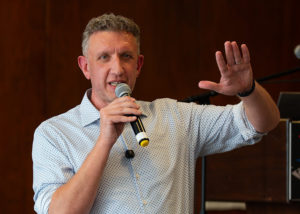
Chuck is a US-based internal communications strategist and the founder of ICology – a community and resource hub for IC professionals. He brings a practitioner lens to every conversation. Chuck is a recognised voice in the industry, a regular speaker and event host, and one of the most connected people in the North American IC world.

Jenni is a UK-based leadership and internal communications consultant, author of two best-selling books, and international speaker. She runs Redefining Communications, a consultancy working with organisations around the world to help them communicate better and close the gap between what leaders say and what employees experience.